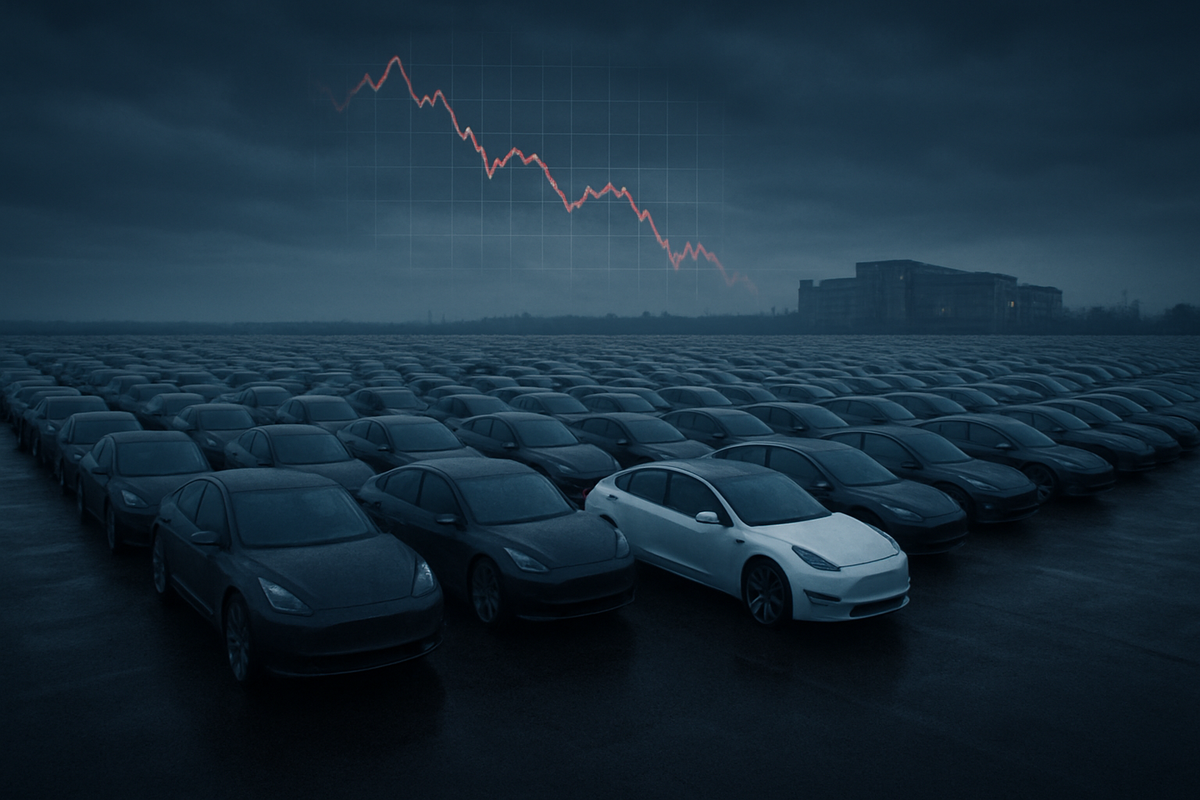
As of April 10, 2026, the once-unstoppable momentum of Tesla, Inc. (NASDAQ: TSLA) has ground to a halt, with the stock closing out its eighth consecutive week in the red. A perfect storm of record-high unsold inventory, cooling global demand, and the sudden expiration of federal EV tax credits has sent the electric vehicle pioneer into a technical tailspin. Investors who once viewed Tesla as a high-growth safe haven are now grappling with a valuation reset that has wiped out nearly 25% of the company's market cap since the start of the year.
The immediate implications are dire for Tesla’s growth narrative. With the stock currently hovering between $337 and $344, market sentiment has shifted from optimism over autonomous futures to the grim reality of a manufacturing bottleneck. Analysts warn that the disconnect between Tesla’s massive production capacity and the actual consumer appetite for EVs has reached a breaking point, forcing the company to reconsider its aggressive expansion strategy in a high-interest-rate environment.
The Inventory Glut: A 60% Plunge Warning from Wall Street
The primary catalyst for this week’s sell-off was a scathing research note from JPMorgan Chase & Co. (NYSE: JPM). Analyst Ryan Brinkman, a long-time skeptic of Tesla’s premium valuation, reiterated his "Underweight" rating and maintained a price target of just $145—implying a staggering 60% downside from current levels. Brinkman’s report highlighted a "fundamental disconnect" between Tesla’s automotive performance and its stock price, which he argues is still being propped up by "robotaxi vaporware" and speculative AI projects like the Optimus humanoid robot.
The data behind the bearish sentiment is difficult to ignore. In the first quarter of 2026, Tesla reported its widest production-over-delivery gap in history, manufacturing 408,386 vehicles while delivering only 358,023. This resulted in a surplus of over 50,000 unsold units in a single quarter, bringing total global unsold inventory to a record 164,000 units. For a company that once operated with a lean 10-day supply of vehicles, the current "days of supply" metric has ballooned to over 30 days globally, signaling a massive demand wall that price cuts have failed to penetrate.
Winners and Losers in the Great EV Realignment
While Tesla (NASDAQ: TSLA) struggles to move metal, its competitors are aggressively carving out market share. The primary beneficiary has been BYD Co. Ltd. (OTC:BYDDY), which has utilized its vertical integration to dominate the low-to-mid price tiers that Tesla has neglected. In Q1 2026, BYD’s "New Energy Vehicle" sales nearly doubled Tesla’s output, buoyed by a robust lineup of plug-in hybrids (PHEVs) that appeal to consumers wary of charging infrastructure limitations. BYD has now overtaken Tesla in over 20 international markets, including Australia and Brazil, positioning itself as the new global leader in EV volume.
In the premium and adventure segments, Rivian Automotive, Inc. (NASDAQ: RIVN) has emerged as a significant threat. April 2026 marks the official mass-production start of the Rivian R2 SUV, a $45,000 vehicle widely dubbed the "Model Y Killer." With over 90 cubic feet of cargo space and a rugged aesthetic, the R2 is already poaching reservations from Tesla’s aging lineup. Conversely, legacy players like Ford Motor Company (NYSE: F) are finding mixed results; while Ford has successfully pivoted toward hybrids and commercial EV services, its "Model e" consumer EV division continues to bleed cash, making it a loser in the pure-play electric race but a potential winner in the broader energy transition.
Industry Trends and Regulatory Headwinds
The crisis at Tesla reflects a broader cooling of the electric vehicle market, exacerbated by significant policy shifts. The expiration of the $7,500 federal EV tax credit in late 2025, a move spearheaded by the current administration, has made the total cost of ownership significantly higher for the average American buyer. This policy shift has effectively killed the "demand pull" that sustained Tesla’s margins for years. Historically, Tesla’s success was tied to government incentives and a lack of viable competition; in 2026, neither of those factors remains in their favor.
Furthermore, the "Elon Musk factor" continues to weigh on the brand. Sentiment data suggests that the CEO’s increasingly polarizing political activities have led to brand erosion in key demographic segments, particularly among suburban buyers in California and the Northeast. This cultural shift, combined with the lack of a truly affordable "Model 2" (which has reportedly been delayed or merged into the "Cybercab" project), has left a void in the $25,000 to $30,000 price bracket that Chinese manufacturers are all too eager to fill.
The August Gamble: Robotaxis or Bust
Looking ahead, Tesla’s future now rests almost entirely on its upcoming "Tesla Network" milestone scheduled for August 2026. The company is betting that a transition from a car manufacturer to an AI-driven "Robotics Utility" will justify its current valuation. Mass production of the "Cybercab"—a vehicle designed without a steering wheel or pedals—began at Giga Texas earlier this month. If Tesla can secure regulatory approval for a full public beta of its autonomous ride-sharing network across major U.S. cities like Phoenix and Las Vegas by late summer, the stock could see a massive "short squeeze" and recovery.
However, the regulatory hurdles remain formidable. While Texas and Arizona have adopted AV-friendly laws, California’s DMV continues to withhold "unsupervised" permits following a string of high-profile FSD-related accidents in early 2026. The short-term possibility is a "sell the news" event in August if the commercial rollout is limited to a few select "invite-only" pilots rather than the nationwide revolution promised by Musk. For the long term, Tesla must decide whether to return to its roots as a mass-market automaker with a simplified "Redwood" compact SUV or go "all-in" on an autonomous future that may still be years away from widespread legal acceptance.
A Crucial Crossroad for Investors
The eight-week losing streak is more than just a technical correction; it is a fundamental re-evaluation of what Tesla actually is. The summary of key takeaways is clear: demand for pure EVs has plateaued, competition has arrived in force, and Tesla is sitting on a mountain of inventory that it can no longer easily clear through price reductions. JPMorgan’s warning of a 60% plunge serves as a stark reminder that if the "AI and Robotics" premium is stripped away, Tesla’s automotive fundamentals look increasingly like those of a traditional, cyclical car company.
Moving forward, the market will be hyper-focused on two metrics: inventory levels and the August 6th regulatory deadline for the Tesla Network. Investors should watch for any signs of a "Model 2" revival, as a traditional $25,000 vehicle may be the only way to clear the current demand bottleneck. For now, the "wait and see" approach seems to be the dominant strategy on Wall Street, as Tesla attempts to navigate its most significant identity crisis since the Model 3 ramp-up nearly a decade ago.
This content is intended for informational purposes only and is not financial advice.