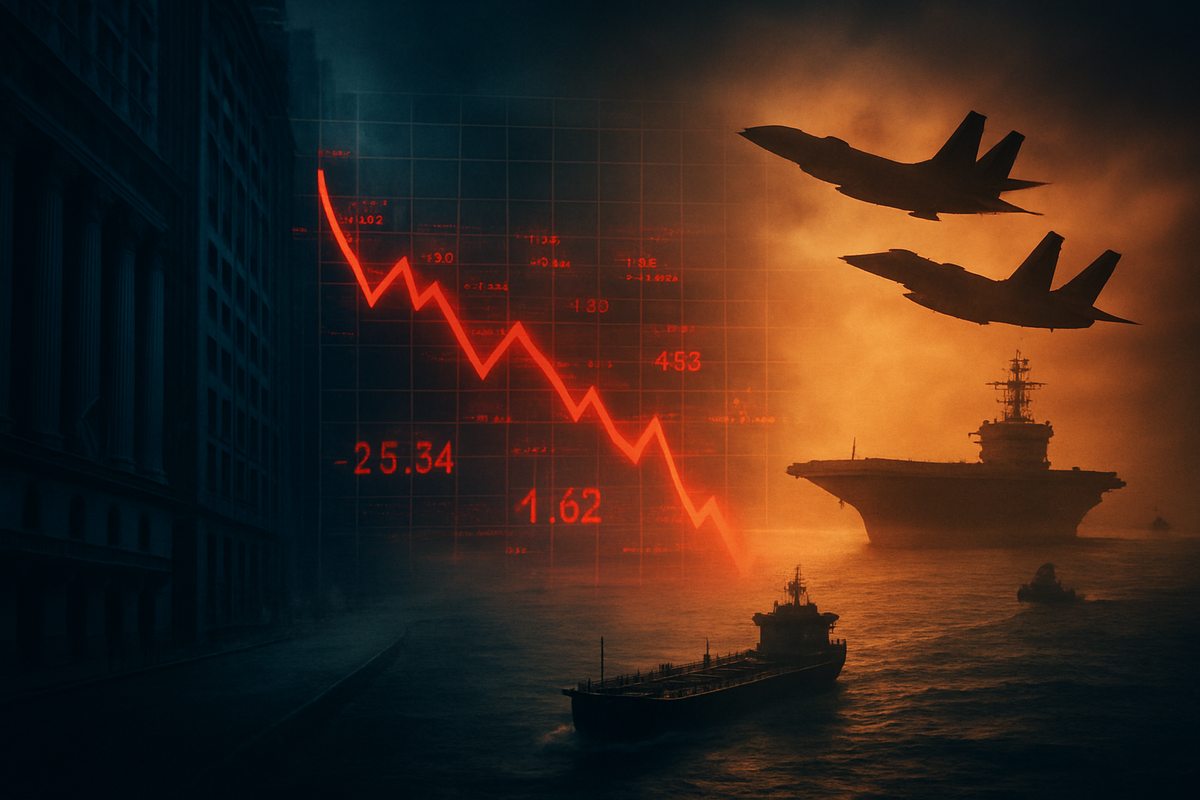
As of April 10, 2026, the global financial landscape is gripped by a profound sense of "geopolitical vertigo." Following the conclusion of Operation Epic Fury—a bruising 40-day aerial and maritime campaign—the United States and Iran are currently observing a fragile 14-day ceasefire. However, the initial relief that propelled markets earlier this week is rapidly evaporating. Today, the Dow Jones Industrial Average fell 313 points (-0.65%), while the S&P 500 slipped 0.20%, as investors weighed new military threats from President Donald Trump against the backdrop of critical diplomatic talks scheduled for tomorrow in Islamabad.
The immediate implications of this standoff are felt most acutely in the energy sector and global shipping lanes. While the ceasefire technically mandates the "complete and safe opening" of the Strait of Hormuz, transit remains at a fraction of its pre-war levels. The market's nervous posture today reflects a growing fear that the diplomatic window is closing before it has even fully opened, with the specter of a "Stone Age" military escalation looming over the Persian Gulf.
A Timeline of Escalation and the "Stone Age" Ultimatum
The current crisis traces its roots to late February 2026, when localized maritime skirmishes spiraled into a full-scale regional conflict. Operation Epic Fury saw the U.S. military deploy unprecedented force against Iranian infrastructure, citing the need to protect international shipping. On April 1, 2026, President Trump intensified the rhetoric, warning that if the Strait of Hormuz were not immediately cleared of Iranian naval assets, the U.S. would "blast Iran into oblivion... back to the Stone Ages." This was followed by a "Civilizational Warning" posted on social media just hours before the April 7 ceasefire, where the President claimed "a whole civilization will die tonight" if deadlines were not met.
The ceasefire, brokered by Pakistan and China, went into effect on April 7, leading to a massive one-day relief rally. On April 8, the Dow surged 1,332 points as investors bet on a de-escalation. However, the peace is haunted by the "Hormuz Toll" controversy. Iran’s Supreme National Security Council has proposed a 10-point plan that includes a tiered payment system for any vessel transiting the Strait—a move the U.S. and UK have branded as "maritime extortion." Today’s market dip is a direct reaction to President Trump’s April 9 statement that the U.S. military is "loading up and resting," prepared for its "next conquest" if the toll proposal is not withdrawn.
The Bifurcation of the Market: Defense Giants vs. Consumer Staples
The geopolitical volatility of 2026 has created a stark divide between "war winners" and sectors crippled by energy volatility. Lockheed Martin (NYSE: LMT) has been a primary beneficiary, with its stock up 25% year-to-date as the Pentagon scrambles to replenish F-35 parts and precision munitions expended in March. Similarly, RTX Corporation (NYSE: RTX) has seen a meteoric rise, largely driven by the heavy use of Patriot missile batteries and Tomahawk cruise missiles during the height of the bombardment. Other defense heavyweights like Northrop Grumman (NYSE: NOC) and General Dynamics (NYSE: GD) are trading near all-time highs as the "Maximum Pressure" military posture appears likely to persist.
Conversely, the tech and transportation sectors are bearing the brunt of the uncertainty. United Airlines Holdings (NASDAQ: UAL) and American Airlines Group (NASDAQ: AAL) have seen their share prices crater by over 15% in the first quarter of 2026, as jet fuel costs remain stubbornly high despite Brent crude’s recent correction from $119 to $95 per barrel. Big Tech has also found itself in the crosshairs; Apple Inc. (NASDAQ: AAPL) and Alphabet Inc. (NASDAQ: GOOGL) were specifically named by Iranian officials as potential targets for "asymmetric retaliation," leading to a defensive posture from institutional investors who fear cyber disruptions or supply chain bottlenecks in the Middle East.
Global Supply Chains and the New Energy Reality
This event marks a pivot point in the broader industry trend of "energy decoupling." The 2026 conflict has forced a radical acceleration of U.S. domestic energy production. ExxonMobil (NYSE: XOM) and Chevron (NYSE: CVX) have seen significant gains as the U.S. increasingly relies on Permian Basin output to offset the risk of a total Hormuz closure. For the first time in decades, energy security has decisively overtaken the green energy transition as the primary driver of federal policy, with Occidental Petroleum (NYSE: OXY) gaining favor as a key player in the domestic "surge capacity" strategy.
The regulatory implications are equally significant. The rejection of the Iranian "toll" system by the West suggests a future where maritime law may be enforced through permanent naval escorts rather than international treaties. This mirrors historical precedents like the "Tanker War" of the 1980s but on a much more digitized and destructive scale. The ripple effects are being felt by global competitors; Chinese firms are caught between their diplomatic role as a mediator and their economic reliance on Iranian crude, creating a volatile environment for global trade indices.
The Islamabad Summit: Scenarios for the Coming Weeks
All eyes are now on Islamabad, where Vice President JD Vance and senior envoys are set to meet Iranian representatives on April 11. The market is currently pricing in three potential scenarios. The "Bull Case" involves a formal extension of the ceasefire and a withdrawal of the toll proposal, which could see the Nasdaq (NASDAQ: QCOM) and other tech-heavy indices lead a recovery toward January’s all-time highs. The "Base Case" is a continuation of the current "neither war nor peace" stalemate, which would likely keep oil prices in the $90-$100 range and favor defensive stocks like Palantir Technologies (NYSE: PLTR), which has become integral to battlefield intelligence.
The "Bear Case"—and the one driving today's pre-talk jitters—is a total collapse of the truce. Should Iran attempt to enforce its toll system or should Israel’s ongoing conflict with Hezbollah draw Tehran back into the fray, the ceasefire could end as early as this weekend. In this scenario, analysts warn of a potential spike in Brent crude to $150/barrel, which would likely trigger a broader market correction and a flight to safe-haven assets like gold and U.S. Treasuries.
Final Assessment: A High-Stakes Game of Brinkmanship
The events of April 10, 2026, serve as a stark reminder that the "peace dividend" of previous decades has officially expired. The Dow and S&P 500 remain roughly 2.3% below their January peaks, reflecting a market that is fundamentally "re-pricing" geopolitical risk. The key takeaway for investors is that while the ceasefire offers a temporary reprieve, the underlying structural tensions between the U.S. and Iran regarding the Strait of Hormuz remain unresolved and highly combustible.
Moving forward, the market will likely remain in a state of high-alert volatility. Investors should closely watch for the results of the Islamabad summit and any further rhetoric from the White House regarding military readiness. The lasting impact of this crisis may well be a permanent shift in how we value energy independence and defense capabilities. For now, the world waits to see if the April 11 talks will pave the way for a lasting peace or if today's market dip was merely the precursor to a much larger storm.
This content is intended for informational purposes only and is not financial advice.