SANTA CLARA, Calif. — April 10, 2026 — Nvidia (NASDAQ: NVDA) continued its relentless ascent today, with shares rising 2.1% to reach a fresh record high of $189.42 in mid-day trading. The latest rally, which added nearly $95 billion to the company’s staggering $4.5 trillion market capitalization, was fueled by a series of high-profile partnership expansions with global cloud titans and the initial pre-order success of its next-generation "Rubin" architecture. As Nvidia extends its lead in the artificial intelligence sector, its upward momentum is providing a significant "halo effect" for the broader market, lifting the Nasdaq Composite to its third consecutive all-time high this week.
The surge in Nvidia’s valuation comes as the semiconductor giant shifts its narrative from providing the hardware for "training" AI models to becoming the indispensable infrastructure for the "Agentic AI" era—where autonomous software agents perform complex, multi-step tasks across the global economy. Analysts suggest that for every dollar spent on Nvidia hardware, an estimated five dollars in economic value is now being generated through "AI tokens," a metric that has replaced traditional software licensing as the primary driver of growth in the tech sector.
The primary driver behind today's 2% gain was an update regarding the "Fairwater" initiative, a massive multi-year collaboration between Nvidia and Microsoft (NASDAQ: MSFT). Sources close to the project indicate that Microsoft has moved to double its deployment of Nvidia’s GB200 NVL72 liquid-cooled systems to power its "Copilot-6" autonomous agent framework. This expansion reinforces Nvidia's position as the primary architect of the world’s most advanced AI supercomputing clusters, even as cloud providers continue to develop their own internal silicon.
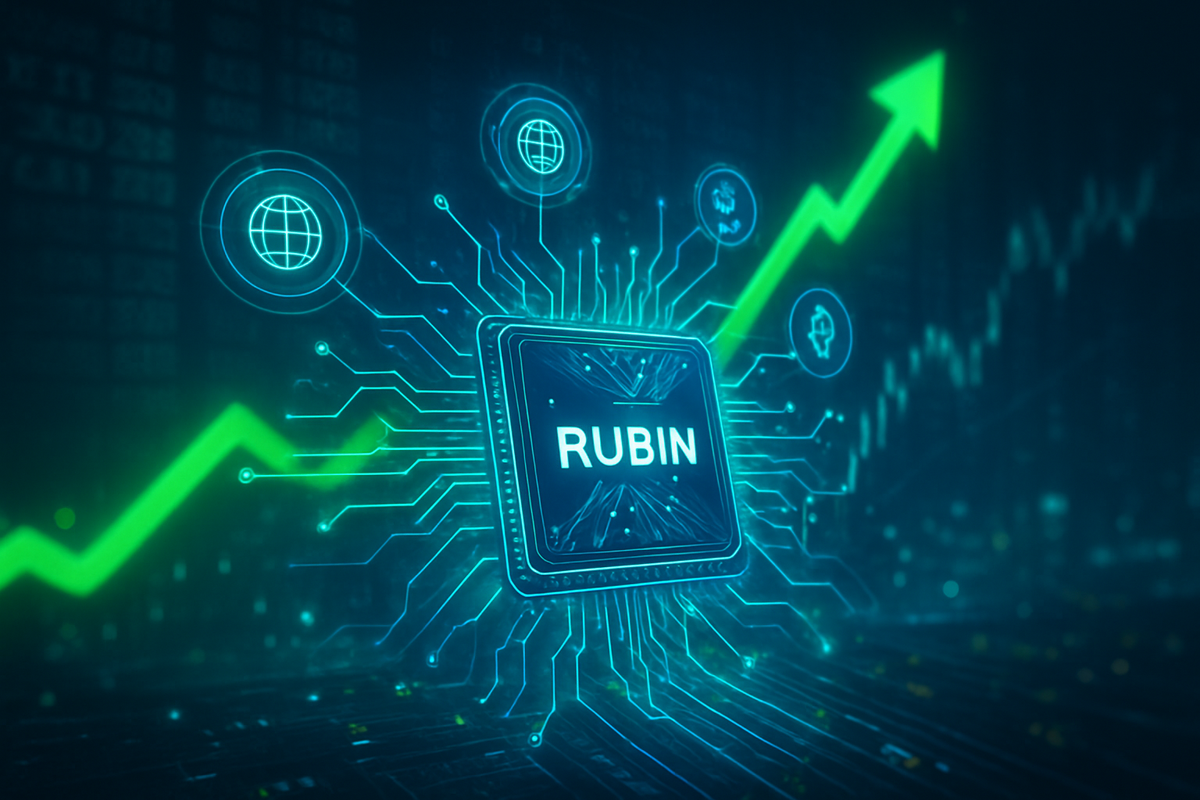
This momentum follows a landmark 18-month period that began with the release of the Blackwell architecture in late 2024. While competitors initially hoped that supply chain easing would erode Nvidia’s pricing power, the company’s shift to a one-year product cadence has kept rivals in a perpetual state of catch-up. Today's market excitement is also tied to early benchmarks for the upcoming Rubin (R100) platform. Formally unveiled earlier this spring at the GTC 2026 conference, the Rubin architecture utilizes TSMC’s (NYSE: TSM) 3nm process and high-bandwidth HBM4 memory, promising a 10x improvement in inference efficiency—a critical metric for the millions of AI agents expected to go live by the end of the year.
Industry reaction to Nvidia’s continued growth has been overwhelmingly positive, though marked by an air of inevitability. "We are no longer in a chip cycle; we are in an infrastructure revolution," said Sarah Chen, Lead Semiconductor Analyst at Global Alpha Research. "Nvidia has successfully navigated the transition from being a GPU vendor to a full-stack platform provider. When they move 2%, the entire tech ecosystem shifts with them."
Nvidia’s continued dominance has created a bifurcated landscape in the technology sector. Among the clear winners is Broadcom (NASDAQ: AVGO), which rose 1.8% today. As the leader in custom silicon and AI networking, Broadcom has become the essential "secondary" play for hyperscalers who use Nvidia for general compute but rely on Broadcom for custom TPU designs and high-speed switching. Similarly, Arm Holdings (NASDAQ: ARM) hit record highs today, as its architectural designs now power nearly 50% of the top hyperscale data centers, including those hosting Nvidia’s new Vera CPUs.
The physical infrastructure of AI has also produced unexpected market darlings. Vertiv (NYSE: VRT), a specialist in data center cooling, and Eaton (NYSE: ETN), a power management leader, both saw shares climb more than 3% following news of Nvidia’s expanded "Fairwater" deployments. These companies have become critical bottlenecks; as AI chips get hotter and more power-hungry, the ability to manage thermal density and secure grid power has become as valuable as the silicon itself.
Conversely, traditional "legacy" tech players continue to face headwinds. Intel (NASDAQ: INTC), despite showing progress in its Foundry business, saw its stock trade flat today. While Intel's 18A process node is now in high-volume production, the company is still struggling to translate technical milestones into the same high-margin AI revenue that Nvidia enjoys. Advanced Micro Devices (NASDAQ: AMD) also faced a modest 1% dip as investors rotated capital into Nvidia, despite AMD securing a significant $60 billion agreement with Meta (NASDAQ: META) for its own MI400-series chips. The market remains skeptical that any rival can break Nvidia’s "software moat" provided by its CUDA programming platform and the newer NIMs (Inference Microservices).
The wider significance of Nvidia’s 2026 performance lies in the fundamental shift of the global economy toward "Agentic AI." Unlike the generative AI boom of 2023 and 2024, which focused on creating text and images, the 2026 era is defined by autonomous systems that can manage supply chains, conduct scientific research, and execute financial trades with minimal human oversight. This shift requires a massive increase in "inference" capacity—the stage where AI models are put to work—which plays directly into Nvidia's hardware and software strengths.
However, this explosive growth has triggered a new set of regulatory and structural challenges. The sheer power demand of Nvidia’s gigawatt-scale "AI Factories" has led to increased scrutiny from energy regulators. In parts of Virginia’s "Data Center Alley," utility providers like Dominion Energy (NYSE: D) are reportedly struggling to meet the demand of new clusters, leading to a surge in "behind-the-meter" energy solutions involving small modular reactors and direct natural gas pipelines.
Historically, Nvidia’s current trajectory draws comparisons to the Cisco Systems (NASDAQ: CSCO) era of the late 1990s, though with a key difference: Nvidia’s revenue and earnings growth have kept pace with its stock price. While Cisco was built on the promise of the internet, Nvidia is the engine of an economy that is already generating billions in real-time "token" revenue. The risk of a "bubble" remains a constant topic of debate on Wall Street, but for now, the company’s record-shattering gross margins of 75% suggest that its pricing power is nowhere near its ceiling.
Looking ahead, the next 12 to 24 months will be defined by two major themes: the "Power Crunch" and "Sovereign AI." As the "Rubin" architecture begins shipping in late 2026, the focus will shift from chip performance to energy efficiency. Companies that cannot provide "green" or sustainable compute may find themselves sidelined by increasingly stringent ESG mandates and local zoning laws. Nvidia’s strategic pivot toward ARM-based, energy-efficient designs like the Vera CPU is a direct response to these emerging constraints.
On the geopolitical front, "Sovereign AI" is becoming a multi-billion dollar tailwind. Nations such as Saudi Arabia, Japan, and the United Kingdom are now treating AI compute as a matter of national security, building their own domestic AI factories using Nvidia hardware. This diversification of the customer base—moving beyond a handful of U.S. hyperscalers to entire nation-states—provides Nvidia with a more stable, long-term revenue floor that could protect it from any potential slowdown in the American venture capital or enterprise sectors.
As Nvidia celebrates another day of record gains, the key takeaway for investors is the company’s transition from a component supplier to the literal "operating system" of the AI age. Today’s 2% rise is more than just a stock ticker movement; it is a signal of the market's confidence in the industrialization of artificial intelligence.
Moving forward, the market will likely remain tethered to Nvidia’s "beat and raise" earnings cycles, which have become the most important events on the financial calendar. Investors should keep a close eye on the rollout of the Rubin architecture in late 2026 and monitor the supply of high-bandwidth memory (HBM4) and liquid cooling infrastructure, as these will be the primary governors of growth. While the competition from AMD and custom internal silicon is intensifying, Nvidia’s ability to innovate at a one-year cadence remains its most formidable defense.
This content is intended for informational purposes only and is not financial advice.