By: MarketMinute
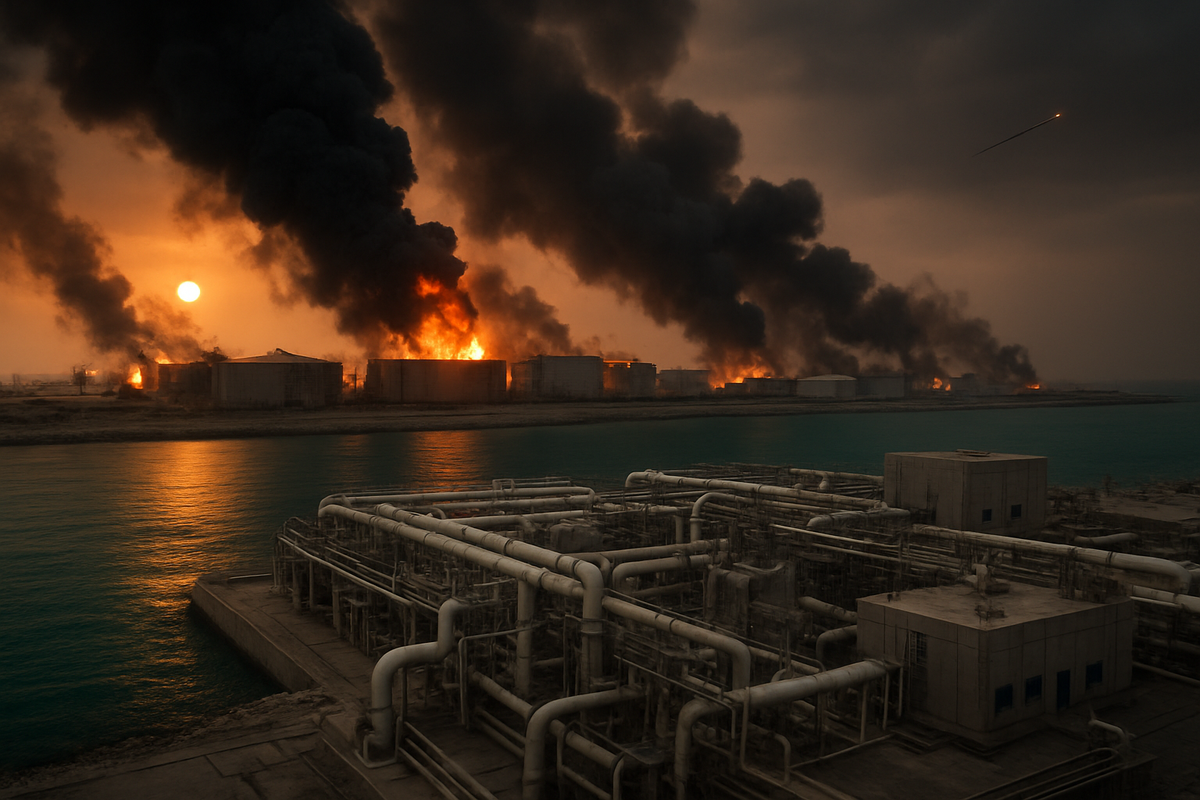
The geopolitical landscape of the Persian Gulf shifted violently on March 9, 2026, as a wave of Iranian missile and drone strikes targeted critical civilian and energy infrastructure across Bahrain, the United Arab Emirates, and Oman. Moving beyond traditional military targets, the latest escalations have struck at the heart of regional survival: desalination plants and strategic energy storage. The attacks have triggered immediate "force majeure" declarations from major state-owned energy firms and sent shockwaves through global maritime insurance markets, effectively paralyzing trade through the Strait of Hormuz.
The immediate implications are dire for regional stability and global supply chains. By targeting the Hidd desalination complex in Bahrain, Tehran has signaled a transition to asymmetric "total war" tactics, aiming to compromise the basic water security of Gulf Cooperation Council (GCC) nations. Meanwhile, the strikes on the Fujairah storage hub in the UAE—a critical bypass for the Strait of Hormuz—have severely curtailed the region's ability to export crude and refined products even through alternative routes. As of today, the Gulf is transitioning into a "no-go" zone for commercial shipping, with insurance premiums skyrocketing to levels not seen since the tanker wars of the 1980s.
The Escalation of March 9: A Timeline of Infrastructure Targeting
The current crisis traces its roots back to February 28, 2026, when a major joint U.S.-Israeli military operation targeted Iranian military facilities and nuclear research sites. Following a week of localized skirmishes, March 9 marked a decisive escalation. At dawn, a swarm of loitering munitions struck the Hidd Independent Water and Power Project in Bahrain, a facility that provides nearly 90 million imperial gallons of water daily. Simultaneously, drone strikes were reported at the Vopak Horizon Fujairah terminal in the UAE and battery storage facilities in Oman’s Salalah Free Zone.
The timeline has been a rapid descent into chaos. Following the February 28 strikes, Iran declared the Strait of Hormuz a "war zone," warning that any vessel entering would be treated as a hostile target. By March 5, major shipping lines had already begun rerouting around the Cape of Good Hope. However, the March 9 strikes on land-based infrastructure represent a strategic pivot; Iran is no longer just blocking the sea lanes but is actively dismantling the infrastructure required to process and store the region’s primary exports and life-sustaining resources.
Key stakeholders, including the Gulf Cooperation Council (GCC) leadership and Western allies, are now grappling with a dual-pronged crisis of water and energy. In Bahrain, Bapco Energies has already declared force majeure on its refinery operations following secondary strikes on the Sitra refinery complex. Similar declarations have followed from QatarEnergy and the Kuwait Petroleum Corporation (KPC), as the lack of available shipping insurance makes it legally and financially impossible to fulfill long-term delivery contracts.
Corporate Exposure and the Insurance Shockwave
The corporate fallout from these attacks is widespread, affecting both regional utilities and global energy logistics firms. ACWA Power (TADAWUL: 2082), a titan in the Middle Eastern utility space with significant stakes in Bahrain’s Hidd and Al Dur plants, faces substantial operational risks and potential asset write-downs. Similarly, Sumitomo Corporation (Tokyo: 8053) and Mitsubishi Corporation (Tokyo: 8058), which are heavily invested in the region’s independent water and power projects (IWPPs), are seeing their regional portfolios come under extreme duress.
In the energy storage and logistics sector, Royal Vopak (Euronext: VPK) has seen its Fujairah operations significantly disrupted, impacting its global storage utilization rates. ADNOC Logistics & Services (ADX: ADNOCLS) is perhaps the most exposed publicly traded entity in the UAE, as its entire business model relies on the safe passage of tankers and the integrity of the Fujairah terminals. Conversely, companies specializing in water technology and emergency desalination, such as GS Engineering & Construction (KOSPI: 006360) through its subsidiary GS Inima, may see a long-term surge in demand for mobile and contingency water solutions as GCC nations scramble to build redundancy.
Furthermore, the global maritime insurance industry is facing a "black swan" event. Members of the Lloyd’s Market Association have begun issuing 7-day cancellation notices for existing policies in the Persian Gulf. War risk premiums have reportedly spiked by over 1,000% since late February, with hull war risk rates reaching a staggering 3% of a vessel's value per voyage. For a standard Very Large Crude Carrier (VLCC) valued at $300 million, the insurance cost alone has jumped from roughly $625,000 to over $7.5 million for a single transit, making commercial trade virtually non-viable without state-backed guarantees.
The Water-Energy Nexus: A New Doctrine of Warfare
The targeting of desalination plants marks a significant evolution in Middle Eastern conflict dynamics. Historically, "red lines" were drawn at civilian water and electricity infrastructure, but the March 9 strikes suggest those norms have evaporated. This shift forces a re-evaluation of the "water-energy nexus" in the Gulf. Without desalination, most GCC nations have only a few days of potable water reserves, making these facilities higher-value targets than even oil refineries for an adversary seeking maximum leverage.
This event fits into a broader trend of infrastructure-focused warfare seen in other global conflicts, where the goal is to break the economic and social backbone of a nation rather than just its military. The ripple effects are already being felt by competitors in the energy market. Crude oil prices have breached $130 per barrel as the market prices in the "near-total blockage" of the Strait of Hormuz. Competitors in the Atlantic Basin and North American shale plays are seeing a surge in demand, yet the global economy faces a massive inflationary shock that could dampen long-term demand.
Regulatory and policy implications are also mounting. GCC governments are likely to move toward "nationalizing" the risk of maritime trade through sovereign insurance pools, as the private market retreats. Historically, similar events—such as the 1980s Tanker War—led to the creation of escorted convoys (Operation Earnest Will). We are likely to see a repeat of such military-led maritime protection strategies, though the proliferation of drone and missile technology makes modern escorting far more complex than it was forty years ago.
Strategic Pivots and the Search for Resiliency
In the short term, the market should prepare for a protracted "force majeure" environment. It is unlikely that insurance rates will stabilize until a credible maritime security corridor is established. Investors should watch for a strategic pivot toward the East-West Pipeline in Saudi Arabia and other bypass routes, though these too may become targets if the conflict continues to widen. The UAE and Oman will likely accelerate their battery storage and green hydrogen initiatives to create a more decentralized and resilient energy grid, but these are multi-year transitions that offer no immediate relief.
A major strategic adaptation will be the rapid deployment of modular, "plug-and-play" desalination units to provide emergency water security. Companies like TAQA (ADX: TAQA) and OQ Gas Networks (MSX: OQGN) will likely be tasked with leading these resiliency projects. However, the looming threat of further strikes on energy storage hubs in Oman, such as the Ibri III project involving KEPCO (NYSE: KEP), suggests that even renewable energy infrastructure is no longer "safe" from the widening reach of Iranian regional strategy.
Summary: A Permanent Shift in Regional Risk
The events of March 9, 2026, represent a watershed moment for regional risk management. The simultaneous targeting of Bahraini water and Omani/Emirati energy assets has proven that the geography of the Gulf is no longer a shield. For investors, the takeaway is clear: the "geopolitical risk premium" is no longer a theoretical exercise but a permanent fixture of Gulf-linked assets. The volatility in energy prices is secondary to the existential threat posed to the infrastructure that sustains life and commerce in the region.
Moving forward, the market will be looking for two key indicators: the response of the U.S. Navy and its allies in establishing a protected maritime corridor, and the ability of GCC states to maintain domestic stability in the face of water and power disruptions. Investors should remain cautious of companies with concentrated physical assets in the Gulf and look toward those providing security, redundancy, and emergency infrastructure services. The coming months will be defined by a "siege economy" mentality in the Persian Gulf, where survival and resilience take precedence over growth and expansion.
This content is intended for informational purposes only and is not financial advice