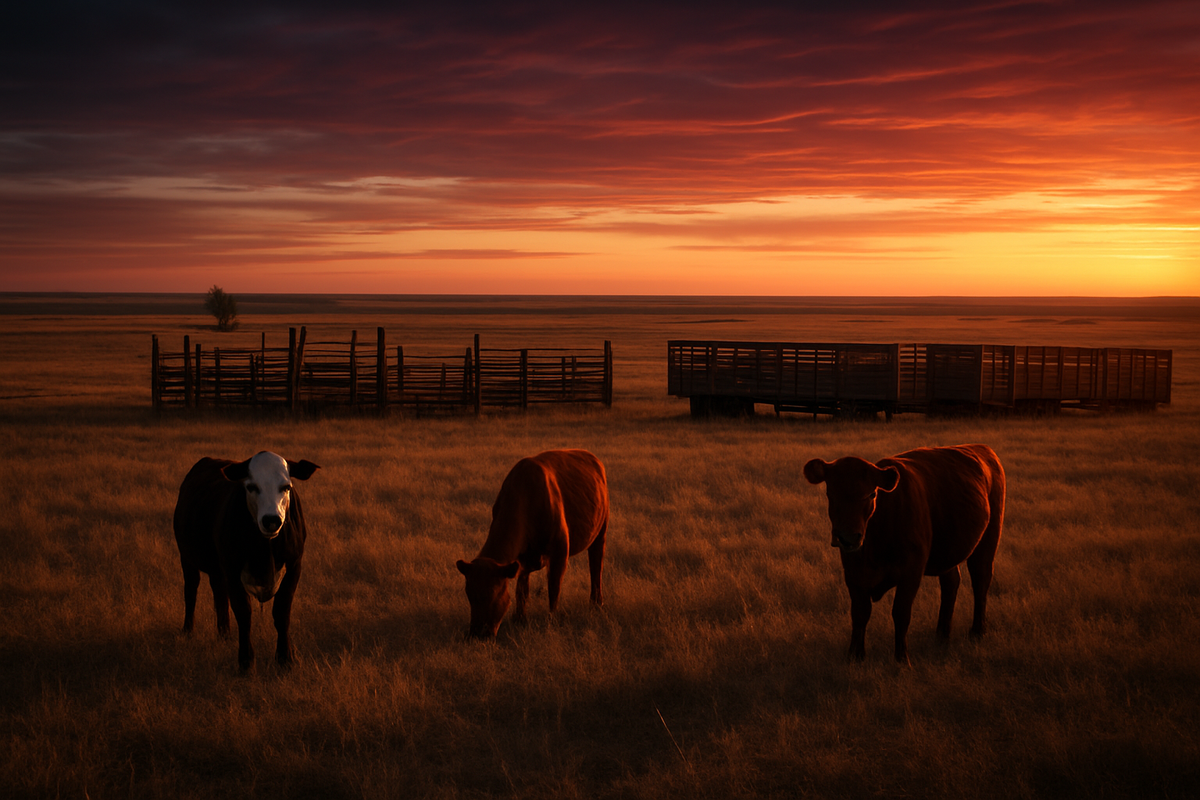
The American cattle market has entered a period of unprecedented structural scarcity, with live and feeder cattle futures hovering near historic highs as of March 6, 2026. A "perfect storm" of biological lags, high interest rates, and environmental pressures has pushed the U.S. cattle inventory to its lowest level since the Truman administration, creating a "Beef Super-Cycle" that is fundamentally reshaping the economics of the protein industry.
For consumers and investors alike, the implications are stark: beef production is forecast to contract further throughout 2026, and the multi-year timeline required to "biologically" rebuild a herd means that relief is unlikely to arrive before 2028. With retail beef prices now touching nearly $10 per pound, the market is grappling with a supply-side constraint that cannot be solved by capital alone, but rather requires the slow, unyielding pace of nature.
A 75-Year Low: The Numbers Behind the Scarcity
The depth of the current supply crisis was laid bare in the USDA’s January 2026 Inventory Report, which sent shockwaves through the commodities pits in Chicago. The report confirmed that the total U.S. cattle inventory has fallen to 86.2 million head, the lowest mark since 1951. More concerning for long-term supply is the state of the beef cow herd, which has plummeted to 27.6 million head—the smallest breeding population since 1961. This contraction is the culmination of a decade-long cycle of liquidation triggered initially by the "Flash Droughts" of the early 2020s and exacerbated by the economic volatility of the mid-2020s.
The timeline leading to this moment began in earnest in 2023 and 2024, when persistent drought across the Southern Plains forced ranchers to sell off breeding stock they could no longer afford to feed. By the time weather patterns normalized in 2025, the industry hit a financial wall. Live cattle prices, which reached a record $246 per hundredweight (cwt) in late 2025, remain elevated at $238 in March 2026. Meanwhile, feeder cattle—the young animals destined for feedlots—are trading in a volatile range of $358 to $368, reflecting a desperate scramble by feedlots to fill empty pens.
Key stakeholders, including the National Cattlemen’s Beef Association and major market analysts like CattleFax, have noted that the 2025 calf crop was the smallest in over 80 years. This ensures that even if every rancher in America decided to start expanding today, the resulting beef wouldn't reach a dinner plate for at least another two to three years. The market reaction has been one of "grinding optimism" for producers but deep anxiety for those further down the value chain.
Corporate Fallout: Winners and Losers in a High-Price Era
The "negative margin" environment has hit meat processors with surgical precision. Tyson Foods (NYSE: TSN) has been among the most visible casualties of the supply crunch. In late 2025, the company took the drastic step of closing its major packing plant in Lexington, Nebraska, a move designed to "right-size" its capacity in the face of dwindling cattle numbers. Tyson is projected to report an operating loss in its beef segment between $250 million and $500 million for fiscal 2026, as the cost of live cattle remains stubbornly high while consumers begin to baulk at record retail prices.
Conversely, JBS S.A. (OTC: JBSAY) has managed to weather the storm more effectively due to its global footprint. While its North American beef margins have also turned negative, the company has leveraged its massive operations in Brazil and Australia to offset U.S. losses. This geographical diversification has allowed JBS to maintain a more stable balance sheet than its U.S.-centric competitors. However, even JBS leadership has warned that the "U.S. cattle cycle challenge" will persist for the foreseeable future.
On the retail and dining side, the impact is bifurcated. Texas Roadhouse (NASDAQ: TXRH) reported a staggering 9.5% commodity inflation rate in the final quarter of 2025, almost entirely driven by beef costs. While the chain has maintained record-breaking foot traffic, its margins are under intense pressure, leading to a planned 1.9% price hike in early 2026. Darden Restaurants (NYSE: DRI), the parent of LongHorn Steakhouse, has used its massive scale to negotiate better long-term contracts, managing to keep its price increases roughly 130 basis points below the broader inflation rate to maintain its "value moat" against fast-casual competitors.
The Stalled Rebuild: Why Expansion Isn't Happening
The wider significance of this event lies in the structural barriers preventing a typical recovery. Historically, record-high prices would incentivize ranchers to keep their heifers (young females) for breeding rather than selling them for slaughter. However, in 2026, three primary factors are preventing this "retention" from happening. First, the opportunity cost is simply too high. With feeder calves selling for over $450/cwt, a rancher can net an immediate, guaranteed profit of $2,000 per head today, rather than waiting three years for a calf that might sell for less in a future market.
Second, the cost of financing expansion has become a major deterrent. With agricultural loan rates hovering between 7.5% and 8.0%, the interest expense alone on a $3,000 replacement heifer adds significant overhead. This has created a "liquidity trap" for mid-sized family operations, which represent the backbone of the U.S. herd. Finally, biological and regulatory wildcards have emerged; a New World screwworm outbreak in late 2025 led to severe restrictions on live cattle imports from Mexico, removing roughly one million head of feeder supply that the U.S. market typically relies on to bridge domestic gaps.
This situation echoes the cattle crisis of 2014-2015 but with a darker economic backdrop. Unlike previous cycles, the industry is also competing with land-use shifts toward renewable energy (solar farms) and urban sprawl, which are permanently removing acreage from the national grazing inventory. The result is an industry that is producing more beef per animal via record carcass weights (now averaging 955 lbs for steers) but doing so with a shrinking total population.
The Road Ahead: 2027 and the Inflection Point
Short-term, the market should prepare for continued volatility and further contraction. Analysts expect total U.S. beef production to drop another 2% by the end of 2026. For meatpackers, this means a continued "battle for market share" over a shrinking pool of animals, likely leading to further plant consolidations or shifts toward pork and poultry, which have much shorter biological cycles and better conversion ratios.
The long-term outlook suggests that 2028 will be the true "inflection point." If heifer retention finally begins in late 2026 or early 2027, it will take until 2028 before those offspring reach the market. Strategic pivots are already visible; some forward-thinking ranchers are moving toward "composite" breeds that reach maturity faster, while processors are investing heavily in automated deboning technology to claw back margins through efficiency.
We may also see a permanent shift in American dietary habits. As beef moves into the "luxury protein" category, consumers are increasingly trading down to chicken or ground beef blends. This creates a market opportunity for companies specializing in alternative proteins or premium-tier "heritage" beef, where the high price tag is justified by perceived quality and sustainability.
Summary: What Investors Should Watch
The elevated cattle futures of 2026 are not a temporary spike but the peak of a decade-long supply contraction. The primary takeaway is that the "bottoming out" process is occurring now, and the recovery will be measured in years, not months. The market is currently operating at the limits of biological capacity, and no amount of monetary stimulus can accelerate the growth of a cow.
Moving forward, investors should keep a close eye on the quarterly USDA Cattle on Feed reports and the "heifer-to-steer" ratio in slaughter data. A decrease in heifer slaughter will be the first signal that a recovery has begun, though it will also temporarily tighten supplies even further as those animals are pulled from the food chain to become mothers.
Furthermore, watch the performance of diversified giants like JBS S.A. (OTC: JBSAY) against U.S.-concentrated firms like Tyson Foods (NYSE: TSN). In this "Beef Super-Cycle," global reach and the ability to pivot to other proteins will be the defining characteristics of the survivors. For the public, the era of "cheap beef" appears to have been left behind in the previous decade, replaced by a new reality of scarcity and premium pricing.
This content is intended for informational purposes only and is not financial advice.