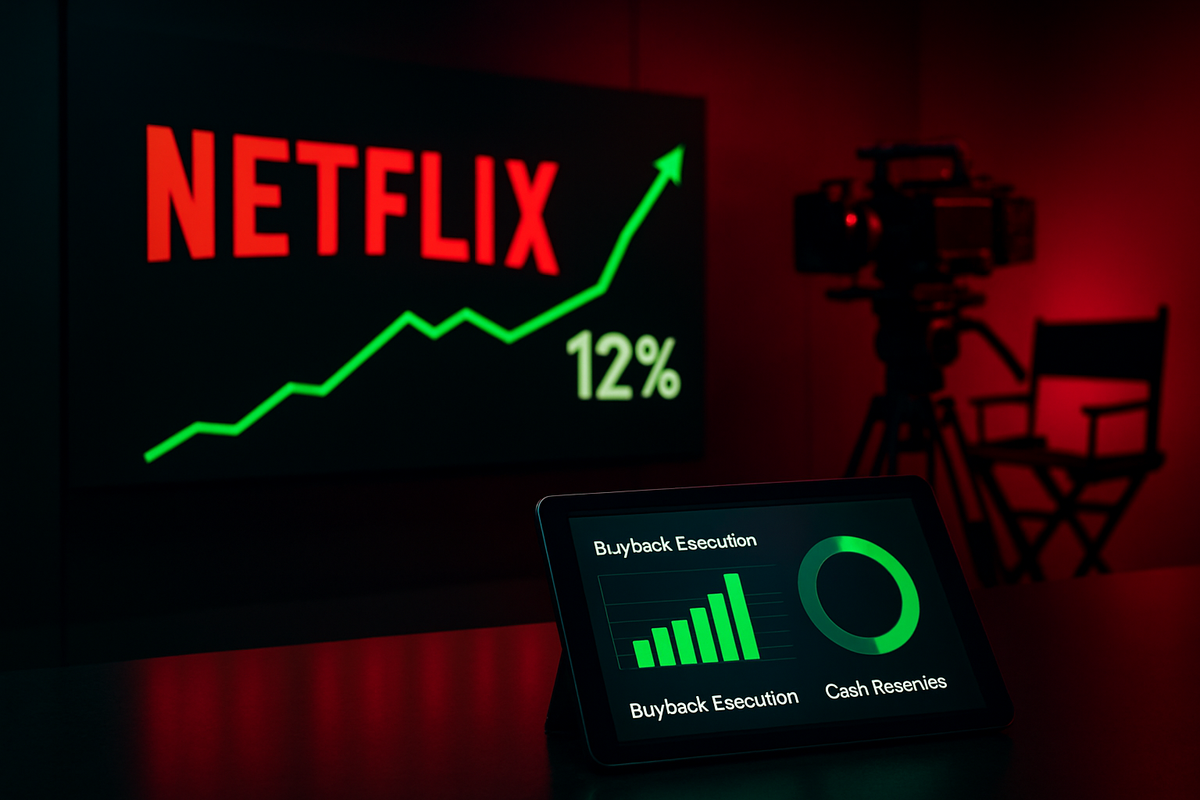
In a decisive move that has recalibrated the landscape of the "streaming wars," Netflix (NASDAQ: NFLX) officially withdrew its $83 billion bid for Warner Bros. Discovery (NASDAQ: WBD) late last month. The market's reaction has been overwhelmingly positive, with Netflix shares rallying 12% as investors expressed profound relief that the streaming giant avoided a massive debt burden and the complicated integration of legacy media assets. By walking away from what would have been the largest acquisition in its history, Netflix has signaled a strategic pivot back to organic growth and aggressive shareholder returns.
The strategic retreat marks the end of a high-stakes pursuit that began in late 2025, shifting the spotlight from mega-mergers to operational excellence. Wall Street has pivoted its focus to Netflix’s robust 2026 roadmap, which includes a record-breaking $20 billion content budget and the immediate resumption of its multi-billion dollar share buyback program. For the first time in months, the narrative surrounding Netflix has shifted from "how will they pay for it?" to "how much can they grow?"
The $83 Billion Gambit: A Timeline of the Retreat
The journey toward this historic non-merger began in December 2025, when Netflix (NASDAQ: NFLX) shocked the industry by placing a definitive bid for the studio and streaming assets of Warner Bros. Discovery (NASDAQ: WBD). The deal, valued at approximately $82.7 billion, was meticulously structured to exclude WBD’s declining linear cable networks—such as CNN and TNT—which were slated to be spun off into a new entity. By January 2026, Netflix had even amended its offer to an all-cash transaction to expedite regulatory hurdles, a move that initially weighed heavily on Netflix’s stock price as analysts fretted over the necessary debt issuance.
The breaking point arrived on February 26, 2026, when Netflix management formally withdrew its pursuit following a "superior proposal" from a consortium led by Paramount Global (NASDAQ: PARA) and Skydance Media. Rather than engaging in a destructive bidding war that could have pushed the price north of $100 billion, Netflix co-CEOs Ted Sarandos and Greg Peters chose financial discipline. The decision was further sweetened by a $2.8 billion termination fee that WBD is required to pay Netflix, effectively turning the failed merger into a significant cash windfall for the streaming leader.
Initial market reactions have been euphoric. Analysts at major firms have upgraded the stock, citing the avoidance of "integration hell" that has plagued previous media mergers like the original AT&T-Time Warner deal. By stepping back, Netflix has preserved its fortress balance sheet at a time when interest rates remain a critical variable for large-scale corporate debt.
Winners and Losers in the Post-Merger Landscape
Netflix (NASDAQ: NFLX) emerges as the clear winner in this saga, possessing both the capital and the focus to double down on its internal pipeline. With the acquisition off the table, the company has redirected its focus toward its $15 billion share buyback authorization, which had been temporarily suspended during negotiations. This move, combined with the $2.8 billion breakup fee, provides a massive tailwind for earnings per share (EPS) growth throughout 2026.
Warner Bros. Discovery (NASDAQ: WBD), while losing the prestige of a Netflix partnership, finds itself in a precarious yet potentially lucrative position. The rival bid from Paramount-Skydance offers a higher valuation, but it includes the burden of legacy linear networks that Netflix was keen to avoid. WBD shareholders must now weigh the certainty of a cash exit against the execution risks of a full-scale merger with another legacy-heavy player. Meanwhile, competitors like The Walt Disney Company (NYSE: DIS) and Apple (NASDAQ: AAPL) face a formidable rival in a "unshackled" Netflix that is no longer distracted by merger integration.
Smaller streaming players may find the environment more challenging. The collapse of the Netflix-WBD deal suggests that the "big players" are becoming more selective about acquisitions, potentially leaving mid-tier platforms with fewer exit strategies. For the broader market, the 12% rally in NFLX serves as a reminder that investors are currently prioritizing cash flow and organic scaling over the "size-at-all-costs" mentality of the early 2020s.
Breaking the Consolidation Fever: Industry Implications
The strategic retreat by Netflix represents a significant cooling of "consolidation fever" in the media industry. For years, the prevailing wisdom was that streaming services needed massive libraries to survive. Netflix's decision to walk away suggests that the company believes its current 325-million-subscriber base can be sustained and grown through targeted investments rather than bulk acquisitions. This move highlights a growing divide in the industry: companies that are "streaming-first" versus those still tethered to the declining revenues of linear television.
Furthermore, the regulatory environment in 2026 has become increasingly scrutinizing toward "Big Tech" and "Big Media" combinations. By avoiding a protracted legal battle with antitrust regulators, Netflix has steered clear of the policy entanglements that have slowed down rivals. This maneuver allows Netflix to remain nimble, focusing on emerging sectors like live sports and interactive gaming without the weight of regulatory concessions that often accompany massive mergers.
Historical precedents, such as the disastrous AOL-Time Warner merger or even the complex integration of Fox into Disney, likely loomed large in the Netflix boardroom. The market’s positive response to the withdrawal confirms a shift in investor sentiment: the "synergy" promised by mega-mergers is often seen as a liability compared to the clean, high-margin growth of a platform that controls its own destiny.
The 2026 Roadmap: $20 Billion in Content and Beyond
Looking ahead, Netflix (NASDAQ: NFLX) has laid out an ambitious roadmap for the remainder of 2026. The company has committed to a staggering $20 billion in content spending this year, a 10% increase over 2025. This budget is not just for scripted dramas; a significant portion is earmarked for live events, including expanded NFL broadcasting rights and the high-profile launch of WWE Raw on the platform. These live "appointment viewing" events are expected to be the primary engine for Netflix's burgeoning advertising tier.
The company’s strategic pivot also includes a deeper dive into gaming and non-English programming. With global hits like Squid Game continuing to drive international subscriptions, Netflix is betting that it can manufacture its own "blockbusters" more cheaply than it can buy them from a studio like Warner Bros. This "organic-first" strategy is paired with a goal to reach an operating margin of 31.5% by the end of 2026, a target that appeared out of reach while the WBD debt load was a possibility.
In the short term, investors should expect a "buyback bonanza." With projected free cash flow of $11 billion in 2026, Netflix is positioned to be one of the most aggressive buyers of its own stock in the S&P 500. This provides a solid floor for the stock price even if broader market volatility persists.
Wrap-Up: A New Era of Financial Discipline
The saga of the Netflix-WBD merger ends not with a bang, but with a rally. The key takeaway for the market is that Netflix has matured into a disciplined financial powerhouse that values its balance sheet as much as its content library. By choosing to walk away from an $83 billion deal, the company has reinforced its status as the "Gold Standard" of the streaming industry, prioritizing sustainable profit margins over the vanity of absolute scale.
As we move further into 2026, the market will be watching closely to see if Netflix can hit its ambitious $20 billion content milestones and if its advertising revenue can continue to scale at the projected double-digit rates. The 12% share price jump is a vote of confidence in this lean, focused strategy. For investors, the message is clear: the era of the reckless "streaming wars" is over, replaced by a calculated era of organic acceleration and shareholder-friendly capital allocation.
This content is intended for informational purposes only and is not financial advice.