
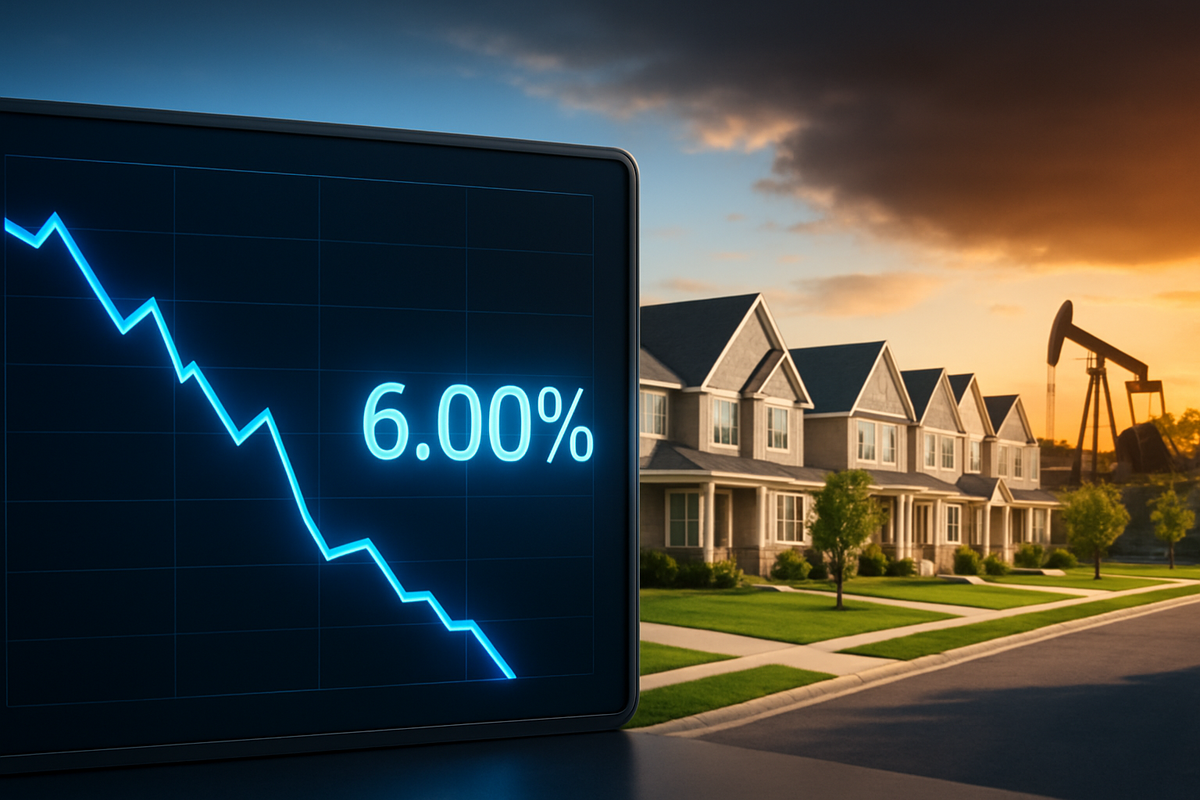
On March 5, 2026, the United States housing market witnessed one of its most dramatic single-day shifts in recent history. The 30-year fixed-rate mortgage plummeted by 63 basis points, officially touching the psychologically critical 6.00% mark. This sudden correction has effectively ended the "higher-for-longer" era that paralyzed the real estate sector for nearly three years, offering a massive reprieve to millions of prospective homebuyers and triggering an immediate surge in refinancing applications.
The implications of this move are profound, coming at the dawn of the 2026 spring selling season. For a market that has been defined by low inventory and the "lock-in effect"—where homeowners were unwilling to trade 3% mortgages for 7% rates—the drop to 6.00% represents the "magic number" required to unfreeze supply. Industry analysts are already revising their home-sales forecasts upward, anticipating a 15% increase in transaction volume for the second quarter of 2026 as affordability constraints begin to loosen across the Sunbelt and coastal markets alike.
The "Flight to Safety" Trigger: Why Rates Decoupled from Oil
The sharp 63-basis-point descent was not the result of a standard economic cooling, but rather a violent "flight to safety" in the global bond markets. Over the weekend leading into March 5th, escalating geopolitical tensions in the Middle East—specifically targeted military actions against Iranian leadership—sent shockwaves through the financial system. While the threat to the Strait of Hormuz caused Brent Crude oil prices to spike above $84 a barrel, the traditional inflationary pressure of energy costs was completely overshadowed by investor panic.
Institutional investors dumped equities and moved billions into US Treasury bonds, the ultimate safe-haven asset. As demand for Treasuries soared, the 10-year Treasury yield—which serves as the benchmark for mortgage pricing—experienced a precipitous drop from 4.05% to 3.93% in a matter of hours. By the morning of March 5th, major lenders had adjusted their daily rate sheets to reflect this new reality. The drop was further fueled by the ADP Employment Report released on March 4th, which showed a cooling labor market with only 63,000 private-sector jobs added, reinforcing the narrative that the Federal Reserve would need to accelerate its rate-cutting cycle.
Initial market reactions were swift. The MOVE Index, a measure of bond market volatility, hit a reading of 63, reflecting the highest level of uncertainty since the banking tremors of early 2023. However, for the mortgage industry, this volatility translated into a "Goldilocks" moment: rates low enough to attract buyers, yet backed by the stability of US government debt during a period of international crisis.
Winners and Losers: Refinance Giants and Volume Builders
The primary beneficiaries of this rate crash are the nation’s largest non-bank mortgage lenders. Rocket Companies (NYSE: RKT) saw its stock price surge following the news, as its highly automated "Rocket Logic" AI platform is uniquely positioned to handle a sudden influx of refinance volume. Rocket entered 2026 with a liquidity fortress of over $10 billion, allowing it to aggressively capture market share from smaller regional banks that are still struggling with high cost-of-funds. Similarly, UWM Holdings (NYSE: UWMC), the nation’s largest wholesale lender, stands to win big. CEO Mat Ishbia had strategically positioned the company for this "thaw," and the move to 6.00% is expected to supercharge their "BILT" partnership program, which targets the purchase-money market.
Homebuilders also find themselves in a position of extreme strength. D.R. Horton (NYSE: DHI) and Lennar (NYSE: LEN) have spent the last 18 months accumulating land and refining their "starter home" designs. With rates at 6%, the mortgage rate buydowns that DHI and LEN have used to entice buyers will now be even more effective, potentially bringing effective rates for new buyers down into the high 4% range. These builders have the inventory ready to meet the pent-up demand that existing homeowners—still largely sidelined by the "lock-in" effect—cannot fulfill.
On the losing side, traditional retail banks with heavy exposure to fixed-income assets may face further margin compression. As consumers rush to refinance the 7.5% mortgages they took out in 2024, these banks will see their high-yield assets vanish from their balance sheets, replaced by 6% loans in a high-volatility environment. Furthermore, the rising price of oil remains a "poison pill" for the broader economy; if energy prices remain elevated, the resulting inflation could eventually force the 10-year yield back up, making this 6.00% window a short-lived opportunity.
A Decisive Shift in the Housing Cycle
This 63-basis-point drop is more than just a daily statistic; it marks a transition in the broader housing cycle. Historically, a 6% mortgage rate has been the threshold where "on-the-fence" buyers return to the market. The event echoes the post-1980s recovery cycles where sharp rate drops following geopolitical shocks often preceded multi-year housing booms. By 3/5/2026, the market has finally digested the post-pandemic inflation spike, and this drop signals that the Federal Reserve’s restrictive policy is officially being dismantled by market forces.
The divergence between oil and interest rates is particularly notable. In a standard inflationary environment, rising oil would lead to higher mortgage rates. The fact that the opposite occurred on March 5th suggests that the market is now more afraid of a geopolitical-induced recession than it is of $90 oil. This creates a complex policy environment for the Federal Reserve. If they continue to cut rates to support the economy, they risk fueling energy-driven inflation. However, the mortgage market has already made the decision for them, pricing in a "lower-for-longer" yield curve regardless of the Fed’s next move.
Looking Ahead: The 2026 Spring Surge
In the short term, expect a "mad dash" for mortgage applications. Lenders like Rocket Companies (NYSE: RKT) are likely to report record-breaking Q1 and Q2 application volumes. The long-term trajectory, however, depends on whether the 6% floor holds. If the geopolitical situation in the Middle East stabilizes, the "flight to safety" premium could evaporate, causing rates to drift back toward 6.5%. Conversely, if the labor market continues to soften, as indicated by the 63,000-job ADP print, we could see rates head toward 5.5% by mid-summer.
Strategic pivots will be required for real estate agents and brokers, who must now navigate a market that is moving from "no activity" to "high intensity" overnight. Buyers will face increased competition as the "6% barrier" brings back the bidding wars that defined the 2021-2022 era, though significantly higher inventory from builders like Lennar (NYSE: LEN) should prevent the same level of price insanity seen during the pandemic.
Summary and Investor Outlook
The events of March 5, 2026, have fundamentally recalibrated the US housing landscape. The drop to a 6.00% mortgage rate—driven by a unique combination of geopolitical "flight to safety" and cooling domestic employment—offers a rare window of opportunity for both buyers and lenders. For investors, the takeaway is clear: the mortgage sector is entering a high-volume refinance cycle, and large-scale builders are the primary beneficiaries of the "unfreezing" of the American homeowner.
Moving forward, the market will be watching the "war premium" on oil and the Federal Reserve’s reaction to the sudden loosening of financial conditions. While the 63-basis-point drop provides immediate relief, the shadow of global conflict remains a wildcard. Investors should keep a close eye on the 10-year Treasury yield and the next few rounds of inflation data to see if the 6.00% rate is a new permanent floor or a fleeting gift from a volatile market.
This content is intended for informational purposes only and is not financial advice.