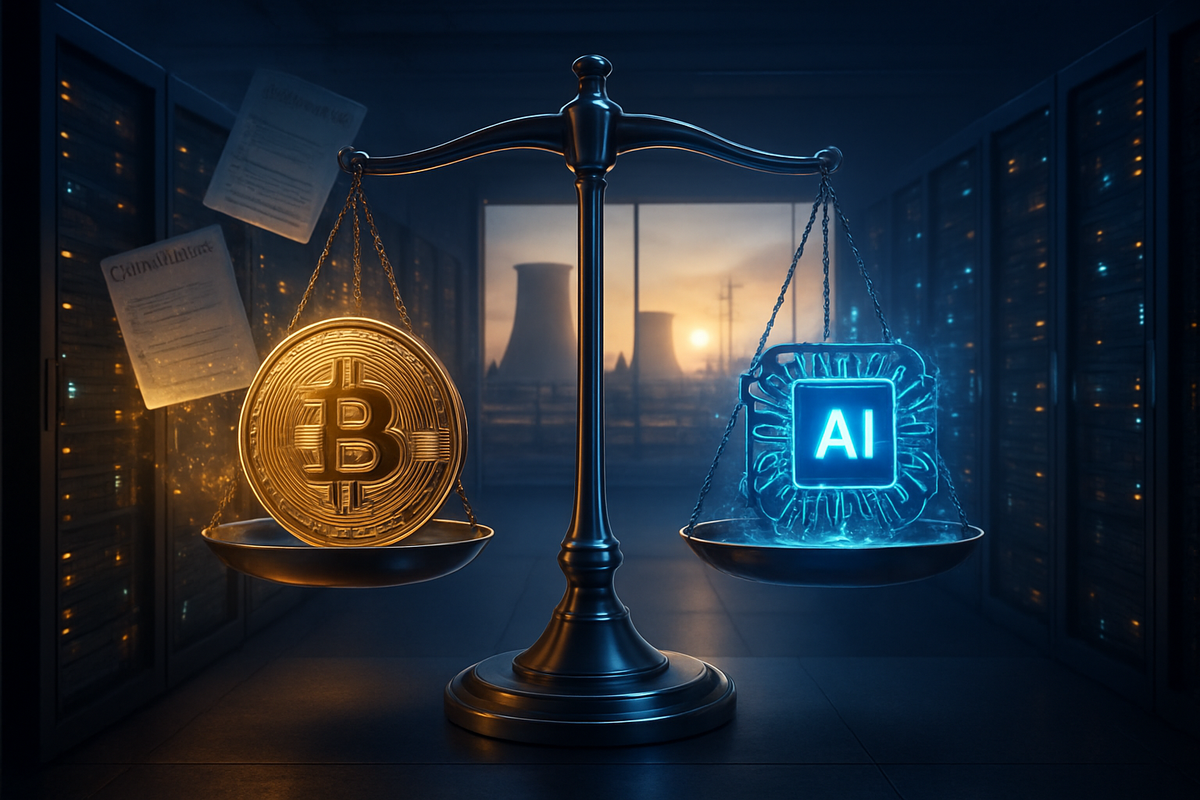
In a move that signals a fundamental transformation for the world’s largest publicly traded Bitcoin miner, MARA Holdings, Inc. (NasdaqGS: MARA) has executed a massive balance sheet restructuring. Between March 4 and March 25, 2026, the company liquidated 15,133 Bitcoin—roughly a quarter of its total holdings—to generate $1.1 billion in cash. This capital was immediately deployed to repurchase $1.0 billion in aggregate principal of its outstanding convertible senior notes at a significant discount, effectively de-leveraging the firm as it pivots toward the burgeoning Artificial Intelligence (AI) and High-Performance Computing (HPC) infrastructure market.
The implications of this pivot are profound, marking the end of MARA’s strict "HODL" (buy and hold) strategy that had defined its corporate identity for years. By prioritizing debt reduction and infrastructure diversification over pure-play digital asset accumulation, MARA is signaling to the market that the era of the "speculative miner" is evolving into the era of the "energy-to-compute" infrastructure giant. For investors, the move highlights a growing divide in the crypto-exposed equity space between those doubling down on Bitcoin as a treasury asset and those repurposing their energy assets for the AI gold rush.
A Calculated Retreat: The Mechanics of the $1 Billion Buyback
The de-leveraging event was the culmination of a volatile fiscal period for MARA. Following a staggering $1.7 billion net loss in the fourth quarter of 2025—driven largely by the extreme price volatility of Bitcoin and rising operational costs—management led by CEO Fred Thiel determined that a leaner balance sheet was necessary for long-term survival. The liquidation of over 15,000 Bitcoin provided the liquidity needed to target the company's 2030 and 2031 zero-coupon convertible notes. By negotiating private repurchases, MARA was able to retire $1.0 billion in debt for approximately $913 million, capturing an $88.1 million discount and significantly reducing potential future shareholder dilution.
This timeline of events reflects a strategic urgency. As of late 2025, MARA’s total convertible debt sat at roughly $3.3 billion. After this March 2026 maneuver, that figure has been slashed to $2.3 billion. The decision to sell Bitcoin during a period of relative price strength allowed the company to "buy back its own debt" at 91 cents on the dollar, a move that analysts have characterized as a "corporate coming-of-age." Initial market reactions were overwhelmingly positive, with MARA shares jumping over 10% on the news, as institutional investors cheered the improved credit profile and reduced risk of a debt-fueled liquidity crunch.
Winners and Losers in the Shift to "Compute"
The primary winner in this pivot appears to be MARA itself, which has successfully traded a volatile asset (Bitcoin) for a more stable balance sheet and the capital necessary to compete in the AI race. Shareholders also stand to benefit from the reduced dilution risk inherent in the retired convertible notes. Furthermore, the shift has strengthened ties with institutional partners. Starwood Property Trust (NYSE: STWD), a leading provider of real estate credit, has emerged as a key beneficiary, acting as a primary financier for MARA’s new AI-ready data center builds within a 2.5 gigawatt (GW) joint venture.
However, the "losers" in this scenario are the Bitcoin purists and maximalists who viewed MARA as a proxy for the digital asset itself. By selling a significant portion of its treasury, MARA has surrendered its crown as the most aggressive "HODL" miner to competitors like MicroStrategy Inc. (NasdaqGS: MSTR), which continues to use debt to acquire rather than retire Bitcoin exposure. Other miners who have stayed committed to pure-play mining without pivoting to AI, such as Riot Platforms, Inc. (NasdaqGS: RIOT), may find themselves viewed as higher-risk "beta" plays on Bitcoin price, whereas MARA is now being valued more like an infrastructure utility.
The "Energy-to-Compute" Revolution
MARA’s pivot is not an isolated event but part of a broader industry trend where Bitcoin miners are leveraging their most valuable asset: "behind-the-meter" power and grid interconnects. In early 2026, the global demand for AI compute has reached a fever pitch, and tech giants are facing a multi-year wait to connect new data centers to the power grid. Miners, who already own massive power footprints, are the natural solution. This shift is mirrored by Core Scientific (NasdaqGS: CORZ), which recently secured a multi-billion dollar AI cloud contract, and TeraWulf, Inc. (NasdaqGS: WULF), which is transitioning its nuclear-powered sites to host GPUs for Google-backed startups.
This movement has significant regulatory and policy implications. As miners transition to AI and HPC, they are increasingly being viewed by policymakers as essential components of national digital infrastructure rather than just energy-intensive "crypto-factories." This transition also changes the historical precedent; in previous cycles, miners typically held onto their Bitcoin until forced to sell by a market crash. MARA’s proactive sale to fund an AI expansion suggests that the industry has found a way to decouple its survival from the four-year Bitcoin halving cycle, moving toward the 15-year fixed-rate cash flows typical of hyperscale data center leases.
What Comes Next: The Path to 2.5 Gigawatts
In the short term, MARA must now execute on the massive 2.5 GW joint venture it established with Starwood Capital Group. This involves the physical transformation of mining sites into "AI-ready" facilities, a process that requires substantial capital expenditure for liquid cooling and high-density power upgrades. The market will be watching closely for the first "energized" AI megawatts to go live, which will determine if MARA can successfully transition its revenue mix. Management has stated a goal of having 30% to 50% of total revenue derived from AI and HPC by the end of 2027.
The long-term challenge lies in the "dual-mode" operational strategy. MARA intends to remain a top-tier Bitcoin miner, but one that can "toggle" its power usage between mining and AI depending on which is more profitable at any given moment. This strategic pivot requires a more complex management of energy loads and a different set of technical skills than traditional mining. If MARA succeeds, it could set the blueprint for the next generation of "Digital Energy" companies that serve as the backbone for both decentralized finance and centralized AI intelligence.
Summary of the New Crypto-Equity Landscape
The $1.1 billion Bitcoin sale and $1.0 billion debt repurchase by MARA Holdings represent a watershed moment for the crypto-mining sector. The key takeaway for investors is that the largest player in the space has prioritized financial stability and the AI infrastructure opportunity over the previous "pure-play" Bitcoin accumulation model. By de-leveraging by 30% and capturing nearly $90 million in debt discounts, MARA has positioned itself as a more resilient, infrastructure-heavy entity that can withstand the volatility of the crypto markets.
Moving forward, the market will likely reward companies that can demonstrate "energy certainty" and secure long-term contracts with A-rated AI tenants. Investors should keep a close eye on MARA’s quarterly capital expenditure and the progress of its partnership with Starwood over the coming months. As the lines between cryptocurrency mining and AI infrastructure continue to blur, the metrics of success for these companies are shifting from "hashrate" and "BTC per month" to "megawatts energized" and "HPC contract value."
This content is intended for informational purposes only and is not financial advice.