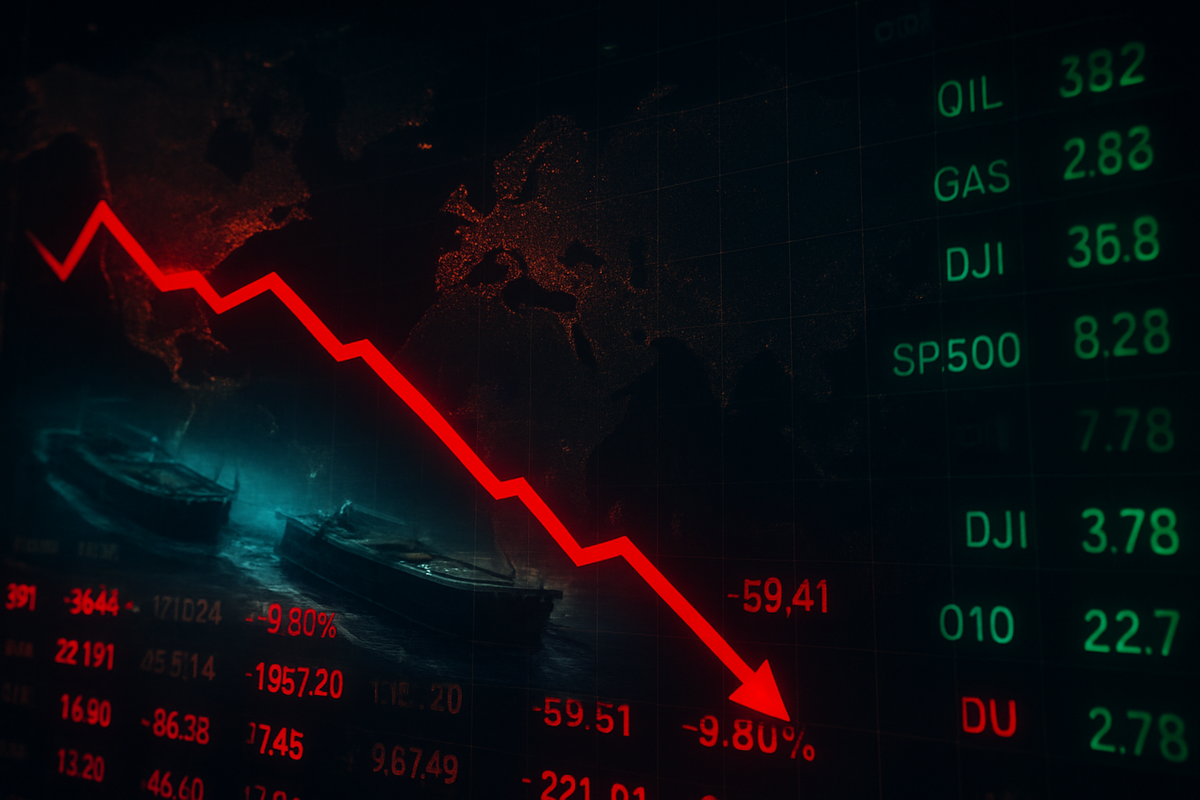
The global financial landscape is currently grappling with the most severe geopolitical shock in years, as the "Iran War" market correction enters its fifth consecutive week of declines. As of today, March 30, 2026, the S&P 500 (NYSEARCA:SPY) sits approximately 7.4% below its January all-time high, marking a period of sustained volatility that has erased trillions in market capitalization. What began as a "stealth" pullback in early February has accelerated into a broad-based retreat, fueled by direct military engagements in the Middle East and a subsequent energy crisis that has sent Brent Crude prices soaring past $115 per barrel.
Despite the prevailing gloom on Wall Street, a growing contingent of market strategists suggests that the correction may be entering its "end stage." While the geopolitical situation remains fluid and the threat of regional escalation persists, historical precedents of "war-shock" corrections often see a bottoming process once the initial uncertainty is priced in. However, with the world’s most vital maritime chokepoints currently contested, the path to recovery remains fraught with risk for both retail and institutional investors.
Escalation and Blockade: The Path to the Correction
The current market turmoil traces back to the initiation of "Operation Epic Fury" on February 28, 2026. This joint military campaign, led by a coalition of U.S. and Israeli forces, targeted Iranian nuclear facilities and command infrastructure following a definitive collapse in diplomatic channels. The conflict reached a boiling point on March 4, 2026, when Iranian forces responded by effectively closing the Strait of Hormuz—a move that immediately removed roughly 20% of the world’s daily oil and liquefied natural gas (LNG) supply from the market.
This transition from a localized military strike to a systemic economic blockade caught many investors off guard. Prior to the conflict, the S&P 500 had reached an all-time high on January 27, 2026, buoyed by a "goldilocks" economic scenario of cooling inflation and robust AI-driven earnings growth. The subsequent 5-week losing streak has been a jarring reversal of that optimism. Key stakeholders, including the U.S. Federal Reserve and the European Central Bank, have been forced into a defensive posture, as the sudden spike in energy costs threatens to reignite the inflationary fires they spent the last three years trying to extinguish.
The initial market reaction was a "sell-everything" rout, with the 10-year Treasury yield spiking to 4.46% as traders priced in a more hawkish Fed. However, as of late March, the panic selling has begun to give way to a more calculated rotation. Market participants are now closely watching the "15-point peace plan" currently being socialized by international mediators, though a formal ceasefire remains elusive.
Winners and Losers: Energy Surges as Tech Falters
In this environment of high-stakes conflict, the divide between winning and losing sectors has become a chasm. The energy sector has emerged as the sole beneficiary of the geopolitical strife. Industry giants such as Exxon Mobil (NYSE: XOM) and Chevron (NYSE: CVX) have seen their stock prices surge by nearly 40% year-to-date, as the scarcity of global oil supply drives margins to record levels. Similarly, defense contractors like Lockheed Martin (NYSE: LMT) and Northrop Grumman (NYSE: NOC) have outperformed the broader market, as "Operation Epic Fury" signals a long-term shift toward increased military spending across the West.
Conversely, the high-flying technology sector has borne the brunt of the correction. Apple (NASDAQ: AAPL) and Microsoft (NASDAQ: MSFT), which dominated market gains in late 2025, have seen their valuations compressed by a combination of rising interest rates and supply chain fears. The closure of the Strait of Hormuz has not only impacted oil but also disrupted shipping routes for critical components used in high-end electronics.
The travel and logistics industries are also facing severe headwinds. United Airlines (NASDAQ: UAL) and FedEx (NYSE: FDX) have seen their shares tumble as fuel costs—a primary overhead expense—skyrocket. For these companies, the correction is not just a matter of investor sentiment but a direct threat to quarterly earnings and operational viability.
A New Era of Volatility: Wider Significance
The "Iran War" correction represents more than just a temporary dip; it marks a significant shift in the macro-economic narrative of 2026. For much of the past year, the market was focused on "the AI revolution" and a soft landing. Now, comparisons to the 1973 oil embargo are becoming increasingly common among analysts. This event fits into a broader trend of "de-globalization" and the weaponization of energy resources, forcing companies to reconsider their reliance on fragile international trade routes.
The ripple effects extend far beyond the energy sector. Competitors in the renewable energy space, such as NextEra Energy (NYSE: NEE), are seeing renewed interest as the vulnerability of fossil fuel supplies becomes a national security concern. However, even these firms are hampered by the broader rise in the cost of capital, as the Fed's "higher-for-longer" mantra is reinforced by war-driven inflation.
Regulatory and policy implications are also mounting. Governments in both the U.S. and Europe are currently debating emergency energy subsidies and price caps, measures that could have lasting impacts on corporate profitability. Historically, market corrections driven by geopolitical events tend to be sharp but short-lived, provided they do not lead to a prolonged global recession—a balance the market is currently trying to weigh.
Looking Ahead: The End Stage or a Deeper Dive?
As we look toward the second quarter of 2026, the primary question is whether the "bottom" has been reached. Michael Wilson, a prominent strategist at Morgan Stanley (NYSE: MS), has recently argued that the correction is in its final stages. Wilson points to the fact that the S&P 500 has already "priced in" a significant portion of the energy shock, and that technical indicators like the Relative Strength Index (RSI) are flashing "oversold" signals not seen since 2022.
However, a more cautious view persists among others. Strategists at Goldman Sachs (NYSE: GS) warn that if the Strait of Hormuz remains closed through the summer, the S&P 500 could see an additional 5-7% decline as the impact on global GDP becomes more pronounced. Investors should watch for "capitulation" signs, such as a sharp spike in the VIX (the market's "fear gauge") or a sudden reversal in the 10-year Treasury yield, which would suggest that the peak of the panic has passed.
In the short term, strategic pivots toward defensive sectors—consumer staples and healthcare—may provide a buffer for portfolios. In the long term, the eventual de-escalation of the conflict could trigger one of the most significant "relief rallies" in market history, as the "priced-in" risk premium evaporates.
Final Assessment: Navigating the Uncertainty
The "Iran War" correction of 2026 has served as a sobering reminder that geopolitical risks can override even the most bullish economic trends. With the S&P 500 down 7.4% and a 5-week losing streak weighing on sentiment, the market is currently in a state of "price discovery," attempting to find a floor amidst the smoke of regional conflict. The key takeaways for investors are the resilience of the energy and defense sectors and the vulnerability of high-multiple growth stocks to inflationary shocks.
Moving forward, the market’s trajectory will depend almost entirely on the diplomatic efforts to reopen the Strait of Hormuz and the Federal Reserve’s response to the current energy spike. While the "end stage" of the correction may indeed be approaching, the transition to a recovery phase will likely be volatile.
Investors should maintain a high degree of caution and watch for a stabilization in oil prices as the first true signal of a market bottom. As we conclude this fifth week of the correction, the market remains at a crossroads, waiting for a catalyst that can turn the tide of geopolitical uncertainty into a new chapter of growth.
This content is intended for informational purposes only and is not financial advice.