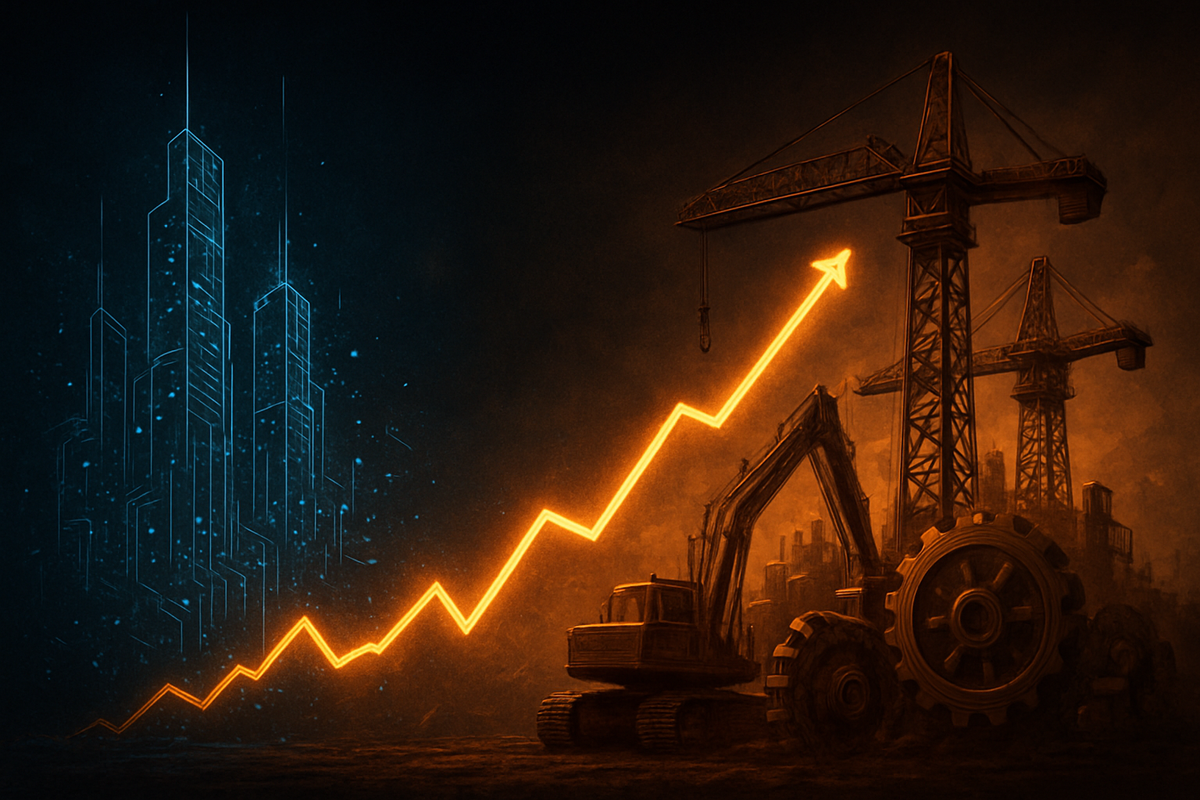
As March 2026 draws to a close, the frantic AI-driven rally that defined the previous two years has hit a formidable wall. Wall Street is currently witnessing a massive "Great Rotation," a structural shift where institutional capital is being pulled from the high-flying mega-cap technology sector and redirected into "old economy" cyclicals. This migration marks a fundamental change in market leadership, signaling that the "honeymoon phase" of Artificial Intelligence has officially ended in favor of tangible earnings and valuation discipline.
The divergence between the major indices highlights the intensity of this shift. During a volatile February-March period, the tech-heavy S&P 500 dropped by 0.87%, weighed down by its massive concentration in semiconductors and software. In stark contrast, the Dow Jones Industrial Average managed to eke out a 0.17% gain, buoyed by its exposure to heavy machinery, consumer staples, and industrial materials. This performance gap underscores a growing skepticism toward tech valuations and a newfound appreciation for the stability of companies that build, feed, and power the physical world.
The End of 'AI Exceptionalism' and the Rise of the Dow
The current market environment is defined by what analysts are calling "ROI Fatigue." After billions of dollars in capital expenditures were poured into AI infrastructure throughout 2024 and 2025, investors have moved from "buying the dream" to demanding "show me the margins." This transition reached a fever pitch in mid-February 2026, following a series of earnings reports from major cloud providers that showed massive spending on AI chips but only incremental gains in bottom-line revenue. The resulting sell-off in the Nasdaq and S&P 500 was swift, as risk-averse funds sought shelter in sectors that had been largely ignored during the AI frenzy.
The timeline of this rotation traces back to early January, when the Shiller PE ratio—a key measure of market valuation—hit a staggering 38.33, a level historically associated with market peaks and subsequent corrections. By late February, the narrative shifted from growth at any price to "valuation mean reversion." As tech multiples began to compress, the Dow Jones Industrial Average became a beneficiary of necessity. Throughout March, the Dow showed remarkable resilience, frequently trading in the green on days when the broader S&P 500 was dragged down by double-digit slides in high-beta software names.
Key stakeholders, including major pension funds and sovereign wealth funds, appear to be the primary drivers of this rebalancing. According to recent flow data, institutional "buy" orders for Industrials and Materials have reached their highest levels since 2021. This isn't just a flight to safety; it is a calculated bet that the "real economy" will provide better inflation-adjusted returns as the US economy navigates a period of 2% GDP growth and persistent labor costs.
Winners and Losers: A Tale of Two Economies
The primary casualties of this rotation are the former darlings of the AI era. Nvidia (NASDAQ: NVDA), which dominated headlines for years, has seen its stock become technically fragile. Despite a robust showing at its GTC 2026 conference, the stock traded between $172 and $181 in late March, down nearly 7% on the month as investors worried that the peak of the semiconductor cycle had passed. Similarly, Microsoft (NASDAQ: MSFT) has emerged as one of the weakest performers among the "Magnificent Seven," falling more than 20% year-to-date as the market questions whether its massive AI investments will yield the promised productivity gains fast enough to justify its premium. Other tech giants like Alphabet (NASDAQ: GOOGL) and Apple (NASDAQ: AAPL) have also faced significant selling pressure as their weight in the major indices triggered automatic rebalancing by passive funds.
On the winning side of the ledger, "non-tech AI" stories are gaining traction. Caterpillar (NYSE: CAT) has become a poster child for the industrial resurgence, with analysts upgrading the stock due to its successful integration of autonomous technology and AI-driven workflow efficiencies in its manufacturing and logistics arms. Procter & Gamble (NYSE: PG) has also seen a surge in interest; as a defensive Consumer Staples play, it offers a combination of dividend stability and margin protection that tech stocks currently lack.
Other cyclical winners include Union Pacific (NYSE: UNP) and Sherwin-Williams (NYSE: SHW). These companies represent the bedrock of the domestic economy—transportation and construction materials—which are benefiting from a multi-year trend of reshoring and infrastructure modernization. As capital flows out of intangible software and into tangible assets, these "old economy" giants are seeing their multiples expand for the first time in years.
Broader Significance: A Valuation Reset for a New Era
This sector rotation fits into a broader industry trend of "normalization" following the post-pandemic tech boom. The market is essentially correcting the extreme valuation gaps that opened up between the digital and physical economies. Historically, such rotations are not merely temporary dips but can last for several quarters, representing a "valuation reset" that re-aligns stock prices with their underlying fundamental cash flows. Comparisons are already being drawn to the post-Dot-com era, where the "Old Economy" outperformed for years while tech giants spent a decade recovering their previous highs.
The ripple effects are being felt most acutely in the Software-as-a-Service (SaaS) sector. The "Software Selloff" of early 2026 has seen some names fall 30% to 50% from their 2025 peaks. This is largely due to fears that new, agentic AI models might actually disrupt legacy software business models rather than enhance them. As investors grapple with this uncertainty, they are retreating to the predictable earnings of Materials and Staples, where the "threat of disruption" is significantly lower.
From a regulatory and policy perspective, this rotation reflects a broader shift toward industrial policy in the United States. Federal initiatives aimed at infrastructure and domestic manufacturing have created a "floor" for industrial earnings. Unlike the volatile, sentiment-driven AI trade, the growth in the cyclical sectors is backed by long-term government contracts and massive capital projects that are less sensitive to the immediate "hype cycle" of Silicon Valley.
The Road Ahead: Strategic Pivots and Market Challenges
In the short term, the market is likely to remain bifurcated. Tech companies will need to undergo a period of "earnings digestion," where they prove the fiscal viability of their AI initiatives. We may see a wave of strategic pivots, with software firms cutting costs and prioritizing immediate AI revenue over long-term research. For investors, the challenge will be identifying which tech companies are truly undervalued and which are simply falling back to earth.
Longer term, the market may enter a "balanced growth" phase. If the rotation into cyclicals continues, it could prevent a broader market crash by acting as a stabilizer. However, the risk remains that if tech continues to slide too rapidly, it could drag the entire S&P 500 into a bear market, regardless of how well the Dow performs. The key will be the Federal Reserve's response; if inflation remains "sticky" while growth slows, the preference for defensive staples and industrials will only intensify.
Market opportunities will emerge in "convergence plays"—traditional companies that are successfully using technology to lower costs. The "Old Economy" is no longer purely manual; it is becoming digitized. Investors should look for companies in the Industrials and Materials sectors that have high operational leverage and are successfully using AI to mitigate rising labor costs.
Final Assessment: What Investors Should Watch
The events of February and March 2026 serve as a stark reminder that valuations eventually matter. The "Great Rotation" is a signal that the era of blind faith in AI growth has ended, replaced by a more disciplined, value-oriented approach. While the S&P 500's 0.87% decline may seem modest, the underlying churn suggests a profound reorganization of market leadership that could define the rest of the decade.
Moving forward, the primary metric to watch will be AI-to-Revenue conversion rates during the next earnings season. If mega-cap tech companies cannot show a clear path to profitability for their AI divisions, the capital flight into cyclicals will likely accelerate. Conversely, any cooling of inflation or a dovish turn by the Federal Reserve could breathe life back into growth stocks, though the "easy money" of the 2024-2025 AI rally is likely gone for good.
In the coming months, investors should keep a close eye on industrial production data and the Shiller PE ratio. As long as the physical economy remains robust and tech valuations remain historically high, the Dow's outperformance is expected to continue. The market is no longer just about the future; it’s about what is happening on the factory floors and in the grocery aisles today.
This content is intended for informational purposes only and is not financial advice.