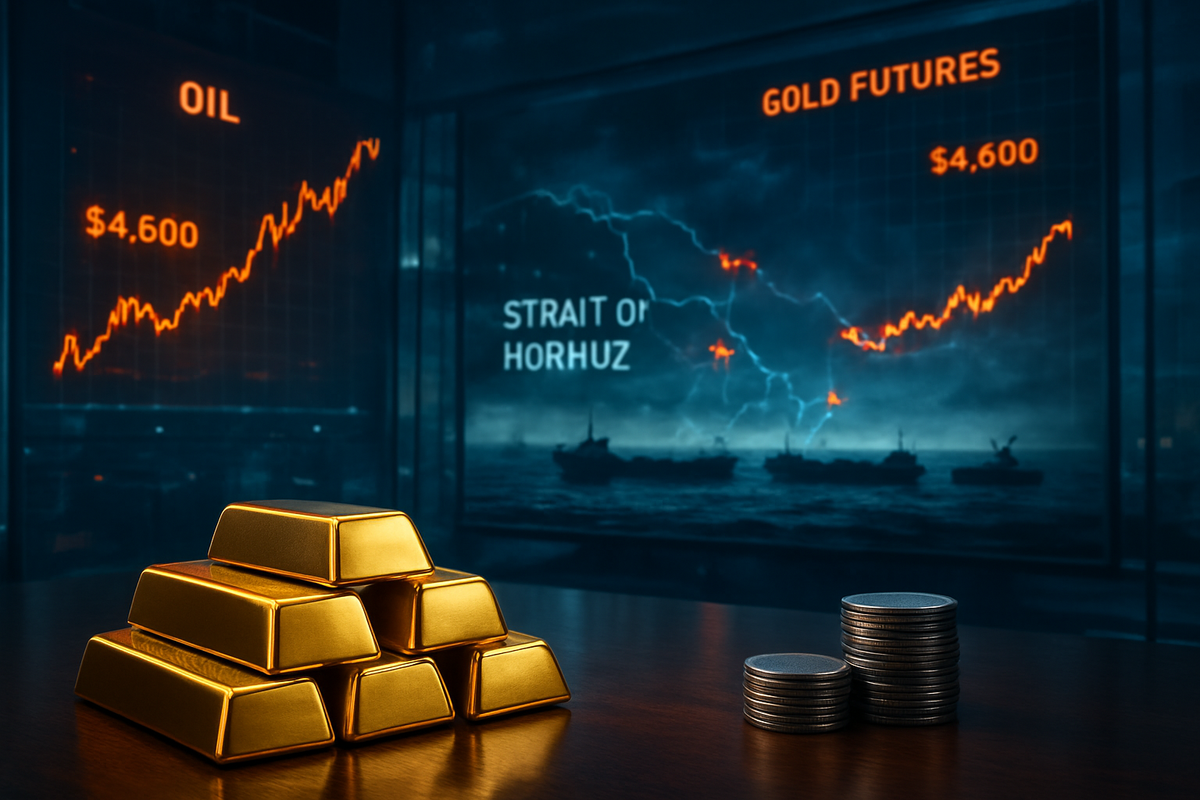
As of March 26, 2026, the global financial landscape is grappling with a volatile convergence of geopolitical conflict and stubborn inflationary pressures. Gold futures have settled into a high-stakes fluctuation range between $4,438 and $4,600 per ounce, a level that would have seemed unthinkable just two years ago. This surge comes as the Federal Reserve pivots away from anticipated interest rate cuts, forced into a "higher-for-longer" stance by a dramatic spike in energy costs following the effective closure of the Strait of Hormuz earlier this month.
The immediate implications are profound: investors are no longer viewing gold simply as a non-yielding asset that suffers when interest rates rise. Instead, the precious metal has re-emerged as the ultimate systemic insurance policy. With Brent crude oil soaring past $120 per barrel and global supply chains once again under duress, the "inflation hedge" narrative has decoupled from traditional interest rate sensitivity, creating a complex tug-of-war between a dominant U.S. Dollar and a frantic flight to safety.
The Hormuz Blockade and the Fed’s Impossible Choice
The current market turmoil traces back to the outbreak of the so-called "2026 Iran War" in late February, which culminated in the closure of the Strait of Hormuz on March 4, 2026. This vital maritime artery, which handles roughly 20-25% of the world's oil and liquefied natural gas (LNG) flows, became a theater of conflict, leading QatarEnergy to declare force majeure on exports after missile strikes damaged critical infrastructure. The resulting energy shock sent Dubai crude to a record $166 and pushed U.S. headline inflation back toward 3.0%, well above the Federal Reserve’s 2% target.
Before this escalation, markets had priced in a series of rate cuts for 2026 to support a cooling economy. However, Federal Reserve Chairman Jerome Powell and the Federal Open Market Committee (FOMC) have been forced to hold the federal funds rate steady at 4.75%–5.00%. The "hawkish hold" has been mirrored by the European Central Bank and the Bank of England, both of which signaled in their March meetings that rate cuts are off the table for the foreseeable future. This "higher-for-longer" environment usually creates a headwind for gold, yet April 2026 gold futures (COMEX: GC) remain buoyed near $4,438 as the threat of a global energy-driven recession looms larger than the opportunity cost of holding bullion.
Corporate Winners and Losers in the New Commodity Super-Cycle
The historic rise in gold prices has created a bifurcated reality for the mining sector. Newmont Corporation (NYSE: NEM), the world’s largest gold producer, is currently trading near $101. While the high price of gold has bolstered its top line, the company is battling a significant surge in All-In Sustaining Costs (AISC), which have climbed to $1,680 per ounce due to the very energy crisis driving gold’s popularity. Newmont has labeled 2026 a "trough year" for production as it prioritizes higher-grade ore to offset these inflationary pressures.
Conversely, Barrick Gold (NYSE: GOLD) has taken a more radical strategic path to navigate the volatility. Trading near $38, Barrick is currently finalizing a spin-off of its North American assets, including the massive Nevada Gold Mines complex, into a separate entity. This move is designed to shed the "geopolitical discount" associated with its international operations in Africa and the Middle East, which have become increasingly risky as regional tensions flare. Meanwhile, SPDR Gold Shares (NYSE Arca: GLD) has seen its Assets Under Management (AUM) swell to a record $180 billion this month, as institutional investors prefer the liquidity of the ETF over the operational risks inherent in individual mining stocks.
On the losing side, heavy industrial users of precious metals and energy-intensive manufacturers are feeling the squeeze. Logistics giants and airlines, such as Delta Air Lines (NYSE: DAL) and FedEx (NYSE: FDX), are facing a double-edged sword of soaring fuel costs and a tightening credit market as the Fed maintains its restrictive stance. The "debasement trade" that favors gold is simultaneously a tax on the broader equity market, particularly for companies unable to pass on 10% year-over-year increases in energy inputs to consumers.
A Systemic Shift: Gold as the New Global Reserve?
The broader significance of gold's current price action lies in the accelerating trend of "de-dollarization" and fiscal anxiety. With U.S. national debt approaching 140% of GDP in 2026, the traditional correlation between the U.S. Dollar and gold has begun to fray. Even as the U.S. Dollar Index (DXY) remains strong at 108—buoyed by its own safe-haven status and high interest rates—gold has refused to retreat to pre-crisis levels. This suggests that central banks in emerging markets, led by China, India, and Turkey, are no longer just diversifying their reserves; they are actively building a "hard asset" floor to protect against Western financial sanctions and currency volatility.
This event mirrors the stagflationary periods of the 1970s but with the added complexity of modern algorithmic trading and high-frequency geopolitical shifts. In previous cycles, a hawkish Fed would have sent gold tumbling. In 2026, the market perceives the Fed as being "behind the curve" of a geopolitical reality that interest rates cannot fix. You cannot drill for more oil or open a closed strait by raising the federal funds rate, and investors are using gold and silver (NYSE Arca: SLV) to opt out of this monetary policy impotence.
The Road Ahead: Peace Talks or Permanent Inflation?
In the short term, the market is laser-focused on potential diplomatic breakthroughs. Reports of a "15-point peace plan" originating from Washington have caused minor intraday dips in gold prices, as any reopening of the Strait of Hormuz would immediately alleviate the energy-inflation pressure. If the strait reopens, analysts at JPMorgan suggest gold could quickly correct toward a floor of $4,350. However, should the blockade persist into the summer, a run toward $5,000 is not out of the question.
Long-term, the strategic pivot for investors will involve balancing the "fear trade" with the reality of a world where capital is no longer cheap. Gold mining companies will need to aggressively transition toward renewable energy sources for their operations to decouple their costs from the volatile fossil fuel market. Furthermore, if the Fed is forced to keep rates high while the economy enters a "Hormuz-induced" recession, we may see a transition from gold as an inflation hedge to gold as a pure "crisis hedge" against a wave of corporate and sovereign defaults.
Conclusion and Investor Outlook
The current situation in March 2026 marks a turning point for precious metals. Gold’s resilience in the face of a $4,438-$4,600 price range, despite a hawkish Federal Reserve, signals a fundamental lack of confidence in traditional fiat-based stability. The combination of the Strait of Hormuz energy shock and "higher-for-longer" interest rates has created a unique macro environment where gold is both a defensive necessity and a speculative powerhouse.
For investors, the coming months will require a watchful eye on two primary indicators: the status of Qatari LNG flows and the Fed’s rhetoric regarding "real" versus "nominal" rates. While the immediate rush into SPDR Gold Shares (NYSE Arca: GLD) provides liquidity, the real value may eventually settle in those miners, like Newmont Corporation (NYSE: NEM), that can successfully manage their AISC in a high-inflation world. For now, the "Golden Hedge" remains firmly in place, serving as a silent witness to a global economy at a geopolitical crossroads.
This content is intended for informational purposes only and is not financial advice.