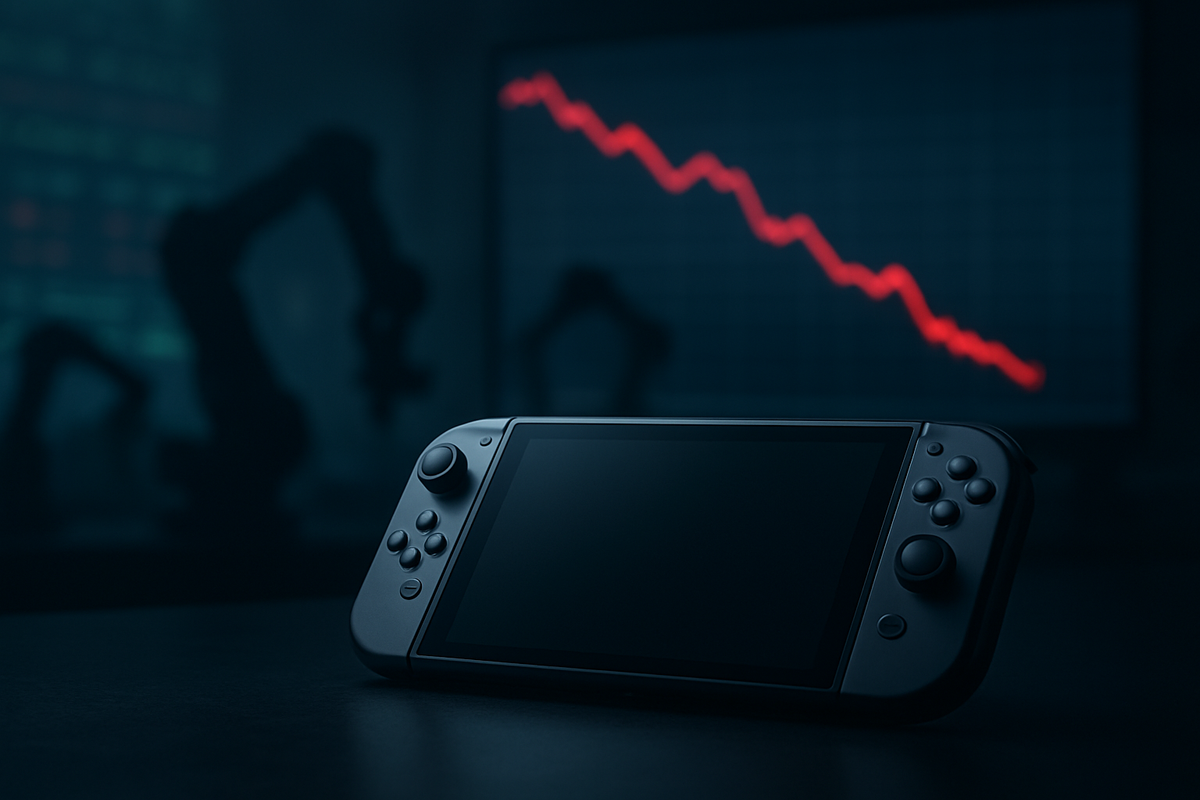
The honeymoon period for Nintendo Co., Ltd. (OTC: NTDOY) and its record-breaking successor console appears to have come to an abrupt end. Shares of the Kyoto-based gaming giant have plummeted more than 6% this week following bombshell reports that the company is slashing production orders for the Nintendo Switch 2 by a staggering 33% for the upcoming quarter. The move, which shocked analysts who had previously labeled the device a "generational triumph," suggests that the initial surge of early-adopter enthusiasm is hitting a wall of cooling consumer demand in the United States and Europe.
As the market digests this sudden pivot, the implications are rippling across the gaming sector. What was once seen as an unstoppable momentum for Nintendo is now being questioned as a potential "sophomore slump," forcing investors to recalibrate their expectations for the 2026 fiscal year and beyond.
A Drastic Correction in the Wake of Holiday Disappointment
The catalyst for the current market turbulence was a March 24, 2026, report from Bloomberg, which revealed that Nintendo has instructed its assembly partners to reduce production targets for the Switch 2 from 6 million units down to 4 million for the April-June quarter. This reduction follows a post-mortem of the 2025 holiday season, which saw U.S. sales for the console drop 35% compared to the original Nintendo Switch's first holiday performance back in 2017. While the console remains a juggernaut in its home market of Japan, the "western cooling" has caught the company off guard.
The timeline leading to this moment is one of extreme highs followed by a sharp reality check. After launching on June 5, 2025, to critical acclaim and record-breaking initial sales, the Switch 2 enjoyed a stellar first six months. By November 2025, Nintendo had even raised its sales forecast to 19 million units. However, industry insiders suggest that the late-2025 software lineup failed to maintain that momentum. Specifically, the long-delayed Metroid Prime 4: Beyond reportedly failed to reach the "system-seller" status Nintendo had banked on, leaving a vacuum in the high-end enthusiast market.
Initial market reactions have been swift and punishing. Following the production cut report, NTDOY shares fell 6.3% in a single trading session, nearly erasing the gains made earlier this month during the successful launch of Pokémon Pokopia. Market analysts at several major firms have since downgraded the stock from "Buy" to "Hold," citing concerns that the $449.99 price point—initially accepted by enthusiasts—may be proving a barrier to more price-sensitive "mass-market" families during a period of lingering economic uncertainty.
Winners and Losers: The Shifting Competitive Landscape
Nintendo's stumble has created an opening for its primary rivals, Sony Group Corporation (NYSE: SONY) and Microsoft Corporation (NASDAQ: MSFT). Sony, in particular, is rumored to be preparing a mid-cycle refresh for its flagship hardware late in 2026, and the news of Nintendo’s production cuts could embolden the PlayStation maker to accelerate its marketing efforts to capture "swing gamers" who were previously considering a Switch 2. Microsoft, which has focused heavily on its Game Pass subscription model, may also see an uptick in engagement as consumers opt for digital services over new $450 hardware.
The production cuts also send a chill through the semiconductor and retail sectors. Nvidia Corporation (NASDAQ: NVDA), which provides the custom Tegra silicon powering the Switch 2, could see a marginal impact on its gaming division revenue if the production slowdown persists through the summer. Similarly, specialty retailers like GameStop Corp. (NYSE: GME) and big-box giants like Best Buy Co., Inc. (NYSE: BBY) are facing a potential inventory headache. Having stocked up in anticipation of continued high demand, these retailers may now have to rely on aggressive software promotions or hardware bundles to clear shelves, potentially squeezing their already thin margins on hardware sales.
Conversely, some smaller third-party publishers might find a silver lining. With fewer first-party Nintendo blockbusters dominating the charts in the first half of 2026, companies like Electronic Arts Inc. (NASDAQ: EA) and Ubisoft (OTC: UBSFY) may find more breathing room for their cross-platform titles on the Switch 2 eShop. However, the overall sentiment remains cautious, as a smaller hardware install base ultimately limits the total addressable market for all software developers.
Analyzing the Significance: Industry Trends and Economic Headwinds
This event fits into a broader historical trend known as the "Year Two Challenge." Historically, successful consoles often face a dip in momentum once the initial wave of "super-fans" has been satisfied. Nintendo’s current predicament draws comparisons to the Wii U era, though on a far less dire scale. The primary difference today is the role of global macroeconomics. In 2025, Nintendo struggled with high component costs—specifically AI-driven competition for high-performance RAM—which kept the Switch 2's retail price high. While the U.S. Supreme Court struck down several major tariffs in February 2026, the temporary price hikes on accessories and the general "cost-of-living" squeeze on U.S. consumers appear to have left a lasting mark on discretionary spending.
The production cut also highlights the increasing volatility of the "hardware-first" business model in an era of cloud gaming and subscription services. While Nintendo has traditionally avoided the "specs race" of its competitors, the Switch 2's reliance on 4K upscaling and sophisticated hardware features has made it more susceptible to supply chain shocks than its predecessor. This pivot to a 33% cut suggests that Nintendo is choosing to protect its margins by avoiding oversupply, a lesson learned from the inventory bloat that plagued past console cycles.
Furthermore, the regulatory environment continues to be a wildcard. While the tariff threat has receded for now, the ongoing tension between "hardware-centric" companies and digital platform regulations in the EU and North America means that Nintendo cannot simply rely on its eShop revenue to offset hardware losses. The company is now under immense pressure to prove that its "hybrid" philosophy still resonates in a market that is increasingly moving toward platform-agnostic gaming.
What Comes Next: Strategic Pivots and the Road to 2027
In the short term, Nintendo must rely on its upcoming "Pokémon Pokopia" expansion and several unannounced first-party titles to reignite interest. There is already growing speculation among industry analysts that Nintendo may be forced to announce a price cut or a "lite" version of the Switch 2 sooner than originally planned—perhaps as early as the 2026 holiday season—to capture the sub-$350 market. A strategic pivot toward more aggressive "Classic" library additions for Nintendo Switch Online could also serve as a low-cost way to maintain subscriber retention while hardware sales fluctuate.
Longer-term, the challenge will be managing the transition to a more stable production rhythm. If the 4 million units produced this quarter sell through quickly, Nintendo may be able to claim the cut was a "normalization" rather than a "decline." However, if inventory continues to sit on shelves through the summer, the company may face a difficult choice: significantly slash its fiscal year guidance or accelerate the release of a "Pro" model to re-engage the enthusiast base that has already moved on.
The market will also be watching for any signs of Nintendo expanding its IP into other media more aggressively. Following the success of the Super Mario Bros. and Zelda films, a larger push into theme parks and cinematic content could provide the diversified revenue stream needed to weather the cyclical nature of console hardware. For now, however, the focus remains firmly on the silicon and the screens.
Market Outlook: Investor Takeaways
The 33% production cut for the Nintendo Switch 2 is a sobering reminder that even the most beloved brands are not immune to market saturation and economic gravity. For investors, the key takeaway is that the "easy growth" phase of the Switch 2's lifecycle has concluded. Moving forward, the stock’s performance will be tied less to the novelty of the hardware and more to the consistent delivery of "must-play" software and the company's ability to manage its global supply chain efficiently.
As we move into the middle of 2026, the gaming market is entering a phase of heightened competition and consolidation. Investors should keep a close eye on Nintendo's upcoming Q1 earnings report for official guidance updates and any commentary on U.S. retail sell-through rates. While the 6.3% drop in NTDOY shares is significant, Nintendo's massive cash reserves and unparalleled library of characters provide a safety net that many of its competitors lack.
In the coming months, watch for "The Big Three" software announcements (Mario, Zelda, or a new IP) as the primary indicators of whether Nintendo can regain its footing. Until then, the market is likely to remain "cautiously bearish," waiting for proof that the Switch 2 has the "legs" to match its predecessor's historic decade-long run.
This content is intended for informational purposes only and is not financial advice.