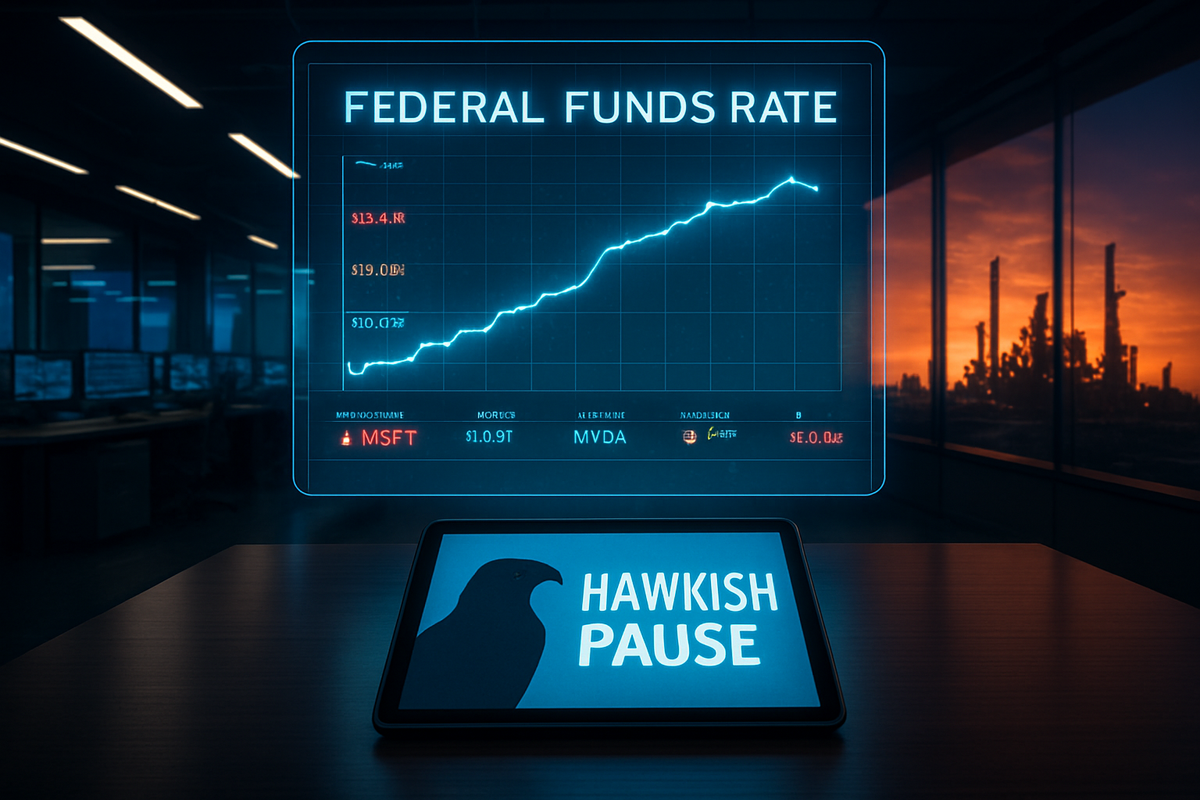
The Federal Reserve has officially entered a "wait-and-see" era that is increasingly testing the patience of Wall Street. Following the conclusion of the March 2026 Federal Open Market Committee (FOMC) meeting, the central bank opted to maintain the federal funds rate at a range of 3.50% to 3.75%. While the pause was widely expected, the accompanying "Summary of Economic Projections" and Chair Jerome Powell’s cautious rhetoric have signaled a hawkish shift that few anticipated at the start of the year. The primary culprit? A volatile cocktail of "stubbornly sticky" core inflation and a sudden energy shock triggered by the escalating conflict between the U.S. and Iran.
The immediate implications are clear: the "easy money" rally that characterized the final months of 2025 has evaporated. Treasury yields have climbed as traders scramble to price out previously expected rate cuts, and the prospect of "higher-for-longer" is once again the dominant narrative. For an economy that was hoping for a soft landing, the current geopolitical and inflationary backdrop suggests a much more turbulent flight path through the remainder of 2026.
A Strategic Stalemate in Washington
The Federal Reserve's decision to hold rates steady for the second consecutive meeting in 2026 marks a dramatic departure from the easing cycle that began in late 2025. Throughout the first quarter of 2026, the FOMC has been forced to navigate a rapidly deteriorating geopolitical environment. After reducing rates to the current 3.50%–3.75% range in December 2025, the committee initially signaled that further cuts were on the horizon. However, the outbreak of hostilities in the Middle East in February 2026 sent crude oil prices soaring, effectively stalling the downward trajectory of headline inflation.
The timeline leading to this "Hawkish Pause" was punctuated by the February CPI report, which showed monthly growth accelerating to 0.3% as energy prices rebounded by 0.6%. More concerning for the Fed was the mid-March release of the Personal Consumption Expenditures (PCE) price index, the central bank’s preferred inflation gauge, which placed Core PCE at a troubling 3.1%. During the March 17-18 meeting, the committee responded by upwardly revising its 2026 year-end PCE forecast to 2.7%, up from the 2.4% projected just three months ago. The meeting also saw a rare dissent from Governor Miran, who advocated for a cut, highlighting the growing internal friction over how to balance growth against a resurgent energy-driven inflation threat.
Sectors at the Crossroads: Winners and Losers
The reality of prolonged high interest rates is creating a stark divide across the equity landscape. The most visible casualties have been the highly leveraged and dividend-sensitive sectors. Realty Income (NYSE: O) and other major Real Estate Investment Trusts (REITs) have seen significant downward pressure as the cost of acquiring new properties remains elevated and their dividend yields lose luster compared to the 10-year Treasury. Similarly, the utilities sector, represented by giants like NextEra Energy (NYSE: NEE), is struggling under the weight of capital expenditure costs that are increasingly difficult to service in a high-rate environment.
On the other side of the ledger, the "AI-trade" is entering a more sober, capital-intensive phase. While companies like NVIDIA (NASDAQ: NVDA) continue to dominate the hardware space, the massive debt issuance required by hyperscalers like Microsoft (NASDAQ: MSFT) and Alphabet (NASDAQ: GOOGL) to build out 2026-generation data centers is finally beginning to impact valuation multiples. Meanwhile, the banking sector presents a mixed bag. Large-cap institutions like JPMorgan Chase & Co. (NYSE: JPM) may benefit from higher interest margins on their massive loan portfolios, but regional lenders like KeyCorp (NYSE: KEY) remain at risk. These smaller banks face a "double whammy" of thinning margins as they compete for deposits and a lingering exposure to a commercial real estate market that has yet to fully recover from the post-pandemic reset.
The Geopolitical Shadow and the Neutral Rate Debate
The current market volatility is not just a function of domestic data; it is a reflection of a fundamental shift in the global order. The 2026 energy shock draws uncomfortable parallels to the 1970s oil crises, forcing the Fed to weigh the risks of a "No Landing" scenario where growth remains positive but inflation refuses to die. This has reignited the debate over the "Neutral Rate" (R-Star)—the interest rate that neither stimulates nor restricts the economy. Powell’s recent assertion that the current 3.50%-3.75% range is only "moderately restrictive" suggests the Fed believes the floor for interest rates in the late 2020s will be significantly higher than the zero-bound era of the previous decade.
Furthermore, the "leadership premium" is now a tangible factor in market pricing. With Jerome Powell’s term as Chair set to expire on May 15, 2026, and the recent nomination of Kevin Warsh as his successor, investors are bracing for a potential "regime change." Warsh, known for a more hawkish lean and a focus on financial stability over pure employment mandates, represents a shift that could see the Fed become even less tolerant of inflation overshoots, potentially leading to a more aggressive policy stance in the second half of the year.
The Road Ahead: Potential Pivots and Scenarios
As the market looks toward the second half of 2026, two primary scenarios are emerging. In the "Baseline Recovery" scenario, geopolitical tensions in the Middle East de-escalate, allowing oil prices to stabilize and headline inflation to resume its crawl toward 2%. In this case, the Fed might deliver a single, face-saving 25-basis-point cut in late 2024 to signal a "mission accomplished" on the soft landing. This would likely spark a relief rally in small-cap stocks and REITs, which have been starving for a lower cost of capital.
Conversely, the "Inflationary Persistence" scenario assumes that the energy shock becomes systemic, filtering into wages and service prices. If Core PCE remains above 3% into the summer, the Fed may be forced to do the unthinkable: resume rate hikes. While currently only a 20% probability in the eyes of the CME FedWatch Tool, such a move would likely trigger a significant correction in the tech sector and push the regional banking system back into a state of heightened stress. Strategic pivots for investors will likely involve moving into cash-rich, high-margin companies that can self-fund growth without relying on the debt markets.
Final Assessment: A Market in Transition
The Federal Reserve’s current path is one of calculated caution, but the margin for error is razor-thin. The "Hawkish Pause" of March 2026 has sent a clear message that the central bank will not be bullied into rate cuts by market expectations, especially when geopolitical factors are actively working against its inflation targets. The key takeaway for investors is that the era of predictable, downward-sloping interest rates has officially ended, replaced by a regime of heightened volatility and data-dependency.
Moving forward, the market will be hyper-focused on two key milestones: the incoming inflation prints for April and May, and the transition of power at the Federal Reserve on May 15. The nomination of Kevin Warsh suggests a Fed that may be more willing to endure economic pain to ensure price stability, a prospect that could redefine market valuations for years to come. For now, investors should maintain a defensive posture, watching for signs of a peak in energy prices and closely monitoring the health of the credit markets as the "higher-for-longer" reality truly begins to sink in.
This content is intended for informational purposes only and is not financial advice.