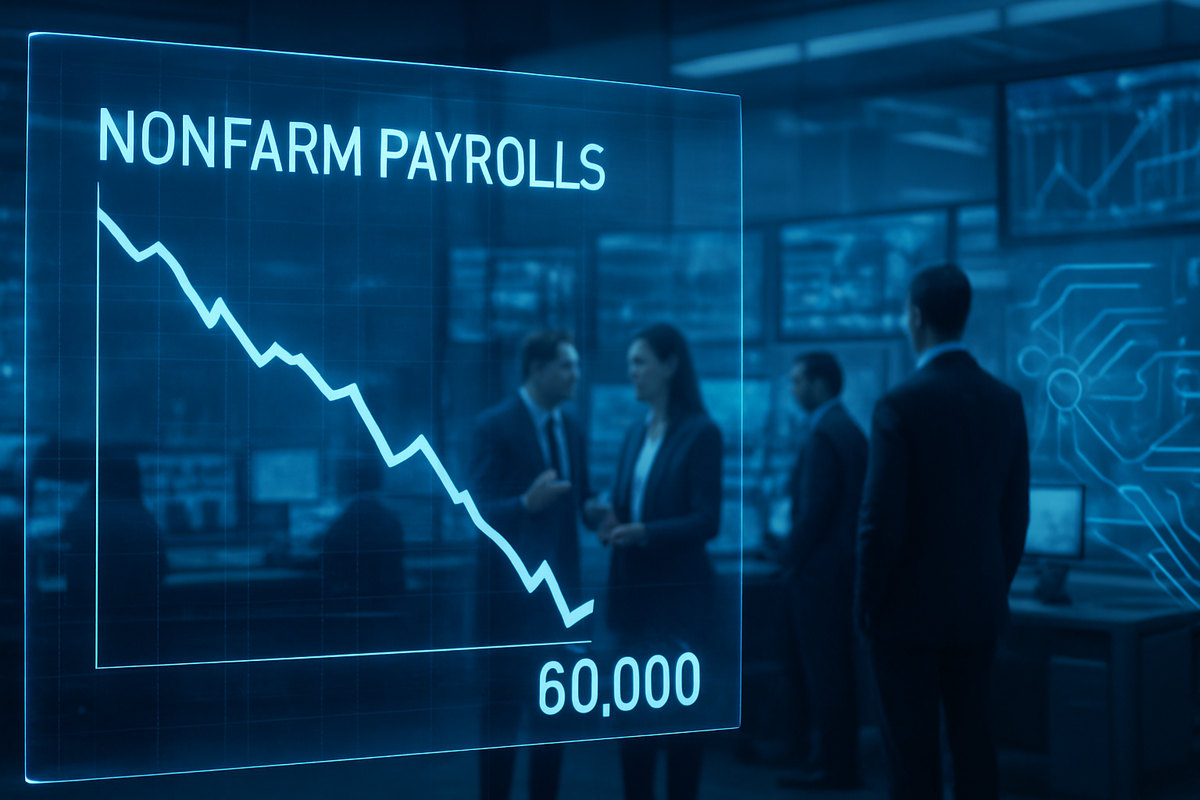
The U.S. labor market showed significant signs of cooling in February 2026, with nonfarm payrolls rising by just 60,000, a sharp deceleration from the revised 130,000 jobs added in January. Despite the slowdown in hiring, the unemployment rate remained steady at 4.3%, suggesting a labor market that is tightening through attrition and structural shifts rather than mass layoffs. This "controlled cooling" comes at a delicate time for the Federal Reserve, which has been attempting to navigate a soft landing amidst sticky inflation and the lingering effects of 2025’s aggressive fiscal policies.
The immediate market reaction was one of cautious recalibration. While a 60,000-job print would have sparked recessionary fears in previous decades, economists in 2026 point to a "new breakeven" for the labor market. With lower immigration levels and the accelerating displacement of entry-level roles by artificial intelligence, the number of jobs required to keep unemployment stable has plummeted. Nevertheless, the report signals that the post-pandemic hiring boom has definitively transitioned into a period of "jobless growth," where efficiency and margin expansion take precedence over headcount expansion.
A New Era of "Low-Hire, Low-Fire" Dynamics
The February Employment Situation Report, released by the Bureau of Labor Statistics (BLS) earlier this month, highlights a labor market in the throes of a structural transformation. The 60,000 gain in nonfarm payrolls fell well below the consensus estimate of 110,000, marking the weakest monthly performance since the brief stagnation in late 2024. The data reveals a stark divide between sectors: healthcare and education continued to add positions out of necessity, while professional and business services saw net losses as generative AI integration began to cannibalize administrative and junior-level roles.
This slowdown is the culmination of a timeline that began in mid-2025, following the passage of the One Big Beautiful Bill Act (OBBBA). While that legislation provided significant corporate tax incentives that spurred capital investment, it also introduced stricter work requirements and shifted the focus of the labor force toward high-skill technical roles. Throughout the winter of 2025-2026, major corporations adopted a "defensive" hiring posture—a trend analysts have dubbed "Low-Hire, Low-Fire." Companies are reluctant to let go of experienced talent in a tight market but are equally hesitant to expand their payrolls given the current 3.50%–3.75% interest rate environment.
Key stakeholders, including Federal Reserve Chair Jerome Powell and various labor leaders, have noted that the 4.3% unemployment rate acts as a "floor" in this new economy. The steady rate, despite low hiring, is attributed to a shrinking labor force participation rate among older workers and a significant reduction in the supply of migrant labor following the policy shifts of 2025. Initial market reactions saw a brief dip in the 10-year Treasury yield, as traders initially bet on an early rate cut, before yields stabilized as the "sticky inflation" narrative regained its footing.
Sector Winners and Losers in a Leaner Labor Market
In this environment of tepid job growth, technology giants like Microsoft (NASDAQ: MSFT) and Nvidia (NASDAQ: NVDA) are emerging as winners. For these firms, the cooling labor market validates their "growth through efficiency" thesis. As payroll growth slows, investors are rewarding companies that can maintain or expand margins through AI-driven automation rather than human capital. Nvidia, in particular, continues to benefit from the massive infrastructure spend required by other corporations looking to "right-size" their workforces using autonomous systems.
Conversely, the traditional banking sector faces a more arduous path. Firms like JPMorgan Chase & Co. (NYSE: JPM) are grappling with the twin pressures of narrowing Net Interest Margins (NIM) and slowing consumer loan demand. As the labor market cools, the breakneck pace of credit card and mortgage applications seen in 2024 has ebbed. Furthermore, if the Fed is forced to hold rates steady to combat core inflation despite the weak job numbers, the "yield curve steepening" could create volatility in bank balance sheets that are still recovering from the 2025 bond market fluctuations.
In the consumer space, retailers such as Walmart (NYSE: WMT) and Amazon (NASDAQ: AMZN) present a mixed bag. While Amazon benefits from the same AI-driven logistics efficiencies as the tech sector, both companies are vulnerable to a potential softening in consumer spending. If the 60,000-job trend continues, the "wealth effect" that bolstered retail sales throughout 2025 may begin to fade, leaving discretionary spending at risk. Meanwhile, investment banks like Goldman Sachs (NYSE: GS) are seeing a silver lining; the stabilization of interest rates and the fiscal incentives from the OBBBA have led to a resurgence in M&A activity, as companies look to merge to gain scale in an increasingly automated economy.
The Significance of the "AI Purge" and Fiscal Overhang
The February report is more than just a data point; it is a reflection of how broader industry trends like AI displacement have finally hit the "real" economy. In previous years, the threat of AI to jobs was largely theoretical. In 2026, however, the "AI Purge" is visible in the BLS data, specifically in the decline of middle-management and clerical positions. This mirrors historical precedents where major technological shifts—like the mechanization of agriculture or the rise of the internet—briefly decoupled productivity from employment growth.
Furthermore, the shadow of 2025's fiscal policy looms large. The OBBBA’s tax cuts have arguably kept the economy out of a technical recession, but they have also created a "term premium" in the bond market. With the federal deficit remaining elevated, the 10-year Treasury yield has stayed anchored above 4%, preventing the kind of rapid rate relief that usually follows a 60,000-payroll report. This creates a "policy barbell" where the government is stimulating the economy with one hand while the Fed is forced to keep the brakes on with the other to prevent an inflationary flare-up.
This situation has potential ripple effects for international markets. As the U.S. labor market cools, the dollar has shown signs of softening against the Euro and Yen, providing some relief to multinational exporters. However, if the U.S. remains the "cleanest shirt in the laundry" regarding GDP growth—currently projected at a sturdy 2.0% despite the hiring lull—global capital may continue to flow into U.S. equities, further detaching stock market performance from labor market reality.
Looking Ahead: The Fed’s "Vigilant Patience"
In the short term, all eyes are on the upcoming Federal Open Market Committee (FOMC) meeting. The "vigilant patience" mantra adopted by the Fed suggests they will not be rushed into a rate cut by a single month of weak payroll data, especially with the unemployment rate still at a historically respectable 4.3%. Investors should prepare for a period of heightened sensitivity to Consumer Price Index (CPI) releases; if inflation remains "sticky" around 2.6%, the Fed may remain on hold well into the summer of 2026.
Longer-term, the labor market may require a strategic pivot from both policymakers and corporations. We are likely to see an increased emphasis on "reskilling" programs as the structural mismatch between available jobs and worker skills widens. For investors, the opportunity lies in identifying "efficiency plays"—companies that can grow their bottom line without needing to fight for talent in a shrinking labor pool. The risk, however, is a "consumer cliff" if wage growth begins to lag behind the core cost of living in an AI-driven economy.
Closing Thoughts for the 2026 Market
The February Employment Situation Report serves as a definitive signal that the "Great Reset" of the 2020s has entered a new phase. The era of rampant job hopping and double-digit wage gains is over, replaced by a disciplined, efficiency-first corporate landscape. For the market, the 60,000-job figure is a double-edged sword: it keeps the Fed from further hikes but highlights the dwindling engine of consumer-led growth.
As we move toward the second half of 2026, investors should watch for signs of "labor hoarding" in essential services and the continued impact of the OBBBA on capital expenditures. The 4.3% unemployment rate remains the most critical anchor for the economy; as long as it stays steady, the "soft landing" remains the base case. However, any move toward 5.0% would likely force the Fed's hand, regardless of inflation, marking the next major turn in this economic cycle.
This content is intended for informational purposes only and is not financial advice.