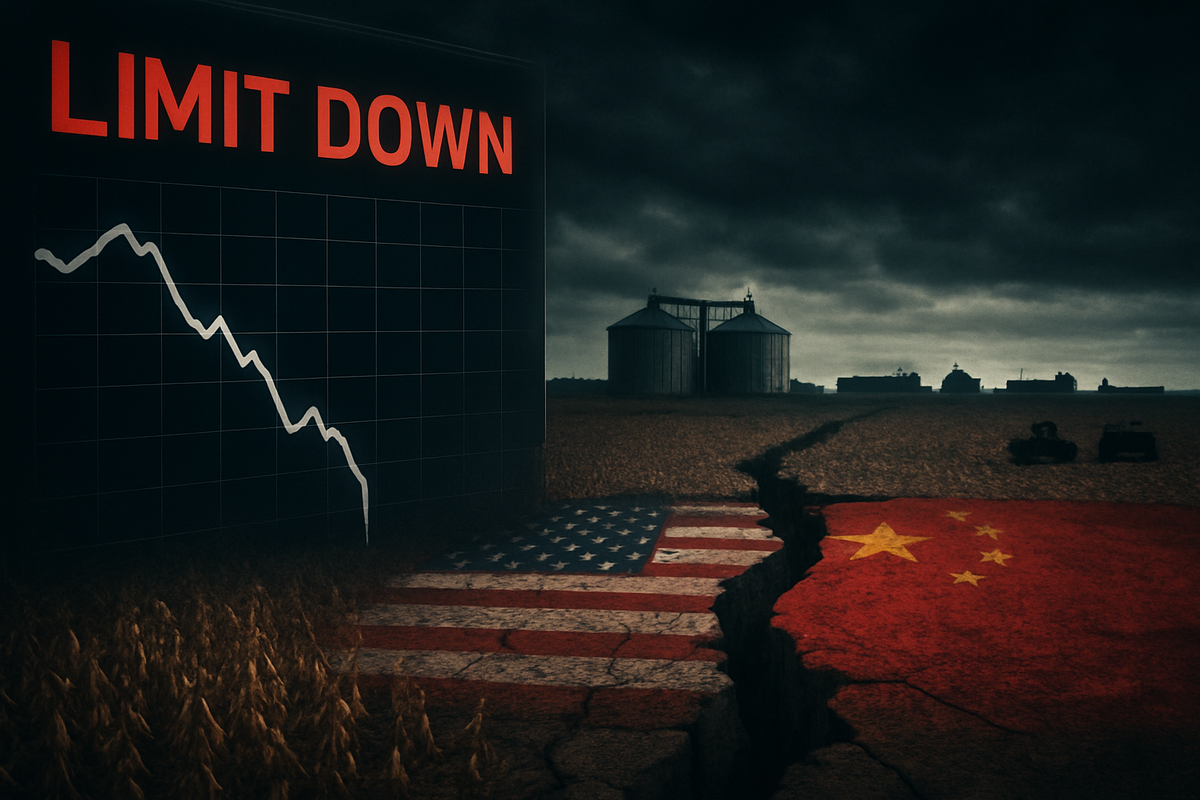
The Chicago Board of Trade (CBOT) witnessed a dramatic "limit down" session this week as soybean futures plummeted, following the White House announcement that a long-anticipated summit between President Trump and Chinese President Xi Jinping would be postponed. The delay, attributed to the escalating diplomatic and military pressures of the ongoing conflict in the Middle East, has sent shockwaves through the agricultural sector. For a market that had priced in a de-escalation of trade tensions, the news of a postponement was a catalyst for panic, wiping out billions in paper value in a single trading day as investors scrambled to price in the risk of a renewed, full-scale trade war.
The immediate implications are dire for American producers who have already been grappling with a sluggish export season. With the "Busan Framework" agreement signed in late 2025 now appearing increasingly fragile, the $0.70 per bushel drop in soybean prices represents more than just a technical halt; it is a signal of deep-seated anxiety regarding the future of the U.S. agricultural relationship with its largest buyer. As the Strait of Hormuz remains a focal point of global instability, the intersection of energy security and food trade has created a perfect storm of volatility that many analysts fear could persist well into the summer planting season.
Geopolitical Friction Triggers Limit Down Sessions
The volatility reached a breaking point on Monday when soybean futures hit the daily price limit of $0.70 per bushel, forcing a temporary halt in trading. This "limit down" event was a direct response to a statement from the Oval Office indicating that the summit, originally scheduled for late March 2026, would be pushed back by at least a month. The stated reason—the ongoing regional war and the blockade of the Strait of Hormuz—has complicated trade negotiations, as the U.S. reportedly sought Chinese assistance in maritime security that Beijing has yet to formally provide. This lack of coordination has reignited the "America First" rhetoric that characterized the trade wars of the late 2010s.
The timeline leading to this moment is one of missed opportunities and shifting deadlines. In October 2025, trade officials met in Busan, South Korea, to establish a "good faith" purchase agreement where China committed to 12 million metric tons (MMT) of U.S. soybeans by the end of the year. However, as of March 23, 2026, confirmed USDA sales for the current marketing year stand at a disappointing 9.4 MMT—less than half of the two-year average of 20.4 MMT typically seen by this date. The 2025 calendar year ended with only 18.2 MMT exported to China, a staggering 33% decline from 2024 levels, marking one of the worst performances for U.S. soy in nearly a decade.
Key stakeholders, including the American Soybean Association and the National Grain and Feed Association, have expressed "profound disappointment" over the summit's delay. The market reaction was exacerbated by fund liquidation; money managers had increased their long positions by nearly 17% since January on the assumption that a March summit would finalize the Busan Deal. When those hopes evaporated, the resulting "long squeeze" was rapid and indiscriminate, hitting not only soybeans but also soybean oil and meal, which fell by 350 points and $20 per ton, respectively.
Corporate Fallout: From Grain Giants to Equipment Manufacturers
The fallout of this trade paralysis is being felt acutely across the balance sheets of major agribusinesses. Archer-Daniels-Midland (NYSE: ADM) (ADM), one of the world's largest agricultural processors, recently reported a 31% drop in its Ag Services & Oilseeds segment profit for the final quarter of 2025. The company cited the "hand-to-mouth" buying patterns of Chinese state-owned enterprises as a primary headwind, as Beijing increasingly pivots toward South American suppliers to mitigate its reliance on U.S. originations.
Similarly, Bunge Global SA (NYSE: BG) (BG) has issued a cautious outlook for 2026, projecting earnings per share between $7.50 and $8.00, well below the previous consensus of $8.94. While Bunge’s 2025 merger with Viterra has provided some insulation by expanding its capacity in Brazil, the volatility in the U.S. market continues to squeeze domestic crush margins. For these grain giants, the inability to forecast Chinese demand makes capital allocation and inventory management a high-stakes guessing game.
The equipment sector is perhaps even harder hit. Deere & Co (NYSE: DE) (DE) has termed 2026 the "bottom of the cycle," with first-quarter net income falling to $656 million from $869 million a year ago. The company estimates it will face $1.2 billion in pre-tax costs due to ongoing and potential new tariffs this year. As soybean prices hover near or below break-even points for many U.S. farmers, the appetite for high-tech tractors and combines from firms like AGCO Corp (NYSE: AGCO) (AGCO) and CNH Industrial (NYSE: CNHI) (CNHI) has vanished. Both companies have reported double-digit sales declines in North America as growers prioritize liquidity over capital upgrades.
A Structural Shift in Global Trade Dynamics
This current crisis is more than a temporary market hiccup; it reflects a broader, structural shift in the global soybean trade that has been accelerating since 2018. While the U.S. and China argue over summits and regional conflicts, Brazil has moved aggressively to fill the void. Current estimates suggest that Brazil now supplies nearly 74% of China's total soybean imports, bolstered by a record-breaking 177 MMT harvest this year. The U.S. is no longer the "must-buy" origin for Chinese crushers, who have spent the last eight years diversifying their supply chains to insulate themselves from American political volatility.
The ripple effects extend beyond just trade volumes. The ongoing war in the Middle East has driven up shipping insurance and fuel costs, further eroding the competitiveness of U.S. exports. Unlike the 2018 trade war, which occurred during a period of relative global stability, the 2026 conflict adds a layer of inflationary pressure that makes trade barriers even more painful for the end consumer. Regulatory moves toward biofuels in the U.S. have provided some domestic demand support, but industry leaders at ADM and Bunge argue that without "regulatory clarity" and a finalized international trade deal, the domestic market cannot absorb the surplus left by a retreating China.
Historically, U.S. administrations have used aid packages to bridge the gap during trade disputes, such as the $12 billion package announced in December 2025. However, market analysts warn that these are "band-aid solutions" that fail to address the long-term loss of market share. The comparison to the 2018-2019 trade war is stark; while that conflict was primarily about intellectual property and trade deficits, the current tension is inextricably linked to a "hot" war and a struggle for regional influence, making a resolution far more complex than simple purchase quotas.
Scenarios for the Second Quarter: Pivot or Persist?
As the market looks toward the rescheduled summit, likely in late April or May 2026, two primary scenarios emerge. In a "strategic pivot" scenario, the U.S. and China could reach a temporary truce, where China resumes large-scale purchases of U.S. soybeans in exchange for a softening of rhetoric regarding the Strait of Hormuz. This would likely trigger a sharp "relief rally" in CBOT futures, potentially pushing prices back toward their January highs. However, such a rally would require more than just words; it would require confirmed USDA "daily sales" reports showing millions of tons in new commitments.
Conversely, a "continued escalation" scenario would see the summit postponed indefinitely or canceled. In this case, the U.S. could move forward with higher tariffs on Chinese manufactured goods, prompting a retaliatory "zero-buy" policy from Beijing. This would force U.S. farmers to rely almost entirely on domestic crush and the $12 billion aid package, likely leading to another series of limit-down sessions as the market adjusts to a "lost season." For investors, the focus must remain on the USDA’s weekly export sales reports and any diplomatic communiqués regarding the Iran conflict, as these will be the primary drivers of volatility in the short term.
Navigating the Uncertainty: A Wrap-up for Investors
The current turmoil in the soybean market is a sobering reminder of how geopolitical conflict can derail global commodity trade in an instant. The combination of a delayed Trump-Xi summit, the logistical nightmare of the Strait of Hormuz blockade, and the persistent lag in U.S. export commitments has left the agricultural sector in its most precarious position in years. The key takeaway for investors is that the "Busan Framework" is currently failing to deliver its promised stability, and the reliance on Brazilian soy is no longer a temporary trend but a permanent fixture of the global economy.
Moving forward, the market will likely remain in a "wait-and-see" mode, characterized by high volatility and low liquidity. Investors should keep a close eye on the performance of companies like Archer-Daniels-Midland and Deere & Co, as their quarterly earnings will serve as a barometer for the health of the entire agricultural supply chain. While the Dec 2025 aid package provides a safety net for some, the real solution lies in a diplomatic breakthrough that decouples food trade from regional military conflicts. Until then, the soybean market is likely to remain a primary theater of the ongoing economic and political tug-of-war between the world's two largest superpowers.
This content is intended for informational purposes only and is not financial advice.