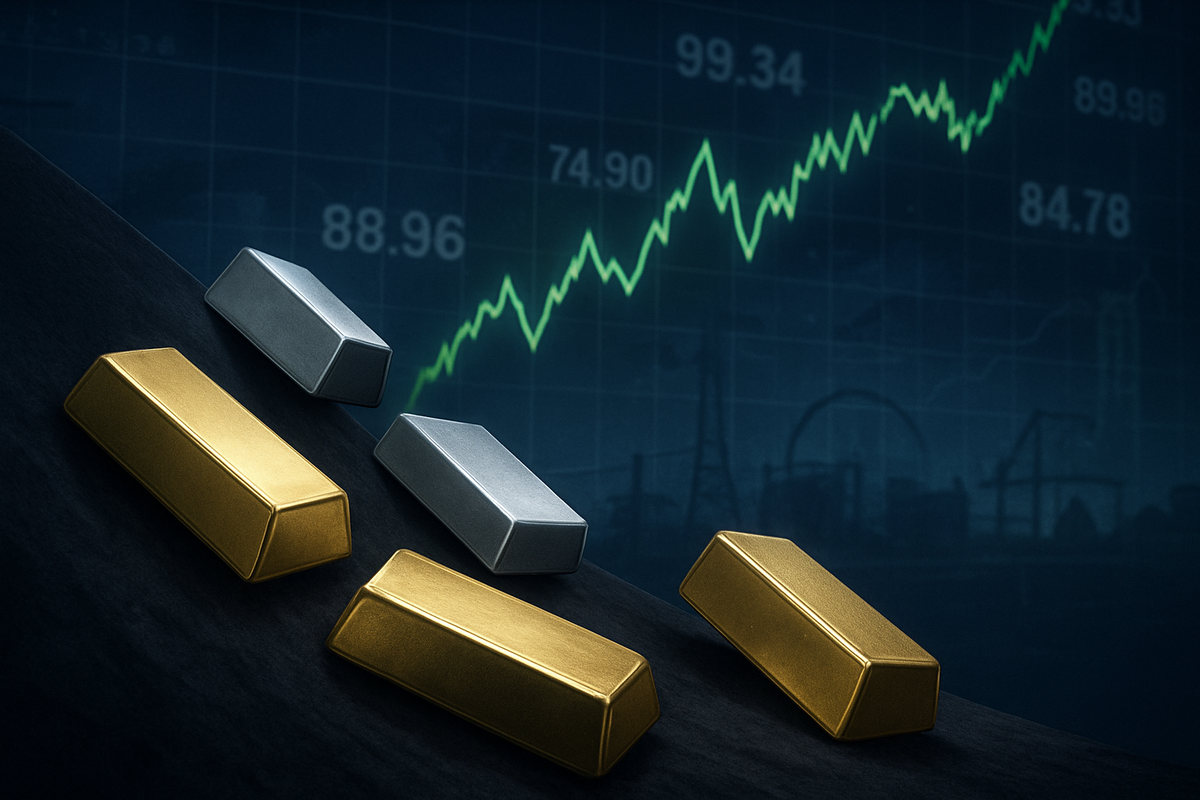
NEW YORK — The global commodities market witnessed a historic liquidation event today, March 23, 2026, as the "fear trade" that had dominated the first quarter evaporated in a matter of hours. Gold and silver prices, which had reached stratospheric heights amid rising Middle East tensions, suffered their sharpest single-day decline in years. The catalyst was a sudden and unexpected signal of de-escalation between the Trump administration and Tehran, prompting a massive rotation of capital out of precious metals and back into riskier assets like equities.
By mid-day trading, spot gold (XAU/USD) had plummeted more than 10%, struggling to find support near $4,408 per ounce after trading near $5,000 just last week. Silver (XAG/USD) fared even worse, crashing 15% to approximately $66.71 per ounce and hitting "lower circuit" limits on several international exchanges. As the safe-haven premium vanished, the Dow Jones Industrial Average surged over 1,100 points, signaling a profound shift in investor sentiment from defensive posturing to aggressive growth seeking.
A Monday Morning Pivot: From Brinkmanship to Diplomacy
The volatility was triggered early Monday morning when President Trump took to social media to announce that the United States and Iran had engaged in "very good and productive conversations" aimed at a "complete and total resolution" of the recent maritime and energy conflicts. This diplomatic breakthrough followed a terrifying three-week period that began on February 28, 2026, with US-Israeli airstrikes on strategic targets, which led Iran to effectively close the Strait of Hormuz. With 20% of the world’s oil flow throttled, gold had become the ultimate insurance policy for panicked investors.
However, the President’s announcement of a five-day postponement of all planned strikes on Iranian energy infrastructure served as the "off-switch" for the geopolitical risk premium. Within minutes of the news, Brent Crude oil prices plunged 14% toward $96 per barrel, and the bid for precious metals vanished. Market participants, who had spent weeks hedging against a full-scale regional war, found themselves over-leveraged in "paper gold" and rushed for the exits simultaneously. The U.S. Dollar Index (DXY) also shot past the 100 mark, providing further downward pressure on dollar-denominated commodities.
The Mining Sector Reels While Tech Gains Ground
The immediate casualties of this shift are the major precious metals producers and royalty companies. Newmont Corporation (NYSE: NEM) and Barrick Gold Corporation (NYSE: GOLD) both saw their shares slide by more than 8% in early trading as the realized price of their core product recalibrated downward. The silver sector was hit particularly hard; Pan American Silver (NASDAQ: PAAS) and First Majestic Silver (NYSE: AG) saw double-digit percentage losses, reflecting the higher volatility inherent in the silver market. Streaming and royalty giant Wheaton Precious Metals (NYSE: WPM) also faced significant selling pressure as investors lowered long-term revenue projections based on the new price floor.
Conversely, the de-escalation is a massive boon for high-growth sectors that had been weighed down by energy costs and geopolitical uncertainty. Large-cap technology firms and industrial manufacturers are leading the charge in the broader indices. Companies with heavy energy dependencies or those sensitive to global trade stability are seeing a "relief rally." Financial institutions are also benefiting from the surge in trading volume and the return of the "carry trade," as the U.S. dollar strengthens against the backdrop of a more stable global outlook.
The Death of the 'Fear Trade' and the Return of the Fed Factor
This pivot marks a significant turning point in the 2026 market narrative. For months, the primary driver of asset prices was "financial disaster insurance," with central banks in China, India, and Turkey leading an aggressive accumulation of gold that briefly made the metal the world’s second-largest reserve asset. Today’s sell-off suggests that the "war premium" has been fully extracted, forcing investors to return their focus to traditional macroeconomic fundamentals: inflation and interest rates.
With the geopolitical "smoke" clearing, the market is now forced to confront a hawkish Federal Reserve. Recent U.S. inflation data remains sticky at 3.2%, and Fed officials have signaled only one potential rate cut for the remainder of 2026. This "higher for longer" interest rate environment increases the opportunity cost of holding non-yielding assets like gold and silver. Historically, similar "buy the rumor, sell the news" events—such as the price corrections following the peak of the 2011 debt ceiling crisis—have led to prolonged periods of consolidation for precious metals as liquidity returns to the equity markets.
Navigating the 'New Normal' in the Coming Months
In the short term, the market remains in a state of price discovery. Analysts are watching the $4,400 level for gold and the $65 level for silver to see if institutional buyers return at these lower valuations. While the immediate threat of a major energy war has subsided, the structural issues that drove gold to record highs—high global debt levels and persistent inflation—have not disappeared. Some contrarian investors may view today’s 10-15% correction as a "buy the dip" opportunity, provided the Trump-Iran diplomatic channel remains open.
The primary challenge for investors will be managing the extreme volatility that has become the hallmark of the 2026 trading year. Strategic pivots toward diversified portfolios that balance the current equity rally with "hard asset" floors will be essential. We may see a cooling-off period for the mining majors, but exploration companies like U.S. Gold Corp. (NASDAQ: USAU) may find it harder to secure capital in a "risk-on" environment where the urgency for new discoveries has temporarily abated.
A Reshuffled Deck for Q2 2026
Today’s sell-off is a stark reminder of how quickly geopolitical headlines can upend a crowded trade. The key takeaway for the market is that the "safe haven" trade is currently in a state of hibernation, replaced by a renewed appetite for corporate earnings and economic growth. As the "war premium" evaporates, the focus shifts entirely to the stability of the 5-day ceasefire and whether it can evolve into a lasting treaty.
Moving forward, investors should keep a close eye on the U.S. Dollar Index and Brent Crude prices as leading indicators for the next move in precious metals. If the de-escalation holds, the equity rally could extend well into the summer, leaving gold and silver to test long-term support levels. For now, the "gold rush" of early 2026 has hit a massive roadblock, and the bulls are being forced to re-evaluate their positions in a world that, for the moment, looks a little less dangerous.
This content is intended for informational purposes only and is not financial advice.