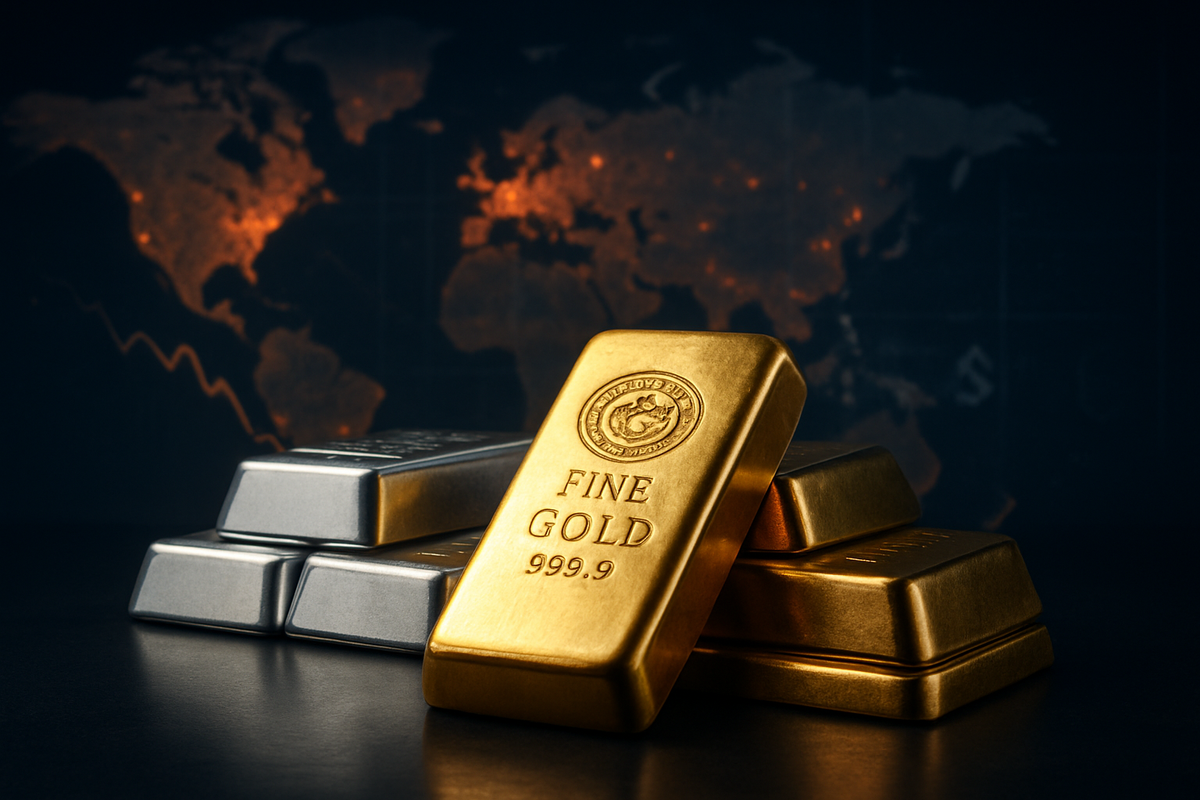
NEW YORK — In a historic reshuffling of global capital, gold and silver have surged to unprecedented all-time highs as of March 20, 2026. Driven by a volatile cocktail of institutional attacks on the Federal Reserve’s independence, aggressive new tariff threats, and a series of escalating military conflicts in the Middle East and Eastern Europe, the precious metals complex has transitioned from a niche safety play to the primary collateral of a fracturing global economy.
The surge has seen gold touch a historic peak of $5,608 per ounce earlier this year, while silver briefly eclipsed the $120 mark, shattering records that had stood for decades. While the markets are currently experiencing a technical correction from those January highs, the underlying drivers—principally a weakening U.S. dollar and a fundamental loss of faith in fiat stability—continue to provide a robust floor for bullion prices. Analysts suggest that the market is no longer merely reacting to news but is instead undergoing a structural repricing of risk in a post-globalization world.
The Perfect Storm: Subpoenas, Tariffs, and the 'Warsh Shock'
The path to these record highs began in late 2025 but accelerated violently in the first quarter of 2026. The primary catalyst was a direct confrontation between the executive branch and the Federal Reserve. Investors were rattled when the Justice Department served subpoenas on Fed officials, including Chair Jerome Powell, amid public demands for more accommodative monetary policy to fund expanding fiscal deficits. This unprecedented pressure on the Fed's independence sparked the "debasement trade," as the market began to price in a future where the central bank is subservient to political mandates.
The "Warsh Shock" of late January further complicated the narrative. The nomination of Kevin Warsh to succeed Powell initially triggered a 30% "flash crash" in silver as the market anticipated a return to "inflation hawk" policies. However, the subsequent realization that even a hawkish Fed cannot easily unwind years of debt expansion brought buyers back into the fold. Parallel to this institutional drama, the administration’s pursuit of unconventional territorial acquisitions, such as the Greenland dispute, led to threats of sweeping "reciprocal tariffs" against European allies, further incentivizing a flight into the borderless security of gold.
Geopolitical triggers reached a fever pitch in early March with a massive military escalation in the Middle East. Reports of major combat operations involving the U.S. and Israel, coupled with the reported death of Iran’s Supreme Leader, sent the iShares Gold Trust (NYSE Arca:IAU) and the iShares Silver Trust (NYSE Arca:SLV) into high-volume frenzies. In this environment, the U.S. dollar, which had fallen nearly 11% throughout 2025, has struggled to maintain its status as the sole safe haven, allowing precious metals to take center stage.
Corporate Impact: Mining Giants and the Cost of Extraction
The primary beneficiaries of the bullion boom have been the major miners, though the gains have been tempered by rising operational costs. Newmont (NYSE: NEM), the world's largest gold miner, has seen its stock price fluctuate wildly. While the company is benefiting from record realized prices, it recently projected a "trough year" for production with All-In Sustaining Costs (AISC) climbing to $1,680 per ounce due to labor shortages and energy inflation. Despite these headwinds, the sheer margin expansion from $5,000+ gold has kept investor interest high.
Similarly, Barrick Gold (NYSE: GOLD) has reported a significant drop in production volume—down 19% year-over-year in the final quarter of 2025—yet its shares have gained approximately 30% over the last six months. The disconnect between falling production and rising stock prices highlights a market that is more concerned with the value of the underlying asset than the operational efficiency of the miners themselves. On the losing side of this equation are industrial consumers of silver, particularly in the solar and electronics sectors, where skyrocketing input costs are beginning to squeeze margins and delay the green energy transition.
Analysis: A Structural Shift Away from Fiat
This rally is more than a repeat of the 2020 pandemic surge; it represents a fundamental shift reminiscent of the late 1970s. During the stagflationary era of 1980, gold reached a then-unthinkable $850 per ounce as energy shocks and loss of confidence in the dollar took hold. The 2026 environment mirrors this, but with the added complexity of "de-dollarization." Central banks across the Global South have been aggressively diversifying away from U.S. Treasuries in favor of physical gold, viewing it as "vested collateral" that cannot be frozen by sanctions.
The regulatory implications are also mounting. As gold and silver prices soar, there is increased talk of "windfall taxes" on mining profits and potential restrictions on private bullion exports in some jurisdictions. Historical precedents suggest that when precious metals become the ultimate barometer of government failure, the legislative response is often to attempt to suppress the signal. However, unlike the 1980 peak, which was largely a speculative bubble, the current trend appears to be a proactive move by institutional capital to hedge against the politicization of the global financial system.
The Road Ahead: Volatility as the New Normal
In the short term, markets expect continued volatility as the "Warsh-led" Federal Reserve attempts to navigate a path between fighting inflation and maintaining fiscal solvency. A potential "commodity supercycle" could see silver re-test its $121 highs if industrial demand for defense-related technologies continues to outpace mine supply. Strategic pivots for investors will likely include a move toward "royalty and streaming" companies that provide exposure to metal prices without the direct operational risks of mining in geopolitically sensitive regions.
Longer-term, the market remains focused on the possibility of a "Grand Bargain" or a new Bretton Woods-style agreement to stabilize exchange rates. Until such a resolution is reached, the primary challenge for the market will be liquidity. The "liquidation waves" seen in March 2026, where even gold was sold to cover margin calls in the plummeting equity markets, suggest that the path to higher prices will be anything but a straight line.
Conclusion: Lessons for the Modern Investor
The ascent of gold and silver to all-time highs in 2026 serves as a stark reminder of the limits of central bank omnipotence. The key takeaway for the market is that "safe haven" assets are only as good as the stability of the institutions they are meant to hedge against. As those institutions—the Fed, the DOJ, and international trade bodies—face unprecedented internal and external pressures, the value of decentralized, physical wealth has become undeniable.
Moving forward, the market is expected to remain in a "high-alert" state. Investors should watch closely for any signs of a ceasefire in the Middle East or a de-escalation of the tariff wars, which could trigger a sharp, albeit temporary, reversal in metal prices. Ultimately, the 2026 precious metals surge is a symptom of a world in transition, and its lasting impact will be felt in the way every major portfolio evaluates geopolitical risk.
This content is intended for informational purposes only and is not financial advice.