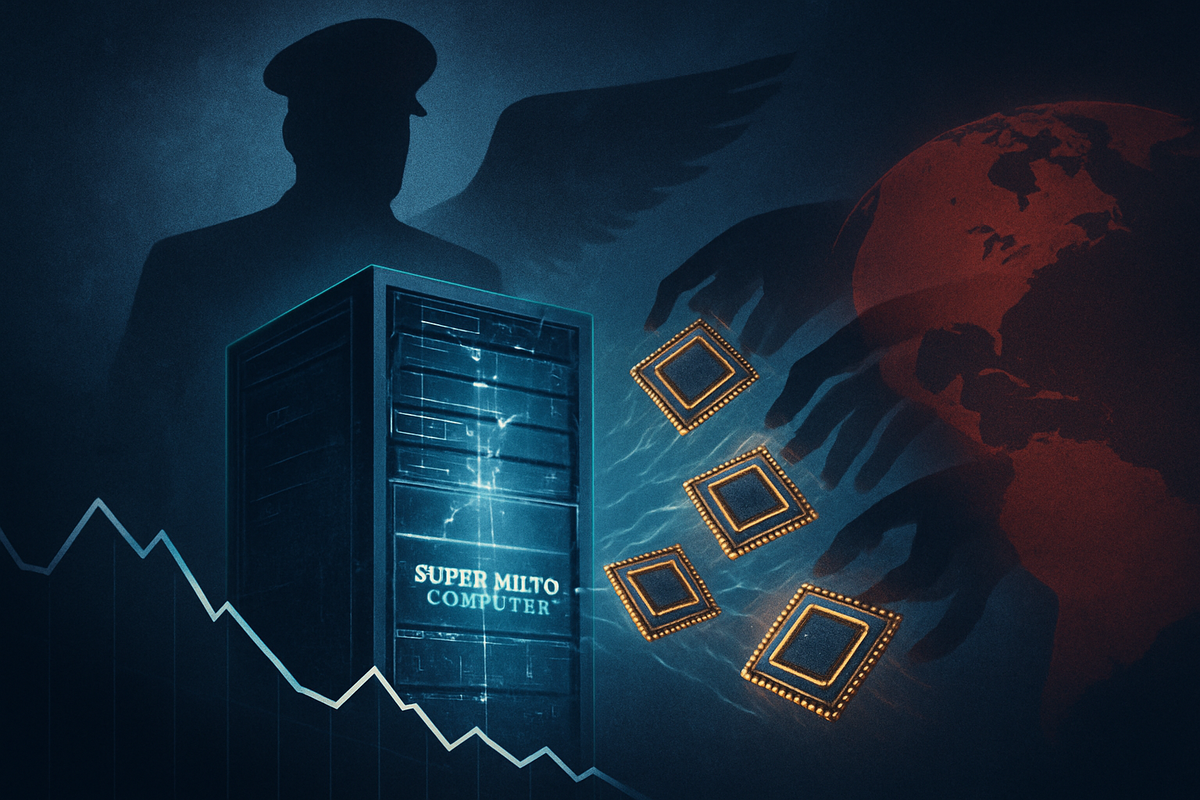
The high-flying era of Super Micro Computer (NASDAQ: SMCI) hit a staggering roadblock on Friday, March 20, 2026, as shares of the server manufacturer plummeted more than 28% following the unsealing of a federal indictment. The charges, brought by the U.S. Attorney’s Office for the Southern District of New York, allege a massive, sophisticated scheme to smuggle billions of dollars worth of restricted artificial intelligence chips to China. The news has sent shockwaves through the financial markets, wiping out nearly $5 billion in market capitalization in a single trading session.
At the heart of the scandal is a high-ranking executive and co-founder, Yih-Shyan "Wally" Liaw, who stands accused of orchestrating a clandestine supply chain to bypass strict U.S. export controls. As the AI hardware sector faces its most significant governance crisis to date, the fallout is raising urgent questions about the integrity of global tech supply chains and the effectiveness of current regulatory oversight. For investors, the event represents a dramatic reversal of fortune for a company that was once the poster child of the generative AI boom.
The Indictment: Hair Dryers, Dummy Servers, and a $2.5 Billion Breach
The federal investigation, led by the FBI, describes an operation that reads more like a corporate thriller than a financial filing. According to the indictment unsealed on March 19, 2026, Super Micro Computer executives allegedly conspired to divert at least $2.5 billion in high-performance servers to Chinese buyers between 2024 and 2025. These servers were equipped with the most advanced hardware from Nvidia (NASDAQ: NVDA), specifically the highly sought-after B200 and H200 "Blackwell" and "Hopper" chips, which are subject to rigorous national security export restrictions.
The timeline suggests that the scheme ramped up in late April 2025, during which time the group reportedly diverted $510 million in hardware in a single three-week window. To evade Department of Commerce auditors, the conspirators allegedly used a "pass-through" company in Southeast Asia to mask the final destination of the hardware. Most shockingly, the indictment claims "fixers" used industrial hair dryers to peel serial number stickers and regulatory labels off servers destined for China, placing them onto "dummy" machines stored in warehouses to satisfy routine inspections.
The key players named in the probe include Yih-Shyan "Wally" Liaw, the Senior Vice President of Business Development and a company co-founder, who was arrested in California on March 19. Also charged is Ruei-Tsang "Steven" Chang, the General Manager of the company’s Taiwan office, who is currently considered a fugitive. A third-party contractor, Ting-Wei "Willy" Sun, was also apprehended for his alleged role as a broker for the illegal shipments. Super Micro has since placed Liaw and Chang on administrative leave, asserting that the company itself is not a named defendant and was unaware of the illicit activities.
Market Fallout: Winners and Losers in the Wake of the Probe
The immediate market reaction was swift and merciless. SMCI shares closed down 28.37% at $22.06, a far cry from the triple-digit highs seen during the peak of the AI craze. However, the ripple effects extended far beyond a single ticker. Nvidia (NASDAQ: NVDA), while not accused of any wrongdoing, saw its stock dip 1.66% as investors grappled with the realization that roughly 9% of its total revenue was tied to Supermicro. The potential for further "gray market" diversions has introduced a new layer of risk for the semiconductor giant, potentially inviting tighter federal scrutiny of its distribution partners.
The crisis has created a "flight to governance," with competitors poised to capture the market share left in the vacuum of Supermicro’s reputational collapse. Shares of Dell Technologies (NYSE: DELL) surged over 5% on Friday, as analysts suggested that enterprise and government clients would likely migrate their server orders to more established players with perceived higher compliance standards. Similarly, Hewlett Packard Enterprise (NYSE: HPE) saw a modest uptick as it positioned itself as a stable alternative for AI data center infrastructure.
On the losing end, Advanced Micro Devices (NASDAQ: AMD) saw its shares slip 2.3%, likely due to broader sector anxiety regarding the potential for even stricter export regulations that could hamper international sales. The "governance discount" now being applied to the AI hardware sector suggests that investors are no longer purely focused on performance and growth; they are now pricing in the massive legal and regulatory risks associated with the US-China "chip war."
Broader Implications: The AI Cold War and Regulatory Reckoning
This event is not merely a corporate scandal; it is a flashpoint in the ongoing technological rivalry between Washington and Beijing. The scale of the alleged smuggling—$2.5 billion—demonstrates the intense demand within China for top-tier AI compute power and the lengths to which actors will go to circumvent U.S. sanctions. It highlights a critical vulnerability in the "small yard, high fence" strategy employed by the U.S. government: while the technology is restricted, the complexity of global distribution makes enforcement a Herculean task.
Historically, this event draws parallels to the 2018 investigations into Chinese tech giants like Huawei and ZTE, but with a crucial twist: the alleged perpetrator is a Silicon Valley-based firm. This shifts the regulatory focus from foreign "bad actors" to the domestic supply chain. We are likely to see a significant policy shift toward "know your customer's customer" (KYCC) requirements for hardware vendors. The Department of Justice and the Department of Commerce are expected to use the Supermicro case as a blueprint for more aggressive auditing of all Tier-1 server integrators.
Furthermore, the "hair dryer" allegations expose the limitations of physical labeling and serial tracking in an era of high-stakes smuggling. This will likely accelerate the adoption of cryptographic hardware identities and "silicon-to-cloud" tracking mechanisms. For the industry, the era of rapid, unchecked growth in the AI sector may be coming to an end, replaced by a more disciplined, compliance-heavy environment that could slow down deployment timelines but offer more long-term stability.
What’s Next: Strategic Pivots and the Threat of Delisting
In the short term, Super Micro Computer faces a grueling battle to maintain its listing on the Nasdaq. With its Senior VP under indictment and a general manager on the run, the company’s internal controls are under a microscope. An independent forensic audit is almost certain, and the company may be forced to restate earnings if any of the illicit sales were improperly recognized or if legal liabilities were understated. The threat of a DOJ-led corporate monitor being installed at the company is high, which would significantly increase operational costs and slow down decision-making.
Strategically, the company may need to undergo a complete leadership overhaul to regain investor trust. There is also the looming possibility of a "de-facto" blacklist; if the U.S. government restricts Nvidia or other suppliers from selling to Supermicro until the investigation is resolved, the company’s business model could effectively evaporate. Investors should watch for announcements regarding new compliance hires and potential divestitures of international units that have been linked to the probe.
Longer term, the AI hardware market will likely consolidate around vendors who can prove "sovereign-grade" security in their supply chains. We may see the emergence of a two-tiered market: one for "certified-clean" hardware for Western government and enterprise use, and a more volatile, less-regulated market elsewhere. Supermicro's survival depends entirely on its ability to prove that this was a "rogue executive" scenario rather than a systemic corporate culture of cutting corners.
Summary: A Turning Point for the AI Sector
The 28% plunge in Super Micro Computer’s stock is a stark reminder that in the high-stakes world of AI, geopolitical risks are as impactful as technological breakthroughs. The indictment of Wally Liaw and the allegations of a multi-billion dollar smuggling operation mark a turning point for the industry, where "governance" and "compliance" are becoming as vital to a company's valuation as "FLOPs" and "terabytes." The event has cleared the way for competitors like Dell and HPE to re-assert their dominance, while casting a long shadow over the entire AI server ecosystem.
Moving forward, the market will be characterized by heightened volatility as the full extent of the legal fallout becomes clear. Investors must keep a close eye on further indictments, potential regulatory fines, and the company's ability to secure components from its primary partner, Nvidia. The Supermicro scandal serves as a cautionary tale: in the race to dominate the future of intelligence, the oldest rules of trade and law still apply.
This content is intended for informational purposes only and is not financial advice.