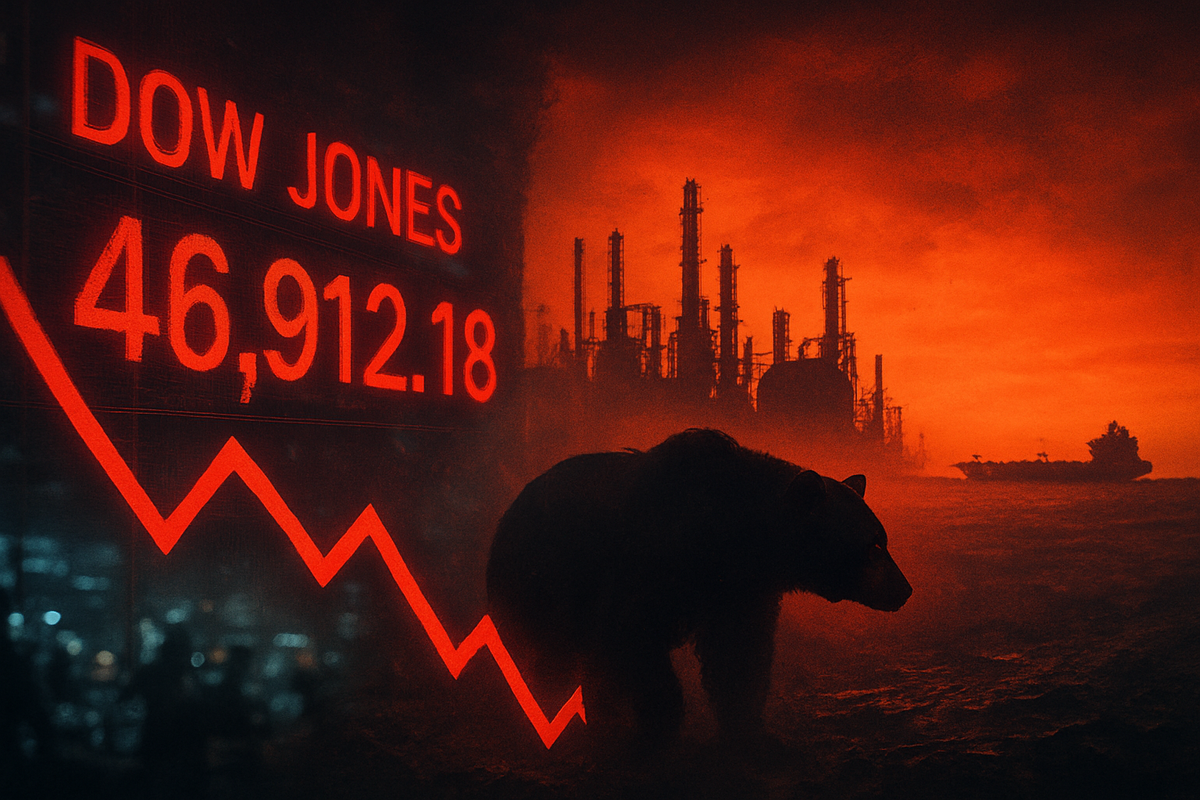
The Dow Jones Industrial Average (INDEXDJX: .DJI) plummeted on Friday, slicing through the psychologically significant 47,000 threshold to mark its lowest closing level of 2026. The blue-chip index fell 842 points, or 1.76%, to finish at 46,912.18, as investors reacted with alarm to a rapidly deteriorating geopolitical situation in the Middle East and a violent spike in crude oil prices that threatens to reignite global inflation.
The sell-off was broad and punishing, with 26 of the 30 Dow components ending the session in negative territory. Traders spent the day grappling with the reality of the "largest energy supply disruption in history," as the Strait of Hormuz remains effectively closed to tanker traffic following a series of military escalations. The sudden shift in market sentiment has effectively wiped out the year’s gains, leaving the index down nearly 6% since the start of January.
A Black Friday for the Blue Chips: The Path to 47,000
The slide below 47,000 was the culmination of a volatile two-week period that began in late February when long-simmering tensions between regional powers in the Middle East escalated into direct military confrontation. The flashpoint arrived on February 28, following targeted strikes against energy infrastructure that prompted a retaliatory blockade of the Strait of Hormuz. By the time the opening bell rang on March 13, 2026, Brent crude had already surged past $120 per barrel, a price level not seen in years, forcing a massive repricing of risk across every sector of the American economy.
The timeline of the day's decline was relentless. Institutional selling intensified during the mid-morning session as reports surfaced of further drone attacks on Saudi Arabian refineries, raising fears that the supply shock could last months rather than weeks. Key stakeholders, including the International Energy Agency (IEA) and the U.S. Department of Energy, have moved to release millions of barrels from strategic reserves, but the market viewed these measures as "temporary band-aids on a gaping wound," according to senior analysts at Goldman Sachs Group Inc. (NYSE: GS).
By the afternoon, the panic had spread from energy-sensitive sectors to the broader industrial and consumer bases. The Dow, which had struggled to hold the 47,500 level earlier in the week, saw support levels vanish as high-frequency trading algorithms triggered a cascade of sell orders. The closing bell served as a grim exclamation point to a week where the global energy security framework appeared to fracture in real-time.
Winners and Losers in a High-Oil World
In a session characterized by deep red across the board, the few "winners" were found exclusively in the energy and defense corridors. Chevron Corp. (NYSE: CVX) was one of the few Dow components to defy the downward trend, gaining 3.2% as crude prices skyrocketed. Outside of the Dow, smaller domestic shale producers saw even more dramatic gains, though the broader market remained skeptical that increased U.S. production could offset the loss of nearly 20% of the world’s daily oil supply.
Conversely, the list of losers was led by transport and consumer-heavy giants. Boeing Co. (NYSE: BA) fell 4.1% as investors feared a resurgence in fuel surcharges would cripple the rebound in international air travel. Similarly, Amazon.com Inc. (NASDAQ: AMZN) and Walmart Inc. (NYSE: WMT) saw their shares slide by 2.8% and 2.1% respectively, as the market braced for a "double-whammy" of rising logistics costs and a potential pullback in discretionary spending by consumers facing $6-per-gallon gasoline.
Tech heavyweights were not spared, despite their perceived distance from the oil fields. Microsoft Corp. (NASDAQ: MSFT) and Apple Inc. (NASDAQ: AAPL) both saw declines of over 1.5%, largely due to the broader "risk-off" environment and the rising yields in the bond market. As energy prices drive inflation expectations higher, the prospect of the Federal Reserve maintaining "higher for longer" interest rates has weighed heavily on the valuation of high-growth technology companies.
The Global Ripple Effect and Historical Echoes
The descent below 47,000 is more than just a technical milestone; it represents a significant shift in the 2026 economic narrative. For the past two years, the market had been operating under the assumption of a "soft landing" and a transition toward a greener economy. However, the current crisis serves as a stark reminder of the global economy's enduring dependence on fossil fuels and the fragility of maritime chokepoints. Analysts are already drawing parallels to the 1973 oil embargo, noting that the speed of the current price surge could trigger a similar period of stagflation if diplomatic efforts fail.
Beyond the immediate price action, the crisis has significant regulatory and policy implications. The Biden administration’s decision to release another 172 million barrels from the Strategic Petroleum Reserve has left the nation’s emergency stockpile at its lowest level in decades, sparking a fierce debate in Washington about energy independence and the pace of the EV transition. While companies like Nvidia Corp. (NASDAQ: NVDA) continue to lead the AI revolution, the current crisis suggests that even the most advanced digital economy can still be brought to its knees by a physical disruption in energy flows.
What Lies Ahead: Strategic Pivots and Market Resilience
As we look toward the remainder of 2026, the market’s trajectory will depend almost entirely on the de-escalation of hostilities in the Middle East. Short-term possibilities remain grim; if the Strait of Hormuz remains blocked, some analysts warn that WTI crude could test $150 per barrel, which would likely push the Dow toward the 45,000 mark. Investors are now watching for any sign of a diplomatic breakthrough or a coordinated OPEC+ production increase that could alleviate the supply crunch.
In the long term, this shock may accelerate a strategic pivot toward alternative energy sources. While the immediate pain is felt at the pump and in the DJIA ticker, the crisis provides a powerful incentive for corporations to insulate themselves from geopolitical volatility. We may see a surge in capital expenditure toward renewable energy and domestic nuclear projects, led by industrial stalwarts like Honeywell International Inc. (NASDAQ: HON) and Caterpillar Inc. (NYSE: CAT), who are already positioning themselves for a post-carbon infrastructure world.
Summary and Outlook for Investors
The fall of the Dow below 47,000 on March 13, 2026, marks a turning point for the year. The combination of geopolitical instability and a historic energy supply shock has broken the market’s momentum and forced a total reassessment of the inflationary landscape. With 26 of 30 components closing in the red, the message from the market is clear: the era of cheap energy is over, and the path to recovery will be arduous.
Moving forward, investors should keep a close eye on the Federal Reserve's rhetoric regarding inflation and the weekly inventory reports from the Department of Energy. While the current volatility is daunting, historical precedents suggest that these periods of geopolitical tension often create long-term entry points for disciplined investors. However, in the near term, caution is the order of the day as the world waits to see if diplomacy can reopen the global oil arteries before the economic damage becomes permanent.
This content is intended for informational purposes only and is not financial advice.