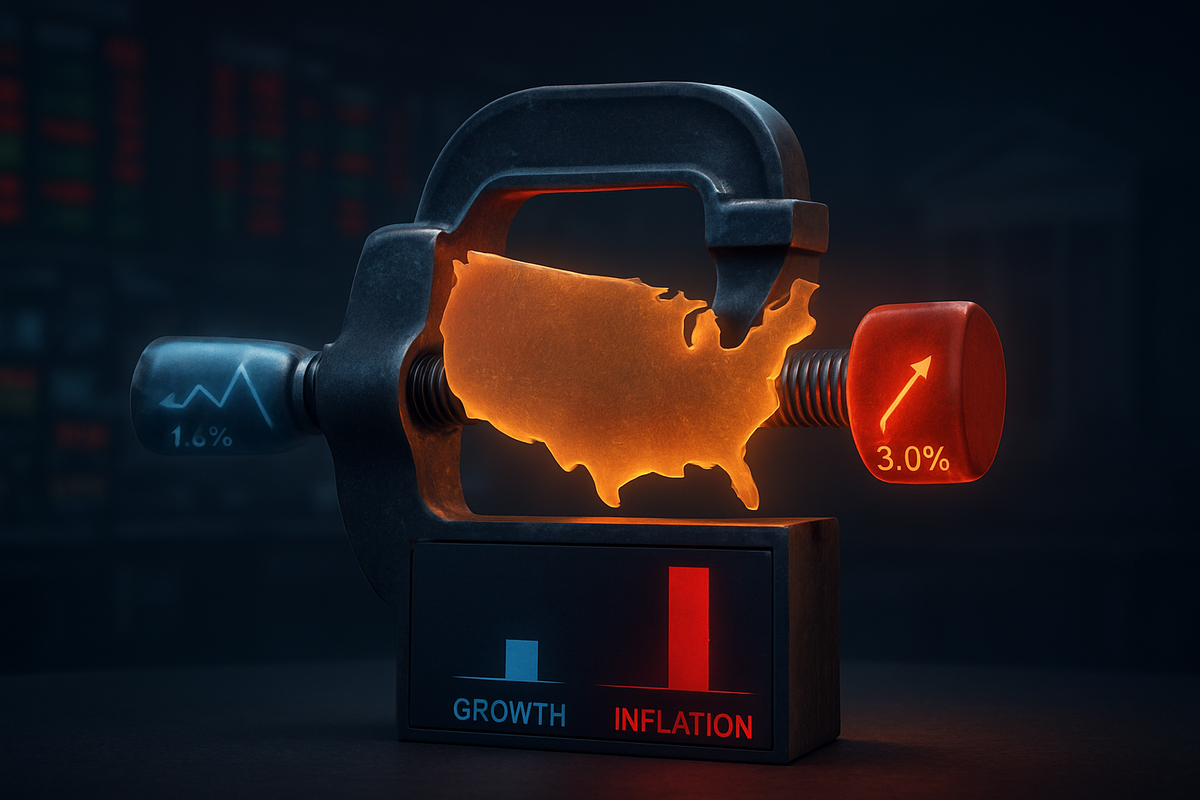
As of March 12, 2026, the U.S. financial landscape is grappling with a "stagflation" narrative that has fundamentally shifted market expectations for the year ahead. Recent data releases have presented a dual-threat scenario: Q4 2025 GDP growth sputtered to a meager 1.4%, significantly hamstrung by a record-breaking 43-day government shutdown, while Core Personal Consumption Expenditures (PCE) inflation—the Federal Reserve’s preferred metric—surprised to the upside at an annual rate of 3.0%.
This conflicting data has effectively slammed the brakes on hopes for an aggressive spring easing cycle. Investors who entered the year pricing in multiple rate cuts are now facing a "higher-for-longer" reality, as the Federal Reserve finds itself caught between a cooling economy that needs support and a sticky inflation profile that demands restrictive policy. The result has been a sharp repricing of assets across the board, from regional banks to high-flying technology growth stocks.
A Tale of Two Data Points: Shutdown Fallout and Price Persistence
The road to this moment began in late 2025 with the longest government shutdown in U.S. history, spanning from October 1 to November 12. The 43rd-day impasse not only stripped an estimated 1.5 percentage points from Q4 GDP but also created a "data fog" that blinded the Bureau of Economic Analysis (BEA) for weeks. When the final tallies were released in late February 2026, the 1.4% growth figure confirmed fears that the shutdown’s impact was deeper than a mere temporary blip; it revealed a consumer base that was beginning to buckle under the weight of sustained high interest rates.
Simultaneously, the inflation front offered no reprieve. The Core PCE print of 3.0% for the end of 2025, which remained stubborn into the first two months of 2026, shocked analysts who had projected a steady glide path toward the Fed's 2.0% target. Initial market reactions were swift and punishing. Upon the data's release, the 10-year Treasury yield surged as traders realized that Federal Reserve Chair Jerome Powell would be unable to justify a rate cut while price pressures remained a full point above target. The "Stagflation-lite" signals were further compounded by rising oil prices, which hovered near $120 per barrel in early March, further squeezing the industrial and consumer sectors.
Key stakeholders, including institutional giants like Goldman Sachs (NYSE: GS) and J.P. Morgan (NYSE: JPM), have since adjusted their models. The consensus has shifted from three to four rate cuts in 2026 to perhaps only one or two, with the first relief not expected until June at the earliest. This "hawkish pivot" has reignited concerns that the Fed may be forced to keep rates high even as the economy slows, increasing the risk of a "hard landing" later this year.
Winners and Losers in a Low-Growth, High-Inflation Era
The "Stagflation Vise" has created a clear divide in the equity markets. Among the hardest hit have been the regional banks, exemplified by the performance of Zions Bancorporation (NASDAQ: ZION) and Comerica Incorporated (NYSE: CMA). These institutions are facing severe Net Interest Margin (NIM) compression; they must pay higher rates to retain deposits in a "higher-for-longer" environment, yet the slowing economy and the 1.4% GDP growth have caused loan demand to stall. The KRE Regional Banking ETF plunged nearly 5% in the wake of the latest PCE data as fears of a renewed credit crunch resurfaced.
In the consumer sector, giants like Target Corporation (NYSE: TGT) and PepsiCo, Inc. (NASDAQ: PEP) are navigating a treacherous margin squeeze. While these companies have historically possessed strong pricing power, the combination of 3.0% core inflation and weak GDP suggests that the "limit" of price hikes may have been reached. With the shutdown-related data showing a decline in discretionary spending, these firms are struggling to pass on rising input costs and tariff-related expenses to a consumer whose real wages are being eroded.
Conversely, some pockets of the market have shown resilience. Cybersecurity firms like CrowdStrike Holdings, Inc. (NASDAQ: CRWD) have remained a relative bright spot. Even in a slowing economy, digital defense remains a non-discretionary expense for corporations, and the shift toward consolidated security platforms has insulated these stocks from the broader tech sell-off. Similarly, defensive sectors like Consumer Staples have seen a rotation of capital from investors seeking haven, though even these "safe" bets are being scrutinized for their exposure to rising commodity prices.
The Return of 1970s Paralysis?
The current economic backdrop has drawn inevitable and sobering comparisons to the 1970s. While the "Misery Index"—the sum of unemployment and inflation—is not yet at the double-digit heights of the Volcker era, the 2026 reading of approximately 7.3 has put historical precedents back on the table. Analysts at Yardeni Research have warned of a "1970s Redux" scenario where the Fed’s dual mandate becomes contradictory: the weak 1.4% GDP growth calls for a "dovish" stimulus, but the 3.0% Core PCE demands a "hawkish" stance.
This policy paralysis has significant ripple effects. Historically, stagflationary periods are the most challenging environments for traditional 60/40 portfolios, as both stocks and bonds can lose value simultaneously. The "data fog" from the 2025 government shutdown has also raised questions about regulatory policy and the reliability of government reporting. If the BEA’s imputed data for October and November misled the market about the strength of the economy, the subsequent correction in early 2026 may be just the beginning of a broader valuation reset.
Furthermore, the geopolitical environment—specifically the energy shock that has kept oil prices elevated—serves as a catalyst that the Fed cannot control with interest rates alone. This has led to calls for more aggressive supply-side policies, though the political gridlock following the record-length shutdown makes any significant legislative action unlikely in the short term.
What Lies Ahead: Strategic Pivots and Recession Odds
Looking forward to the remainder of 2026, the market is bracing for a period of extreme volatility. In the short term, the primary focus will be on the Q1 2026 GDP data, expected in late April. Investors are desperate to see if the 1.4% growth was a "shutdown fluke" or the start of a trend. If the Q1 numbers do not show a significant rebound, the narrative will shift from "higher-for-longer" to "recession-watch." Goldman Sachs has already raised its U.S. recession odds to 25%, citing the toxic mix of energy shocks and stalled growth.
For public companies, the strategic pivot is already underway. We expect to see a wave of cost-cutting measures and "efficiency" initiatives as firms prioritize margin protection over top-line growth. The "AI capex boom" that fueled the markets in 2024 and 2025 is also coming under intense scrutiny; if growth remains at 1.4%, the massive investments in artificial intelligence must begin showing tangible ROI to justify current valuations.
Market opportunities may emerge in "inflation-plus" assets—commodities, infrastructure, and high-yield cash-rich companies that can survive without frequent debt refinancing. However, the prevailing theme for 2026 is one of caution. The "Fed Put," or the idea that the central bank will always step in to save the market, is effectively off the table as long as PCE inflation remains anchored at 3.0%.
The Bottom Line for Investors
The combination of the 1.4% GDP print and the 3.0% Core PCE surprise has marked a turning point for the 2026 market. The optimism of early January has been replaced by a sober realization that the path to a "soft landing" is narrowing. The 43-day government shutdown may have been the catalyst for the growth slowdown, but the underlying inflation suggests that the economic "fever" has not yet broken.
Moving forward, investors should keep a close eye on the "Misery Index" and any signs of a cooling labor market. If unemployment begins to tick up alongside 3.0% inflation, the Federal Reserve will face its most difficult test in decades. For now, the "hawkish pivot" is the dominant force, and the market must learn to navigate an era where growth is scarce, but prices remain high.
This content is intended for informational purposes only and is not financial advice.