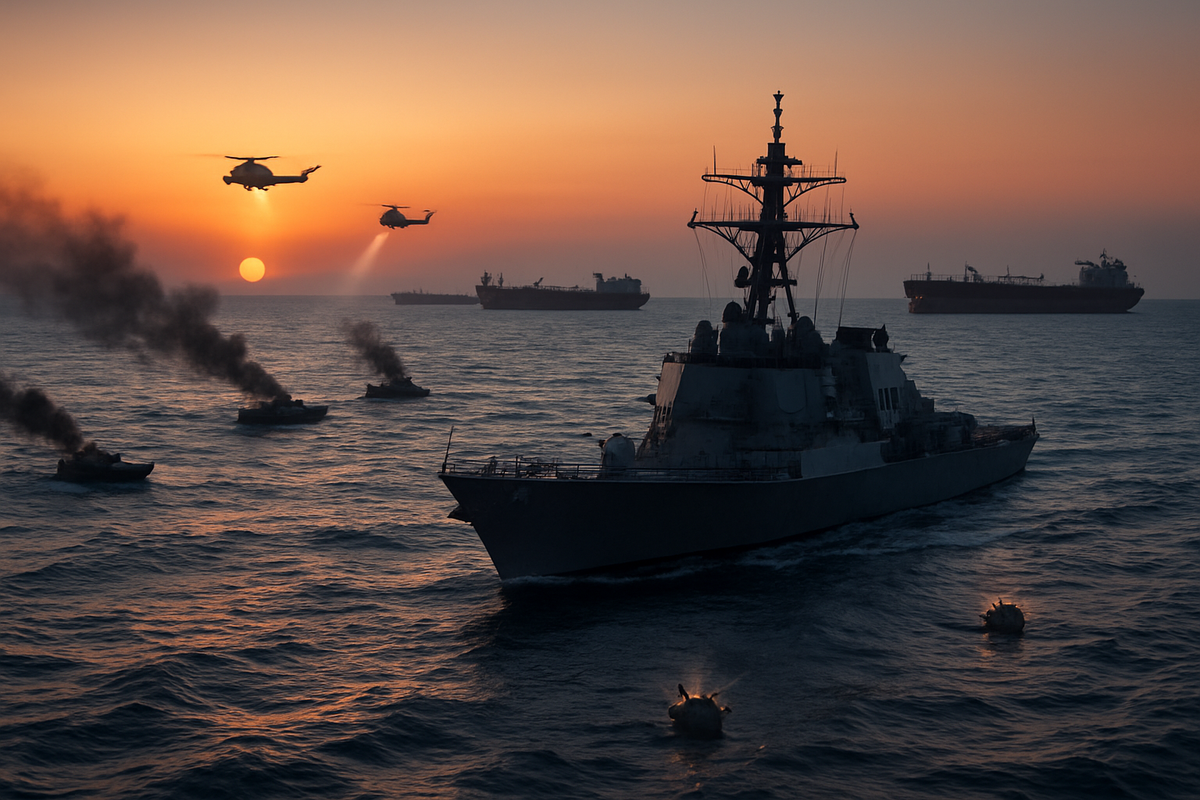
In a decisive escalation of maritime tensions, the US military has reported the successful elimination of 16 Iranian mine-laying vessels in the Strait of Hormuz overnight. The operation, confirmed by US Central Command (CENTCOM) early this morning, March 11, 2026, was launched to preempt a total blockade of the world’s most vital energy artery. While the kinetic engagement has neutralized the immediate threat of naval mines, the strategic waterway remains "effectively closed" to standard commercial traffic as the US Navy begins the arduous task of clearing remaining hazards and securing transit corridors.
The intervention has sent shockwaves through global markets, triggering extreme volatility in energy prices and a historic spike in maritime insurance costs. With approximately 20% of the world’s petroleum and liquefied natural gas (LNG) passing through this narrow passage, the military action marks the most significant direct confrontation in the region in decades, forcing investors and world leaders to grapple with the reality of a semi-permanent "War Risk" environment in the Persian Gulf.
A Night of Fire: The Battle for the Strait
The engagement on the night of March 10-11, 2026, followed a series of aggressive maneuvers by the Islamic Revolutionary Guard Corps (IRGC) to seed the Strait of Hormuz with sophisticated naval mines. According to Pentagon briefings, US naval assets and carrier-based aircraft targeted the Iranian flotilla after intelligence confirmed the vessels were actively deploying mines to enforce a blockade. This move by Tehran was seen as a retaliatory response to "Operation Epic Fury"—a large-scale US-Israeli preemptive strike on February 28, 2026, that targeted Iranian nuclear and military infrastructure following the ascension of Mojtaba Khamenei to the position of Supreme Leader.
The timeline leading to this morning’s strike has been one of rapid deterioration. On March 4, Tehran officially declared the Strait "closed," leading to a virtual standstill for over 1,000 commercial vessels currently idling in the Gulf of Oman. Before the US Navy intervened, at least ten commercial ships had already sustained damage from drone and missile attacks. The intervention was preceded by a final ultimatum from the White House, demanding the immediate cessation of mining activities. When Iranian forces persisted, the US military launched a coordinated strike that effectively dismantled Iran’s near-shore mine-laying capability.
Market reactions were immediate but complex. Earlier in the week, Brent crude prices surged past $126 per barrel as the threat of a complete blockade became real. However, following the US military success and a simultaneous announcement from the International Energy Agency (IEA) regarding a record release of 182 million barrels from emergency stockpiles, oil prices have seen a sharp "relief correction." As of midday March 11, Brent crude has retreated to approximately $88 per barrel, while West Texas Intermediate (WTI) is trading near $84. Despite this drop, the underlying risk remains high, as the "effective closure" of the Strait persists until mine-sweeping operations are completed.
Market Winners and Losers in a High-Stakes Conflict
The primary beneficiaries of the current escalation are the giants of the US defense industry. Shares of Lockheed Martin (NYSE: LMT), Northrop Grumman (NYSE: NOC), and RTX (NYSE: RTX) have all seen gains between 3% and 5% this week. Investors are betting on increased demand for maritime surveillance, missile defense systems, and precision-guided munitions as the US military prepares for a potentially prolonged escort mission in the Gulf. The success of carrier-based operations in this engagement has specifically highlighted the ongoing relevance of high-end naval platforms.
Conversely, the shipping industry is facing a crisis of astronomical proportions. War-risk insurance premiums for vessels transiting the Persian Gulf have jumped 12-fold, from 0.25% to 3.0% of a vessel’s value. For a Very Large Crude Carrier (VLCC) owned by companies like Frontline (NYSE: FRO) or Euronav (NYSE: EURN), the insurance cost for a single transit has ballooned to $7.5 million. While the Danish shipping giant Maersk (CPH: MAERSK-B) has diverted many of its container ships around the Cape of Good Hope, the added fuel costs and time delays are expected to weigh heavily on quarterly earnings across the logistics sector.
In the energy sector, the impact is bifurcated. While traditional oil majors like ExxonMobil (NYSE: XOM) and Chevron (NYSE: CVX) must navigate the physical disruption of their Middle Eastern supply chains, oil field service companies like SLB (NYSE: SLB) and Halliburton (NYSE: HAL) are seeing increased interest. Investors anticipate a renewed push for domestic US production and offshore projects in stable regions like Brazil, benefiting companies such as Petrobras (NYSE: PBR). These firms represent a "flight to safety" for capital that previously relied on the stability of Gulf exports.
Geopolitical Fallout and Historical Precedents
This intervention fits into a broader trend of "weaponized geography," where narrow maritime chokepoints become the primary levers of geopolitical influence. The 2026 crisis echoes the "Tanker War" of the 1980s, yet the scale of modern precision weaponry and the global reliance on just-in-time energy delivery make the current situation far more volatile. The failure of back-channel diplomacy in late 2025 paved the way for this confrontation, signaling a shift in US policy toward direct military enforcement of "freedom of navigation" in the face of unconventional threats like naval mining.
The regulatory and policy implications are profound. We are likely to see a permanent shift in how maritime insurance is structured for "High-Risk Areas," potentially involving government-backed re-insurance programs to prevent a total collapse of trade. Furthermore, the 2026 crisis has accelerated the debate over energy independence in the West. The massive IEA reserve release is a short-term bandage; the long-term policy response will likely involve accelerated investment in nuclear and renewable infrastructure to decouple global economies from the volatility of the Strait.
Furthermore, the involvement of the new Iranian leadership suggests a "nothing to lose" doctrine in Tehran. The shift from shadow warfare to overt mining operations marks a departure from previous decades of strategic ambiguity. For competitors and partners alike, this means that the "Middle East discount" on energy prices is likely a thing of the past, replaced by a permanent "security premium" that will be baked into global inflation expectations for the foreseeable future.
The Road Ahead: Escorts and Retaliation Risks
The immediate next step for the US Navy is the establishment of a formal escort program, likely titled "Operation Sentinel Guard." This will involve US destroyers and frigates providing direct protection for tankers, a move that will require significant naval resources and could leave other theaters, such as the South China Sea, with reduced coverage. For shipping companies, the transition to escorted convoys will mean slower transit times and continued logistical bottlenecks, but it may be the only way to restore the flow of oil to a hungry global market.
However, the risk of Iranian retaliation remains the primary "wild card." While their mine-laying fleet was hit hard, Tehran’s arsenal of land-based anti-ship missiles and "suicide" drone swarms remains largely intact. A secondary strike against regional oil infrastructure—such as refineries in Saudi Arabia or the UAE—could send prices back above the $120 mark regardless of IEA interventions. Strategic pivots by companies will likely include a permanent increase in inventory levels and a diversification of supply routes, including pipelines that bypass the Strait.
Summary: A New Paradigm for Global Trade
The US Navy’s intervention on March 11, 2026, has successfully prevented a total blockade of the Strait of Hormuz, but the victory comes at the cost of a permanently altered risk landscape. Key takeaways for investors include the continued dominance of defense contractors in an era of kinetic conflict and the extreme vulnerability of the global shipping and insurance sectors to geopolitical shocks. While the IEA’s reserve release has temporarily calmed the oil markets, the "effective closure" of the Strait remains a bottleneck that will take weeks, if not months, to fully resolve.
Moving forward, the market will be hyper-focused on two factors: the effectiveness of the US Navy’s upcoming escort program and the potential for a wider regional war involving Iran’s missile forces. Investors should watch for the quarterly earnings of major shipping lines to gauge the true impact of the insurance spike and keep a close eye on rig counts in the Permian Basin as US producers attempt to fill the Middle Eastern void. The Strait of Hormuz has long been a theoretical flashpoint; in March 2026, it became a very real battlefield, and the world’s economy will never be quite the same.
This content is intended for informational purposes only and is not financial advice