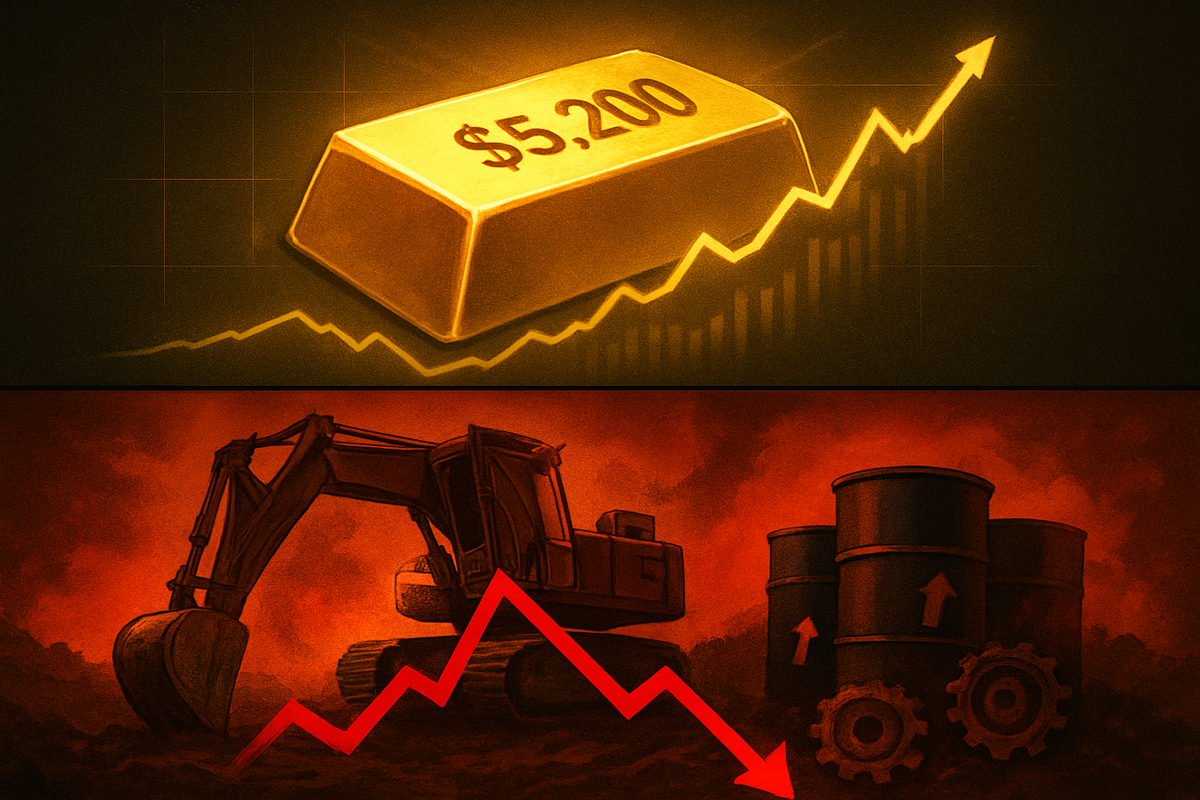
As the global financial markets grapple with a surge in geopolitical tensions and trade volatility, gold has once again asserted its dominance as the ultimate safe-haven asset. By March 11, 2026, the price of physical gold surged to a historic $5,200 per ounce, driving the SPDR Gold Shares (NYSEARCA:GLD) to unprecedented heights. However, a startling divergence has emerged that is leaving equity investors in the cold: while the metal itself glitters, the companies that pull it from the earth are losing their luster.
In a dramatic decoupling that has sent shockwaves through the precious metals sector, the VanEck Gold Miners ETF (NYSEARCA:GDX) plummeted 10.6% during the first week of March 2026. This sharp decline, mirrored by an even steeper drop in the VanEck Junior Gold Miners ETF (NYSEARCA:GDXJ), highlights a growing "margin trap" where record-high bullion prices are being aggressively cannibalized by soaring operational costs, inflationary royalties, and conservative production outlooks from the world’s largest producers.
The first week of March 2026 will likely be remembered as the moment the "Gold Supercycle" met the reality of the "Cost Supercycle." The divergence began in earnest following the February 28 military strikes in the Strait of Hormuz, which sent Brent crude prices spiraling toward $100 per barrel. While the geopolitical uncertainty provided a massive "safe-haven" bid for physical gold, it simultaneously spiked the cost of energy—a primary input for industrial-scale mining operations.
As trading opened on March 2, GDX sat at a peak of approximately $113.82. However, as the week progressed, a flurry of soft guidance reports and macro-economic headwinds began to weigh on the sector. By the close of business on March 6, the ETF had cratered to roughly $101.80, a 10.6% loss in just five trading sessions. During this same window, physical gold prices climbed by nearly 4%, creating a performance gap rarely seen in the history of the asset class.
Key stakeholders, including institutional fund managers who had rotated into miners for "operational leverage," were caught off guard. On March 4, the Federal Reserve added fuel to the fire by signaling that interest rates would remain elevated through the first half of 2026. This hawkish stance strengthened the U.S. Dollar and increased interest-related operational expenses for highly levered mining firms, further penalizing the high-beta GDX and GDXJ relative to the physical metal.
The primary catalyst for the mining rout has been the realization that "record prices" do not necessarily equal "record profits." Barrick Gold (NYSE: GOLD) served as a bellwether for the sector's struggles. In its recent guidance, Barrick projected a production trough for 2026, estimating between 2.90 and 3.25 million attributable ounces—a decrease from 2025 levels. This dip is largely attributed to essential but non-productive "waste stripping" at its tier-one sites. Compounding the volume issue, Barrick’s All-In Sustaining Costs (AISC) were guided significantly higher, ranging from $1,760 to $1,950 per ounce, as labor and consumable costs remain stubbornly high.
Agnico Eagle Mines (NYSE: AEM), often considered the most efficient operator in the space, has also seen its stock price pressured by the escalating cost of doing business. In its 2026 projections, Agnico Eagle noted that approximately 60% of its cash cost increase is directly tied to higher royalties. These royalty payments are often calculated as a percentage of the spot price; thus, as gold climbed toward $5,200, the payments Agnico must make to third-party holders scaled upward accordingly. With labor representing 45% of its cost structure, Agnico’s AISC forecast of $1,400 to $1,550 per ounce has raised fears that even the "gold standard" of miners is struggling to maintain its margins.
Smaller players in the GDXJ index have been hit even harder. Many junior miners, lacking the balance sheet strength of the majors, are facing a liquidity crunch as the cost of machinery parts and diesel fuel skyrockets. For these companies, the high price of gold is a double-edged sword: it increases the value of their reserves but makes the extraction of those reserves prohibitively expensive in the current inflationary environment.
This divergence is not merely a temporary market fluke but a reflection of deep-seated structural shifts in the mining industry. The 2026 "Great Tariff War" has significantly increased the cost of specialized mining equipment and consumables. As trade barriers rise, the global supply chain for heavy machinery has become fragmented, leading to longer lead times and higher capital expenditures for miners trying to maintain or expand production.
Furthermore, the industry is battling a long-term decline in ore grades. In 2026, average gold ore grades have fallen below 1.1 grams per tonne (g/t). This means companies must process more rock and consume more energy to produce the same ounce of gold they did a decade ago. This "grade degradation" effectively raises the floor for gold prices required for miners to break even, making them more sensitive to cost shocks than ever before.
Historically, gold miners were viewed as a leveraged play on the price of gold—a 1% move in the metal might lead to a 2% or 3% move in the stocks. However, the current environment has inverted this relationship. The leverage is now working to the downside as the exponential rise in variable costs (energy, royalties, and labor) outpaces the appreciation of the underlying asset. This shift could force a massive reallocation of capital away from mining equities and toward physical bullion or synthetic ETFs like GLD.
In the short term, mining companies are likely to prioritize "value over volume." Investors should expect more firms to follow the lead of Barrick Gold by focusing on high-margin, tier-one assets while divesting or shuttering high-cost, marginal operations. There is also growing chatter in the market regarding the potential IPO of Barrick’s North American assets later in 2026, a move aimed at unlocking value and providing a "pure play" for investors seeking exposure to more stable jurisdictions.
In the long term, the industry must embrace radical technological shifts to survive the margin trap. Automation and the electrification of mining fleets could help mitigate rising labor and energy costs, but these transitions require significant upfront capital—something many mid-tier miners may struggle to secure if their stock prices continue to underperform. The market may also see a wave of consolidation, as larger companies with stronger cash flows look to acquire distressed junior miners with high-quality deposits.
The primary risk moving forward is a potential "mean reversion" in gold prices. If geopolitical tensions ease and bullion prices drop while operational costs remain "sticky," the mining sector could face a catastrophic earnings crunch. Conversely, if gold continues its ascent toward $6,000, the sheer scale of the revenue increase might finally overcome the cost barriers, leading to a massive "catch-up" trade for the GDX and GDXJ.
The events of early March 2026 have redefined the relationship between gold and the companies that mine it. The 10.6% drop in GDX against a backdrop of record-high bullion prices serves as a stark warning: operational leverage is a two-way street. For investors, the takeaway is clear—owning the metal is not the same as owning the business. Rising royalties, as seen with Agnico Eagle, and conservative production targets from giants like Barrick, have fundamentally altered the risk-reward profile of the sector.
Moving forward, the market will be closely watching for any signs of cooling inflation or a de-escalation in global trade conflicts, both of which could provide relief to the miners' bottom lines. However, until the industry can prove it can translate $5,000+ gold into consistent, growing free cash flow, the performance gap between GLD and its mining counterparts is likely to persist.
Investors should maintain a high degree of selectivity, focusing on companies with "royalty-light" portfolios and those with the technological capability to combat declining ore grades. The golden age of mining may still arrive, but for now, the industry is trapped in a race where the finish line—profitability—keeps moving further away.
This content is intended for informational purposes only and is not financial advice