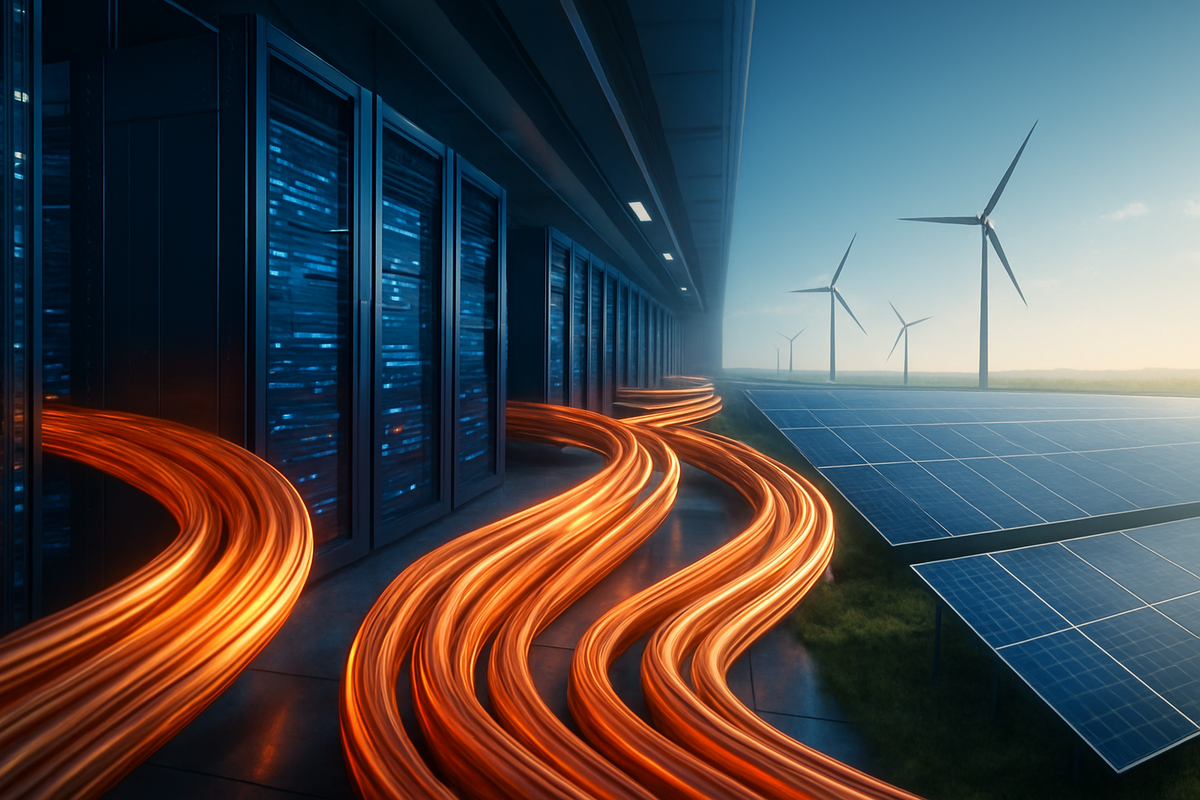
As of March 11, 2026, the global copper market has entered a transformative era, with prices for the industrial metal surging to levels that have caught even veteran analysts by surprise. Often referred to as "Dr. Copper" for its perceived ability to diagnose the health of the global economy, the metal is currently signaling a profound structural shift rather than a standard cyclical recovery. Trading near $13,500 per metric ton on the London Metal Exchange, copper is no longer just a gauge of industrial output; it has become the fundamental bedrock of the dual-engine global expansion: the green energy transition and the artificial intelligence (AI) revolution.
The immediate implications of this price surge are being felt across the manufacturing and technology sectors. While traditional demand from the Chinese property market remains subdued, the insatiable appetite for copper in electric vehicle (EV) production, high-density power grids, and hyperscale AI data centers has pushed the market into a structural deficit. For the first time in decades, the "Dr. Copper" diagnosis suggests that while the broader global GDP growth might be modest, the specific sectors driving the future—electrification and digital infrastructure—are in a period of unprecedented, high-voltage growth.
The Path to a Structural Deficit: A Timeline of Scarcity
The rally observed in early 2026 is the culmination of a series of supply-side shocks and demand-side surges that began in late 2024. In the final quarter of 2025, a significant production disruption at the Grasberg mine in Indonesia, operated by Freeport-McMoRan Inc. (NYSE: FCX), removed a substantial portion of global supply from the market at a critical juncture. Simultaneously, the Kamoa-Kakula project in the Democratic Republic of Congo faced logistics bottlenecks that slowed the delivery of refined cathodes to international markets. These "unplanned" supply hits occurred just as global inventories were at historic lows, creating a perfect storm for the price spike seen in January 2026, when the metal hit an all-time intraday high of $14,527 per metric ton.
Central to this narrative are the "hyperscalers"—tech giants building the infrastructure for the AI age. Throughout 2025 and into 2026, the demand for high-performance data centers has grown exponentially. These facilities require three to four times more copper than traditional data centers to manage massive power distribution and advanced cooling systems. This "new" demand source, projected to reach nearly 475,000 tons annually by the end of this year, has effectively decoupled copper prices from their traditional reliance on the residential construction cycle.
The stakeholders involved in this market have also shifted. While traditional industrial buyers in China still command over 50% of global consumption, their influence is being rivaled by government-backed grid modernization projects in North America and Europe. These public-private partnerships, aimed at updating aging electrical infrastructure to support renewable energy, have become a "price-insensitive" floor for the market. Initial industry reactions to these high prices have been mixed; while miners are reporting record-breaking margins, manufacturers of consumer electronics and appliances are beginning to warn of "greenflation" as the cost of raw materials is passed down to the end-user.
Winners and Losers in the High-Voltage Era
The primary beneficiaries of this environment are the diversified mining giants with significant copper exposure. BHP Group Limited (NYSE: BHP) has emerged as a clear leader, with copper officially becoming its largest earnings driver in the first quarter of 2026, accounting for over 51% of its underlying EBITDA. BHP’s decision to boost guidance at its Escondida mine in Chile has allowed it to capture the premium prices effectively. Similarly, Southern Copper Corporation (NYSE: SCCO) remains a favorite among investors due to its vast reserves and a multi-billion-dollar expansion plan aimed at increasing production capacity by the early 2030s, even as it navigates declining ore grades in its Peruvian operations.
Conversely, Freeport-McMoRan Inc. (NYSE: FCX) has faced a more volatile path. While the company stands to gain massively from the current price environment, the late-2025 disruptions at Grasberg have forced a period of remediation. Although a phased restart is underway as of March 2026, the company’s short-term output has lagged behind its peers, making it a "recovery play" for those betting on its dominant 9% global market share. Other players like Rio Tinto Group (NYSE: RIO) and Antofagasta plc (LSE: ANTO) are also seeing windfall profits, though they face increasing pressure from "resource nationalism" in regions like South America and Africa, where local governments are seeking higher royalties on the "new gold."
The "losers" in this scenario are the industries that rely on copper for non-essential or price-sensitive applications. Small-scale EV startups, already struggling with thin margins, are finding the rising cost of copper wiring and battery components a major headwind. Likewise, the traditional housing sector—already under pressure from high interest rates—is seeing the cost of electrical and plumbing installations rise significantly, further cooling the demand for new residential construction in both the United States and China.
Redefining the 'Wiring of the Energy Transition'
The current state of the copper market fits into a much larger industrial trend: the transition from a fuel-intensive to a material-intensive energy system. Historically, a rise in copper prices signaled that a general economic boom was underway. Today, the signal is more focused. The metal is being called the "wiring of the energy transition" because it is irreplaceable in the transition to renewables. Solar and wind projects require four to six times more copper per unit of energy produced than coal or gas-fired plants. This shift represents a permanent increase in the "intensity of use" for copper, a trend that is unlikely to reverse regardless of short-term economic fluctuations.
This decoupling from traditional cycles is most evident in China. While the Chinese property market continues to struggle, the country’s dominance in "new three" industries—EVs, lithium-ion batteries, and solar—has kept its manufacturing sector in expansion territory. This suggests that the global economy is bifurcating; while the old economy of brick-and-mortar construction slows, the new economy of electrification and digital intelligence is accelerating. This has significant policy implications, as Western nations scramble to secure domestic supply chains for copper, increasingly viewing the metal as a matter of national security rather than just a commodity.
The historical precedent for this may be the oil shocks of the 1970s, which forced a global rethink of energy security. In 2026, we are seeing a "copper shock" that is forcing a similar rethink. Regulatory bodies are fast-tracking mining permits, and there is a renewed push for "urban mining" or copper recycling. However, with it taking an average of 10 to 15 years to bring a new mine from discovery to production, the structural deficit is a problem that cannot be solved by policy alone in the short term.
The Road Ahead: Scarcity and Strategy
In the short term, the market remains on high alert for further supply disruptions. With the global surplus fully exhausted, any labor strike in Chile or geopolitical tension in the DRC could send prices toward the $15,000 mark. Companies are expected to pivot their strategies toward "substitution" and "thrift," looking for ways to use less copper or replace it with aluminum where possible. However, aluminum’s lower conductivity and different physical properties make it a poor substitute in high-performance applications like AI chips or EV motors, limiting the impact of this trend.
Long-term, the market is facing a "looming gap" between supply and demand that some analysts estimate could reach 5 million tons by 2030. This creates a massive market opportunity for junior miners and exploration companies, but also a challenge for global decarbonization goals. If copper remains too expensive or too scarce, the pace of the global energy transition could slow, creating a paradoxical situation where the very material needed to save the climate becomes its primary bottleneck. Strategic partnerships between tech giants and mining firms—where companies like Microsoft or Google might directly invest in copper mines to secure their AI future—are no longer far-fetched scenarios but are actively being discussed in boardrooms.
Conclusion: A Barometer for a New Era
The performance of copper in early 2026 confirms that the metal has successfully transitioned from a cyclical industrial commodity to a strategic asset of the highest order. The "Dr. Copper" of old has been replaced by an "Electrification and AI Barometer." The key takeaway for the market is that the current high prices are not a bubble, but a reflection of a fundamental scarcity in the materials required for the 21st-century economy.
Moving forward, the market will likely remain in a high-floor, high-volatility environment. Investors should keep a close eye on mining productivity reports from companies like BHP Group Limited and Freeport-McMoRan Inc., as well as the pace of data center expansion in North America. While the risks of "greenflation" and supply-chain nationalism are real, the underlying demand driven by the global transition to a cleaner, more digital world suggests that copper’s reign at the top of the commodities ladder is only just beginning.
This content is intended for informational purposes only and is not financial advice.