As the middle of March 2026 approaches, investors are bracing for a week of "March Madness" that has nothing to do with basketball and everything to do with the future of the global economy. With the Consumer Price Index (CPI) report for February 2026 scheduled for release tomorrow, March 11, and two of the year’s most pivotal industry gatherings—the Nvidia GTC and a series of major energy summits—set to kick off next Monday, the market is standing at a critical crossroads. The convergence of persistent energy-driven inflation and the next evolutionary leap in Artificial Intelligence (AI) is creating a volatile cocktail that will likely dictate the market's trajectory through the first half of the year.
The Triple Threat: CPI, Chips, and Crude
The immediate focus for the trading floor is tomorrow’s CPI print. After a period of relative stability, headline inflation has recently flirted with the 2.5% mark, driven largely by a dramatic surge in Brent crude oil prices, which have climbed above $100 per barrel following renewed geopolitical friction in the Middle East. Market participants are looking to see if the Federal Reserve, currently maintaining a funds rate of 3.50%–3.75%, will be forced to hold rates higher for longer or if the "soft landing" narrative remains intact.
Following the data dump, the spotlight shifts to San Jose and Houston. On Monday, March 16, Nvidia Corporation (NASDAQ: NVDA) will begin its annual GPU Technology Conference (GTC). This year’s event is being hailed as the "Inference Era" debut, where CEO Jensen Huang is expected to detail the "Rubin" architecture and provide a roadmap for "Agentic AI"—autonomous systems capable of reasoning and executing complex workflows without human intervention. Simultaneously, the energy sector will gather for the AMPP Annual Conference and the Utah Petroleum Association Annual Meeting (March 16-17). These meetings are taking on newfound importance as the massive power requirements of AI "Giga-factories" begin to collide with a strained global energy grid and fluctuating oil supplies.
Titans of Tech and Energy in the Crosshairs
The primary beneficiary of the upcoming week remains Nvidia (NASDAQ: NVDA), whose dominance in the AI hardware space is being tested by the market’s appetite for its new Rubin chips. However, the ripple effects extend to its primary manufacturing partner, Taiwan Semiconductor Manufacturing Co. (NYSE: TSM), as investors look for clues on the feasibility of the 1.6nm "A16" process required for future architectures. Infrastructure players like Super Micro Computer, Inc. (NASDAQ: SMCI) and Vertiv Holdings Co (NYSE: VRT) are also in focus, as the shift toward liquid cooling and high-density AI data centers becomes a mandatory pivot for the industry.
On the energy front, the sudden spike in crude prices has revitalized the outlook for Exxon Mobil Corporation (NYSE: XOM) and Chevron Corporation (NYSE: CVX). These companies are no longer just oil plays; they are increasingly viewed as the essential backbone for the AI revolution. Analysts expect the energy summits to highlight "AI-for-Oil" partnerships, where Big Tech firms like Microsoft Corporation (NASDAQ: MSFT) and Alphabet Inc. (NASDAQ: GOOGL) collaborate with energy giants to optimize carbon capture and grid stability, ensuring that the AI boom doesn't run out of fuel.
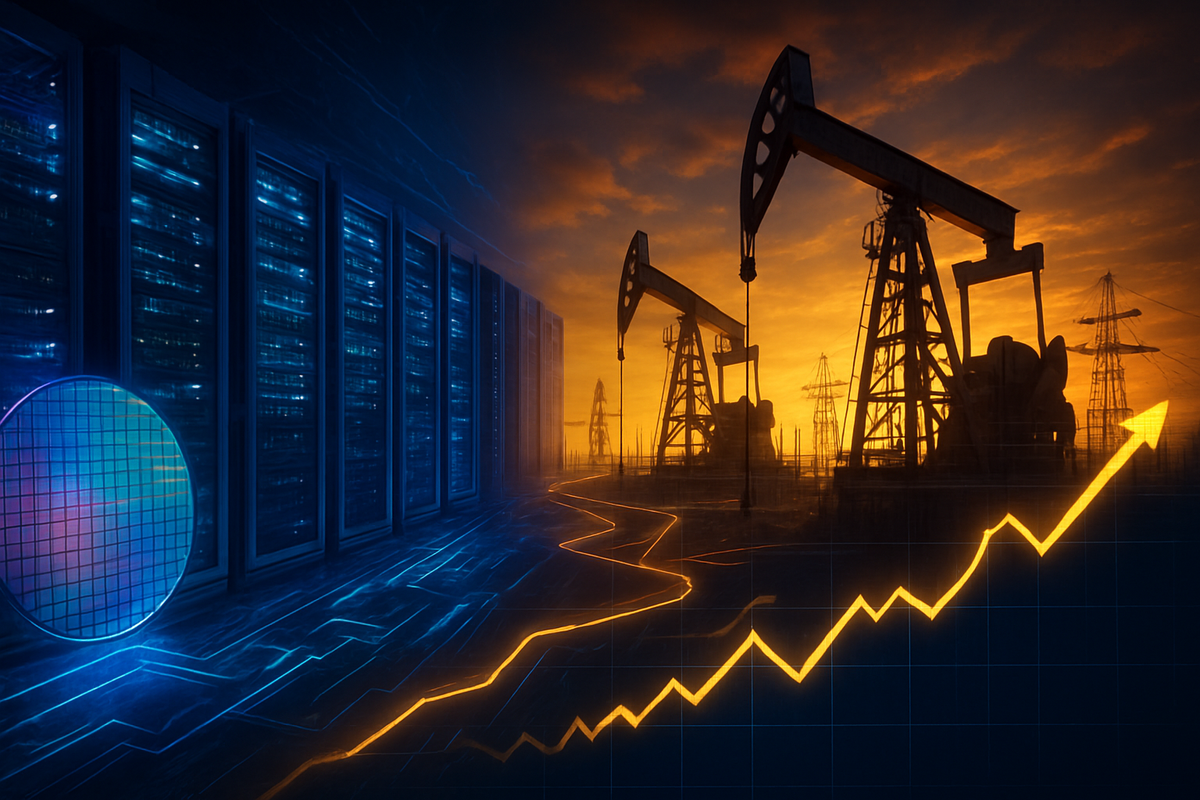
A Convergence of Two Eras: Silicon and Carbon
This week’s events underscore a broader shift in the market's thematic focus. For much of 2024 and 2025, tech and energy were often seen as opposing ends of the ESG spectrum. In 2026, they are becoming inextricably linked. The "AI Capex Boom," which is projected to reach nearly $500 billion this year, is now hitting a physical wall: power availability. The energy conferences on March 16-17 will likely address how the One Big Beautiful Bill Act (OBBBA)—the landmark 2025 legislation that incentivized domestic energy production and high-tech manufacturing—is being implemented to bridge this gap.
Historically, March has often been a month of transition, but the stakes in 2026 feel higher. We are seeing a "re-coupling" of inflation and energy that echoes the volatility of the 1970s, yet it is layered over a technological revolution that promises unprecedented productivity gains. This creates a "bifurcated" market where tech companies with strong pricing power and energy companies with vast reserves are the only safe harbors from the "sticky" services inflation that has kept the Federal Reserve on high alert.
Navigating the Volatility: What Lies Ahead
In the short term, the market's "March Madness" will likely lead to a period of heightened price discovery. If tomorrow's CPI data comes in hotter than the expected 2.4%, we could see a sharp rotation out of growth stocks as the 10-year Treasury yield moves back toward 4.5%. Conversely, a cool print combined with a visionary keynote from Nvidia on March 16 could propel the S&P 500 toward the elusive 7,500 level by mid-summer.
Long-term, the strategic pivot for corporations will be "efficiency at scale." Companies that cannot solve their own energy needs or leverage Agentic AI to reduce labor costs may find themselves sidelined in an environment where capital remains expensive. We expect a wave of "power-purchase agreements" between data center operators and nuclear or natural gas providers to be the next major trend emerging from the Houston energy meetings.
The Wrap-Up: An Investor’s Playbook
As we stand on the eve of this pivotal week, the key takeaway is that the "AI trade" is no longer just about software and chips—it is about the physical infrastructure and the macro-economic environment that sustains it. The convergence of the GTC conference and the major energy summits marks the beginning of a new chapter where silicon and carbon must coexist to drive growth.
Investors should maintain a balanced posture, keeping a close eye on the 8:30 a.m. ET CPI release tomorrow. Watch for Nvidia’s commentary on "Agentic AI" as a sign of the next software cycle, and monitor the Houston conferences for any shifts in domestic energy policy or supply forecasts. While the "Madness" of March 2026 may bring volatility, it also offers a rare moment of clarity for those looking to identify the leaders of the next market cycle.
This content is intended for informational purposes only and is not financial advice.