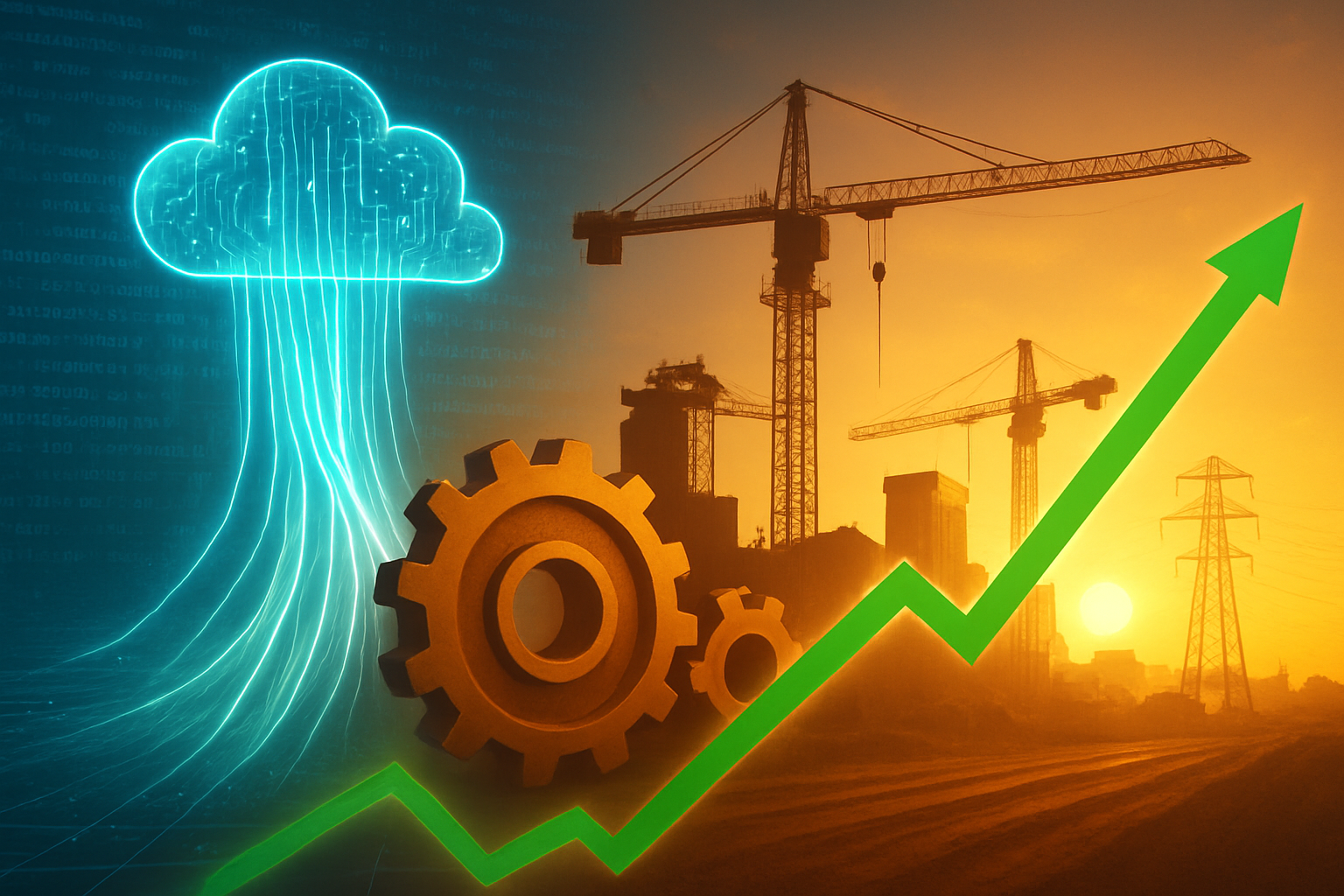
As of February 6, 2026, the dominant narrative on Wall Street has shifted from the virtual to the tangible. After years of dominance by Silicon Valley’s software giants, a powerful "Great Rotation" is underway, with institutional capital aggressively migrating toward the backbone of the physical economy. Investors are increasingly swapping overstretched valuations in the technology sector for the reliable cash flows and secular growth stories found in Energy, Industrials, and Consumer Staples.
This tectonic shift is fundamentally redefining market leadership. While the high-flying "Magnificent Seven" and their AI-adjacent peers face a "valuation reset" driven by skepticism over artificial intelligence returns, the "S&P 493"—the broader market that sat in the shadows for much of 2024 and 2025—is finally having its moment. The immediate implication is a more balanced, albeit more volatile, market where "Physical Reality" stocks are the primary engines of portfolio alpha.
The Great Rebalancing: Unpacking the 2026 Rotation
The market environment in early 2026 is defined by what analysts call "AI Creative Destruction." Throughout late 2025, the initial euphoria surrounding large language models began to sour as major software-as-a-service (SaaS) providers struggled to prove that AI could generate net-new revenue rather than simply cannibalizing existing seat-based subscription models. This "Software Meltdown" has seen companies like Salesforce (NYSE: CRM) and Adobe (NASDAQ: ADBE) experience significant valuation contractions as autonomous "AI agents" threaten to automate the very tasks their software was designed to facilitate.
The timeline leading to this moment began in the fourth quarter of 2025, when earnings growth for mega-cap tech began to decelerate from 30% plus to the high teens. Simultaneously, the passage of the "One Big Beautiful Bill Act" (OBBBA) in late 2025 provided a massive fiscal tailwind for domestic manufacturing and infrastructure. By January 2026, the rotation was in full swing, with the S&P 500's Industrials and Energy sectors reaching record highs while the Nasdaq Composite struggled to maintain its 2025 gains.
Market participants are also navigating a shifting Federal Reserve. Following the January 2026 meeting, the Fed held the target range at 3.50%–3.75%, signaling a "patient but accommodative" stance. However, the looming departure of Chair Jerome Powell in May 2026 and the nomination of Kevin Warsh have introduced the "Warsh Effect." Markets are already front-loading expectations of a Fed that favors real assets and industrial productivity over the "cheap money" era that fueled the tech bubble of the early 2020s.
Winners and Losers of the New Paradigm
In this new regime, the clear winners are the companies providing the "shovels and power" for the AI era. Industrials have emerged as a top-performing sector, led by Caterpillar (NYSE: CAT), which has seen surging demand for heavy machinery required for data center construction and domestic infrastructure. Vertiv Holdings (NYSE: VRT) and Eaton (NYSE: ETN) have also become institutional darlings, as their cooling and power management systems are essential for the next generation of liquid-cooled AI server farms.
The Energy sector has undergone a radical transformation, pivoting from a "dead" sector to a "growth" sector. As AI data centers demand unprecedented levels of electricity, natural gas and nuclear power have taken center stage. Cheniere Energy (NYSE: LNG) and EQT Corp (NYSE: EQT) are benefiting from the demand for gas as a "bridge fuel," while Constellation Energy (NASDAQ: CEG) and Centrus Energy (NYSE: LEU) have soared on the back of a nuclear energy revival. Even traditional refiners like Valero (NYSE: VLO) and Marathon Petroleum (NYSE: MPC) are seeing renewed interest due to their consistent cash flows and high dividend yields.
Conversely, the "losers" of 2026 are found among the previous decade's software darlings. Beyond the aforementioned SaaS giants, companies like ServiceNow (NYSE: NOW), Intuit (NASDAQ: INTU), and Workday (NASDAQ: WDAY) are facing intense scrutiny. Investors are no longer willing to pay 30 or 40 times earnings for growth that is increasingly perceived as vulnerable to AI-led automation. Even the hardware king, NVIDIA (NASDAQ: NVDA), while still massively profitable, has seen its stock consolidate as the market waits for the next phase of enterprise-wide AI implementation to justify its trillion-dollar valuation.
Macroeconomic Drivers and Historical Context
This rotation is not merely a technical correction but a reflection of a "run it hot" macroeconomic scenario. Real GDP growth for 2026 is currently projected at 4% or higher, far exceeding earlier consensus estimates. This expansion is being driven by the "reshoring" of manufacturing to U.S. soil, a trend that has turned the Materials sector—particularly copper and steel—into a high-growth play. Freeport-McMoRan (NYSE: FCX) and Nucor (NYSE: NUE) are trading at multi-year highs as copper scarcity becomes a major bottleneck for power grid modernization.
Historically, this period draws comparisons to the post-dotcom era of the early 2000s, where a decade of tech dominance gave way to a multi-year bull market in commodities and industrials. However, the 2026 version is unique because it is fueled by the very technology that it is rotating away from. The "AI Infrastructure" requirement is creating a feedback loop where the digital world's expansion is fundamentally dependent on the physical world's capacity.
Furthermore, the "Consumer Staples" sector, represented by the likes of Walmart (NYSE: WMT) and Costco (NASDAQ: COST), is acting as a "defensive hybrid." These companies have successfully integrated AI into their supply chains to lower costs, making them attractive to investors looking for stability in an inflationary environment. Unlike the tech giants, these firms offer "physical reality" value that remains insulated from the threat of digital cannibalization.
The Path Ahead: Strategies for a Cyclical Market
As we look toward the remainder of 2026, the primary challenge for investors will be navigating the transition from growth-at-any-price to value-at-a-reasonable-price. In the short term, the market will likely remain fixated on the Federal Reserve’s leadership transition in May. A more "hawkish" or "real-asset-centric" Fed under a potential Warsh chairmanship could further accelerate the flow of capital out of high-multiple growth stocks and into cyclical sectors.
Long-term, tech companies will be forced to undergo strategic pivots. We are likely to see a wave of consolidation in the SaaS space as larger platforms acquire smaller, specialized AI agents to defend their market share. For the "Old Economy" winners, the challenge will be managing the "Capex supercycle." Companies like GE Vernova (NYSE: GEV) and Quanta Services (NYSE: PWR) must scale rapidly to meet the grid-hardening needs of the 21st century without overextending their balance sheets.
Market opportunities will also emerge in niche areas like uranium and specialty materials. As the global race for energy sovereignty intensifies, the "physicality" of the trade will become even more pronounced. Investors should expect a "cyclical bull market" where earnings growth is more evenly distributed across the 11 sectors of the S&P 500, rather than concentrated in a handful of West Coast technology firms.
A New Chapter for Wall Street
The Great Rotation of 2026 marks the end of an era. The days when a few software companies could carry the entire market on their shoulders are over. In its place is a more robust, industrialized market that reflects the necessity of rebuilding the physical world to support the digital one. The "S&P 493" is no longer an afterthought; it is the driver of performance.
Moving forward, the market is likely to reward companies that possess tangible assets, pricing power, and essential roles in the global supply chain. For investors, the takeaway is clear: diversification is no longer just a risk-management strategy; it is a prerequisite for growth in a world where the "Old Economy" is new again.
In the coming months, keep a close eye on the "AI ROI" metrics during earnings season. If software companies continue to report lackluster results while Industrials and Energy firms post record profits, the rotation will only intensify. The 2026 market is proving that while software may eat the world, it still needs a physical plate to sit on.
This content is intended for informational purposes only and is not financial advice.