On January 28, 2026, Microsoft Corp. (NASDAQ: MSFT) released its calendar year-end financial results, delivering a performance that, on paper, should have been a triumph. The tech giant reported record quarterly revenue of $81.3 billion and earnings per share of $4.14, handily beating analyst estimates. However, the market’s reaction was swift and unforgiving: the stock plummeted as much as 11%, erasing nearly $400 billion in market capitalization. The catalyst for this massive sell-off was not a lack of profit, but a staggering $37.5 billion quarterly capital expenditure bill—a 66% year-over-year increase that has forced investors to reconsider the "spend now, profit later" mantra of the generative AI era.
Despite the top-line beat, the underlying narrative shifted from growth potential to capital efficiency. Microsoft’s Azure cloud division posted a 39% revenue increase, which, while robust, represented a slight deceleration from the 40% growth seen in the previous quarter and fell short of the "whisper numbers" exceeding 41% that high-growth investors had banked on. This narrow miss, coupled with the realization that Microsoft is now on an annualized spending run rate of $150 billion, sparked fears that the company is pouring money into a black hole of infrastructure without a clear, immediate acceleration in returns.
A Record-Breaking Spending Spree Meets the 'Power Grid Wall'
The timeline leading to this pivotal moment began with the massive integration of OpenAI’s models across Microsoft’s stack, a move that initially catapulted the company to the top of the AI hierarchy. Throughout 2025, Microsoft aggressively expanded its data center footprint, but the Q2 FY2026 results (covering the final calendar quarter of 2025) revealed the sheer scale of the investment. Of the $37.5 billion spent, CFO Amy Hood clarified that roughly two-thirds was dedicated to short-lived assets—primarily high-end GPUs and CPUs—rather than long-term real estate. This massive hardware injection was intended to meet what CEO Satya Nadella described as "extraordinarily high" demand, yet the company admitted it is still supply-constrained.
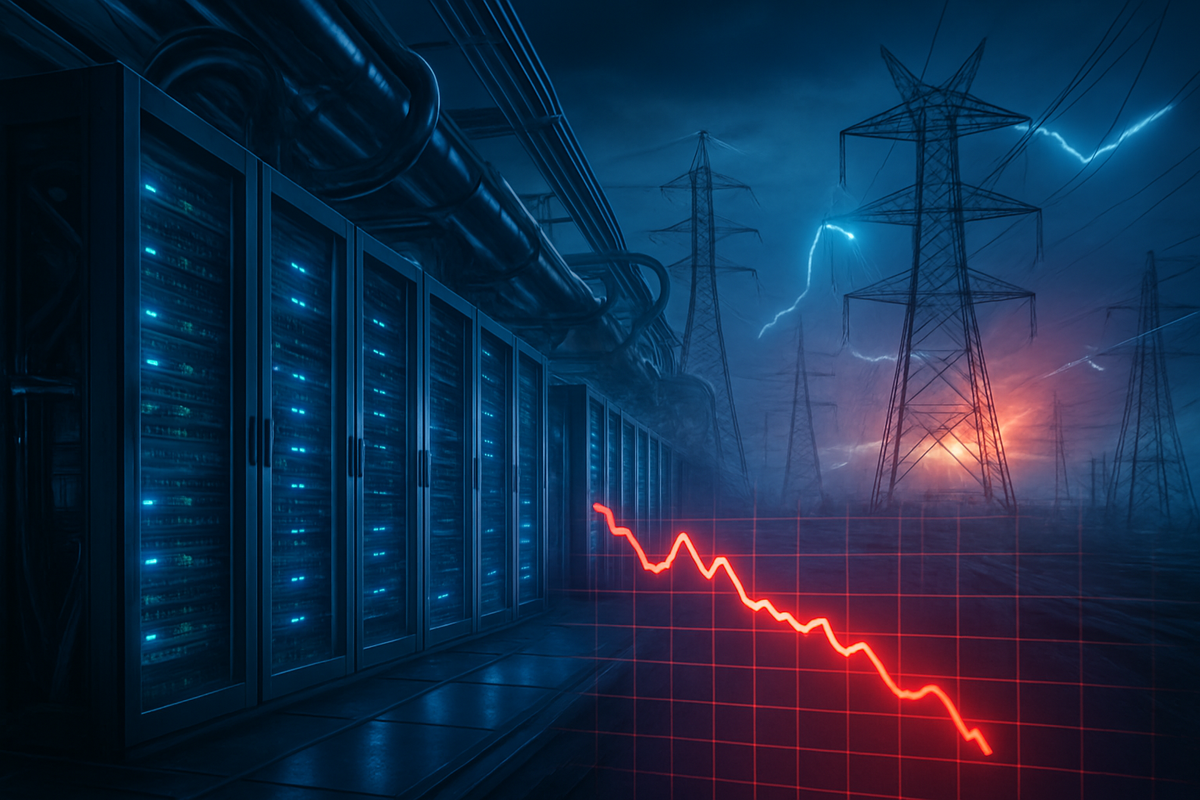
The most jarring revelation from the earnings call was the emergence of the "Power Grid Wall." Nadella told analysts that the primary bottleneck for AI deployment has shifted from a shortage of silicon to a shortage of electricity. He noted that Microsoft added nearly one gigawatt of capacity in the quarter but conceded that "if you can't plug [the chips] in, you have a bunch of inventory sitting in a warehouse." This admission suggests that even with $150 billion in annual spending, Microsoft’s growth is at the mercy of an aging electrical grid, a reality that deeply unsettled investors looking for a clear path to continued cloud acceleration.
Winners and Losers: The Shifting AI Supply Chain
The fallout from Microsoft’s report sent ripples across the tech ecosystem, creating a sharp divide between the infrastructure providers and the hyperscalers themselves.
- The Semiconductor Winners: Nvidia (NASDAQ: NVDA) remains the ultimate "pick and shovel" provider, with Microsoft confirming a massive order backlog for the next-generation Rubin architecture. Similarly, AMD (NASDAQ: AMD) emerged as a strategic winner, as Microsoft revealed it is increasingly deploying AMD’s MI400 series chips to diversify its supply and reduce inference costs.
- The Infrastructure Winners: As liquid cooling and power become the new bottlenecks, Vertiv (NYSE: VRT) saw its stock surge due to its dominance in data center thermal management. Utility providers like Constellation Energy (NASDAQ: CEG) also benefited, as Microsoft’s "power crisis" underscores the immense value of dedicated nuclear energy deals.
- The Hyperscale Losers: While Microsoft was the epicenter of the sell-off, its cloud rivals were not spared. Amazon (NASDAQ: AMZN) and Alphabet (NASDAQ: GOOGL) both saw sympathy sell-offs of roughly 11% and 7%, respectively, after disclosing their own massive 2026 capital expenditure plans. Investors are now punishing any company that signals an "arms race" mentality without providing a concrete ROI timeline.
Analyzing the Significance: The End of AI Euphoria?
Microsoft’s results signal a definitive shift in the AI narrative. For the past two years, the market focused on the "potential" of AI to transform every industry. However, by early 2026, the focus has shifted to "unit economics." The fact that 45% of Microsoft’s $625 billion cloud backlog is tied to OpenAI—a private entity with significant burn and no track record of traditional profitability—has raised eyebrows regarding concentration risk. If OpenAI’s growth stalls, Microsoft could be left with billions of dollars in "stranded assets" that were purpose-built for specific AI workloads.
Furthermore, this event highlights a broader industry trend where physical infrastructure is failing to keep pace with digital ambition. The "Power Grid Wall" isn't just a Microsoft problem; it is a systemic risk for the entire AI sector. Historical precedents, such as the fiber-optic build-out of the late 1990s, serve as a cautionary tale. While the infrastructure eventually became the backbone of the internet, the initial overinvestment led to a painful market correction. Investors are now asking if the $150 billion Microsoft plans to spend this year will follow a similar trajectory of "build it and they will come," followed by a period of massive consolidation.
What Comes Next: A Strategic Pivot to Efficiency
In the short term, Microsoft and its peers must prove they can monetize AI at a rate that justifies their current spending. We are likely to see a strategic pivot toward "efficiency-first" AI development. This may involve smaller, specialized models that require less compute power and more aggressive efforts to secure independent energy sources, such as small modular reactors (SMRs) or dedicated fusion research. If Microsoft can solve its capacity constraints through localized power generation, it may regain its lead; if not, Azure’s growth could continue to bounce against the ceiling of grid availability.
Over the long term, the market will likely differentiate between companies that own the full "stack"—from the power generation to the silicon and the end-user application. Microsoft's current challenge is that it is spending like a hardware company but being valued like a software company. To recover its premium valuation, the company must demonstrate that Azure's deceleration is a temporary byproduct of supply constraints rather than a structural cooling of AI demand. Investors should watch for upcoming announcements regarding Microsoft's proprietary "Maia" silicon and any further developments in their nuclear power strategy.
Conclusion: The Road Ahead for Investors
The January 2026 earnings report will likely be remembered as the moment the AI market "matured." The $37.5 billion spend and the subsequent 11% stock drop mark the end of the honeymoon phase for generative AI. While Microsoft continues to beat top and bottom-line estimates, the market is now demanding a higher standard of transparency regarding capital allocation and the tangible ROI of AI services. The "Power Grid Wall" has replaced "Chip Scarcity" as the defining challenge of the decade, shifting the balance of power toward energy and cooling providers.
Moving forward, the market is expected to remain volatile as other hyperscalers report their results. Investors should look beyond the headline revenue numbers and pay close attention to capital expenditure intensity and the growth of AI-related services relative to that spend. The key takeaway is clear: in the next phase of the AI revolution, the winners won't just be the companies with the best code, but the companies with the most efficient way to power it.
This content is intended for informational purposes only and is not financial advice.