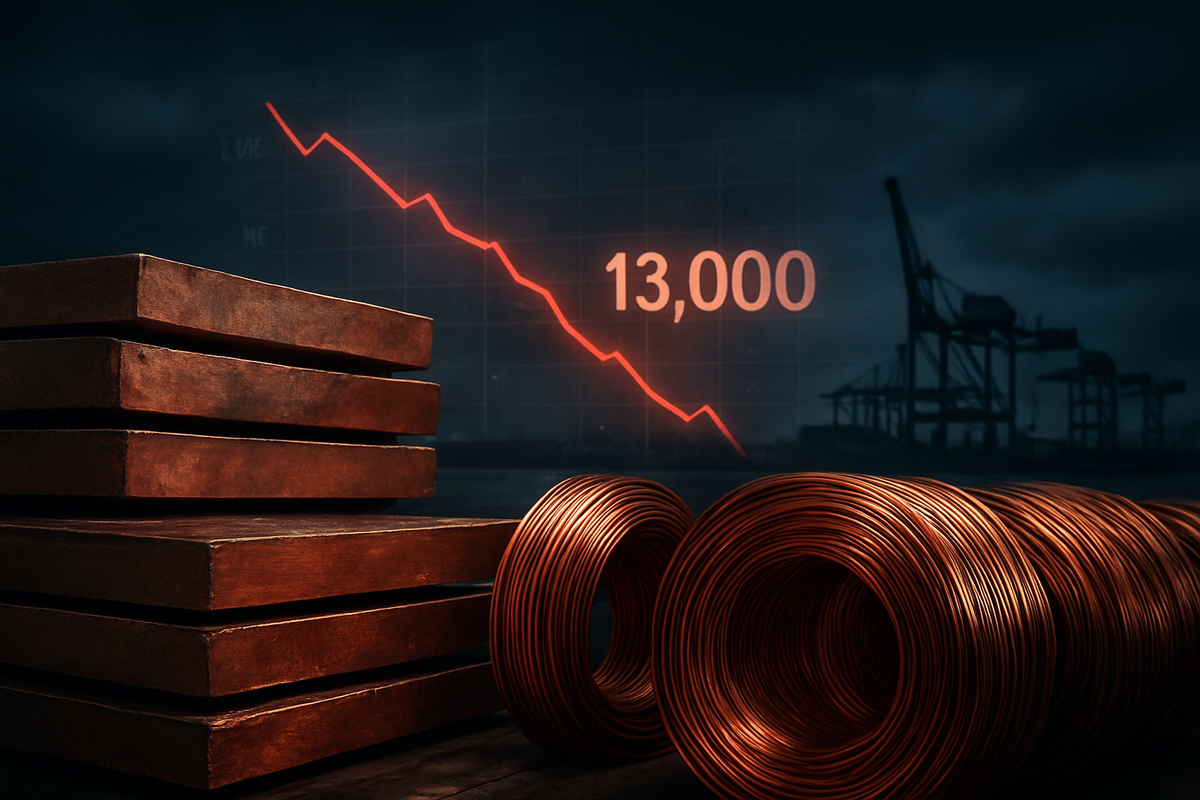
The long-standing "copper supercycle" narrative faced a stark reality check this week as benchmark prices for the red metal plummeted below the critical psychological threshold of $13,000 per metric ton. On the London Metal Exchange (LME), three-month copper futures tumbled to a low of $12,650, marking a significant retreat from the record highs of $14,500 witnessed just weeks ago in early January. This sudden reversal has caught many market participants off guard, signaling a cooling of the speculative fervor that dominated the commodities sector throughout 2025.
The immediate implications of this slide are reverberating across the global economy. For investors, the breach of the $13,000 floor suggests that the "scarcity premium" driven by the green energy transition is being overshadowed, at least temporarily, by darkening macroeconomic clouds. While long-term demand for electrification remains robust, the current price action reflects a growing consensus that the global industrial engine is sputtering under the weight of renewed protectionist policies and a deepening trade rift between the world's two largest economies.
The decline in copper prices began in earnest during the final week of January 2026, following a series of hawkish signals from the U.S. Federal Reserve and a notable shift in Washington's trade rhetoric. The sell-off accelerated after reports surfaced that the U.S. administration is weighing a new round of 15% to 25% tariffs on refined copper imports, a move aimed at bolstering domestic smelting but one that has spooked international traders. This protectionist stance, combined with the appointment of Kevin Warsh as the new Federal Reserve Chair—a move seen as a victory for those favoring a stronger dollar and higher-for-longer interest rates—has created a perfect storm for dollar-denominated commodities.
Throughout late 2025, copper had been the "darling" of speculative funds, with net-long positions reaching historic levels as traders bet on a massive structural deficit. However, the latest data from the world’s largest copper consumer, China, has painted a different picture. Soft manufacturing activity and a stagnant property sector have led to a build-up in inventories at Shanghai Futures Exchange warehouses. Analysts at Goldman Sachs recently revised their 2026 outlook, suggesting a potential 160,000-ton surplus, a sharp departure from the "imminent shortage" narrative that pushed prices to their January peaks.
The reaction across the industrial complex has been swift. Major brokerage houses have begun downgrading their short-term price targets, citing a "cooling of speculative impulses" that had previously ignored rising stockpiles. As of February 5, 2026, the market is no longer pricing in a shortage, but rather a bottlenecked global trade system where high tariffs and geopolitical friction are slowing the physical movement of the metal.
The primary victims of this price correction are the major diversified miners who have pivotally expanded their copper portfolios over the last decade. Freeport-McMoRan (NYSE: FCX), often considered the primary "pure-play" for copper exposure, saw its shares decline by 8% in the wake of the price slide. While the company remains a low-cost producer, its high sensitivity to spot prices means that any retreat from the $14,000 level directly erodes its projected 2026 earnings. Similarly, Southern Copper Corp (NYSE: SCCO) has felt the squeeze, though its industry-leading operating margins, which remain above 50%, provide a significant buffer against the current downturn.
On the other hand, the "big miners" like BHP Group (NYSE: BHP) and Rio Tinto (NYSE: RIO) are navigating a more complex landscape. BHP has recently increased its copper exposure to nearly half of its total EBITDA, meaning this price drop is a direct hit to its growth strategy. Rio Tinto, despite a massive production ramp-up at its Oyu Tolgoi mine in Mongolia, remains heavily tethered to iron ore, which has its own set of challenges regarding Chinese demand. For these giants, the drop below $13,000 may force a reconsideration of capital expenditure on new, high-cost "greenfield" projects that were only viable at much higher price points.
Conversely, the decline offers a much-needed reprieve for industrial consumers. Electric vehicle manufacturers such as Tesla (NASDAQ: TSLA) and General Motors (NYSE: GM) are major beneficiaries, as copper accounts for a substantial portion of the bill of materials for batteries and high-voltage wiring. Utilities like NextEra Energy (NYSE: NEE), currently engaged in multi-billion dollar grid modernization efforts, also stand to benefit. Lower copper costs reduce the capital intensity of installing new transmission lines and renewable interconnections, potentially allowing these firms to accelerate their infrastructure timelines while maintaining ratepayer stability.
This event fits into a broader trend of "geopolitical de-globalization" that has begun to define the mid-2020s. While the 2021-2024 period was characterized by a unified global push toward decarbonization, the landscape in 2026 is increasingly fractured. U.S. protectionism is no longer a fringe policy but a core economic strategy, leading to a "Balkanization" of commodity markets. The result is a paradox: while the world needs more copper than ever for the energy transition, trade barriers are preventing that metal from moving efficiently to where it is needed most, leading to localized surpluses and artificial price volatility.
Historical precedents for this shift can be found in the trade tensions of 2018-2019, though the stakes are now significantly higher. In the previous decade, copper was a proxy for global growth; today, it is a strategic national asset. The ripple effects are already being felt by mid-tier producers in South America and Africa, who are finding it increasingly difficult to navigate the competing regulatory demands of U.S. and Chinese trade blocs. This tension threatens to stall the global energy transition if the cost of "strategic sourcing" remains prohibitively high.
Furthermore, the cooling of speculative demand marks a transition from a "hype-driven" market to one focused on physical delivery. For years, the market was fueled by the "Green Copper" narrative, where institutional investors bought into the metal as a thematic play on climate change. The current correction suggests that the "macro" environment—interest rates, trade wars, and sovereign debt—has reclaimed its role as the primary driver of commodity pricing, displacing the "micro" fundamentals of supply and demand for the time being.
In the short term, the market will likely search for a new floor, possibly around the $12,000 mark, as technical traders reassess the damage to the long-term chart. We may see a strategic pivot among mining companies toward "brownfield" expansions—increasing output at existing mines—rather than the riskier, more expensive "greenfield" developments. This caution could lead to a genuine supply crunch toward the end of the decade, as the lack of current investment in new mines eventually catches up with the relentless demand from the EV and AI sectors.
The emergence of AI data centers as a massive new consumer of copper—expected to reach over 1 million tonnes of annual demand by the end of 2026—provides a potential "safety net" for prices. If the tech sector continues its rapid expansion of electrical infrastructure, the industrial metal could see a V-shaped recovery. However, this depends entirely on whether the U.S. and China can reach a "trade truce" or if the current path toward economic isolationism continues to accelerate.
The drop below $13,000 is more than just a numerical milestone; it is a signal that the commodity markets are entering a new, more cautious phase. The combination of U.S. protectionism and a cooling Chinese economy has successfully countered the "supply deficit" narrative that fueled the 2025 rally. While the structural case for copper remains intact due to its essential role in modern technology, the "easy money" phase for speculators appears to be over.
Moving forward, investors should keep a close eye on LME inventory levels and the rhetoric coming out of the U.S. Treasury regarding further tariffs. The copper market is currently caught between the long-term necessity of the energy transition and the short-term reality of a fractured global trade environment. As we move through 2026, the resilience of industrial demand in the face of these headwinds will determine whether this is a minor correction or the beginning of a prolonged cyclical downturn for the world’s most important industrial metal.
This content is intended for informational purposes only and is not financial advice.