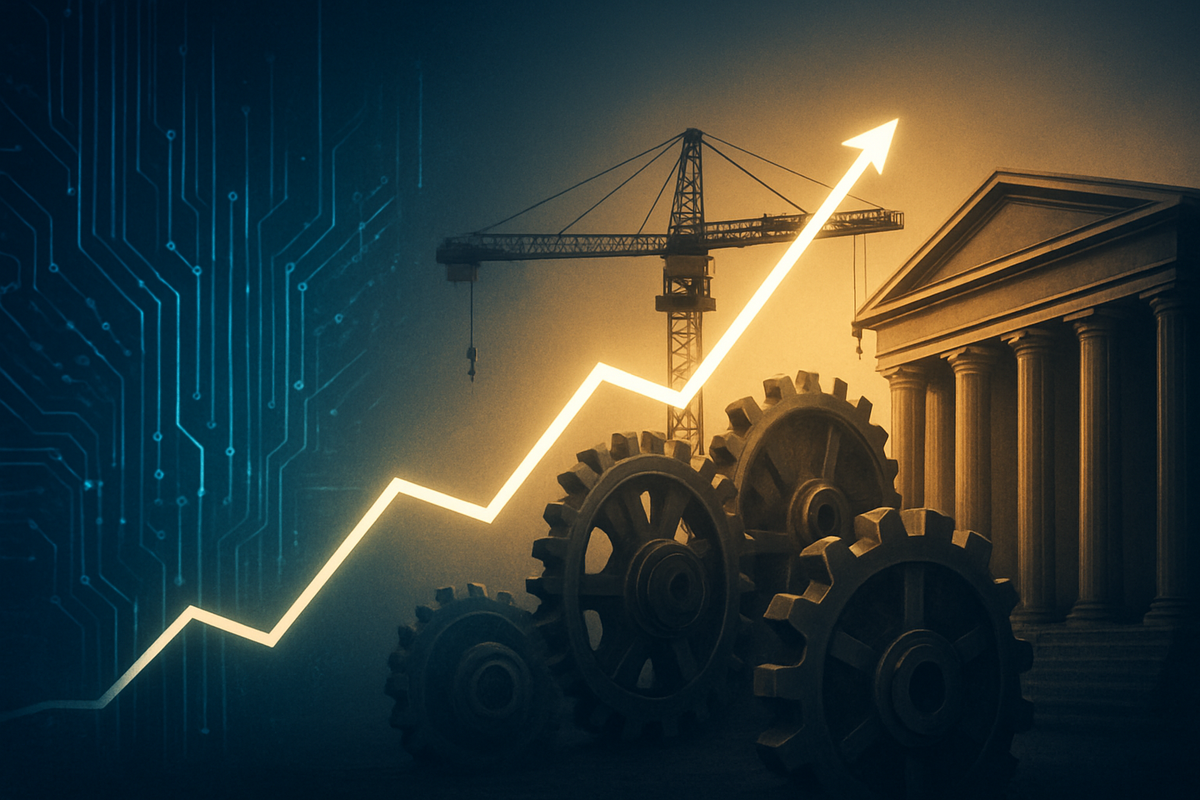
The era of tech-driven market narrowness appears to have met its match. In a series of sweeping upgrades throughout the first quarter of 2026, Wall Street’s most influential strategists have officially moved the Financials and Industrials sectors to "Overweight," signaling a definitive shift in the market's leadership. This "Great Rotation" is driven by a unique confluence of stabilizing interest rates, a resurgence in domestic manufacturing, and the long-awaited diffusion of artificial intelligence productivity gains into the broader economy.
As of late February 2026, the consensus among firms like Goldman Sachs, Morgan Stanley, and J.P. Morgan is clear: the "AI Supercycle" has entered its second phase. While 2024 and 2025 were defined by the meteoric rise of hardware providers, 2026 is becoming the year of the adopters. Strategists argue that the combination of moderate GDP growth—currently tracking at a sturdy 2.6%—and a stabilized interest rate environment has created a "Goldilocks" scenario for cyclical stocks that had previously been overshadowed by mega-cap technology.
The momentum for this sector rotation began building in late 2025 but reached a fever pitch following the release of January 2026 economic data. For nearly two years, the market was held captive by the Federal Reserve's battle with inflation; however, with the federal funds rate now stabilizing in a "neutral" zone of 3.0% to 3.25%, the uncertainty that plagued traditional sectors has evaporated. This stability has allowed major banks and industrial conglomerates to forecast earnings with a level of precision not seen since before the pandemic.
Key stakeholders in this transition include some of the largest asset managers in the world. J.P. Morgan Chase & Co. (NYSE: JPM) and Morgan Stanley (NYSE: MS) were among the first to sound the horn, releasing joint research notes in December 2025 that highlighted the "early cycle broadening" of corporate earnings. According to J.P. Morgan’s Dubravko Lakos-Bujas, the market is witnessing a "new hierarchy" where capital-intensive industries are reclaiming their roles as growth engines.
Initial market reactions have been swift. Since the start of the year, the Financial Select Sector SPDR Fund (NYSE: XLF) and the Industrial Select Sector SPDR Fund (NYSE: XLI) have consistently outperformed the broader S&P 500. This rally was further catalyzed by the implementation of the "One Big Beautiful Bill Act" (OBBBA) in early 2026, a major piece of legislation aimed at deregulation and providing "capital flexibility" to the banking sector. The act effectively rolled back several Dodd-Frank era constraints, allowing money-center banks to ramp up stock buybacks and dividend distributions to record levels.
Simultaneously, the industrial sector has benefited from a massive "reindustrialization" push. As the U.S. continues to reshore critical supply chains and upgrade its aging electrical grid to meet the energy demands of massive AI data centers, companies involved in infrastructure and heavy machinery have seen their backlogs swell to multi-year highs. The transition from "capital-light" software dominance to "capital-heavy" physical infrastructure is the cornerstone of the current Wall Street thesis.
The winners of this shift are found among the "blue chips" of the traditional economy. In the financial sector, Bank of America Corp. (NYSE: BAC) and Goldman Sachs Group Inc. (NYSE: GS) are positioned to reap the rewards of a revitalized Mergers & Acquisitions (M&A) market. With interest rates no longer in flux, the "broken dam" of corporate deal-making has burst, leading to a surge in advisory fees. Furthermore, regional banks, which struggled during the 2023 banking crisis and subsequent high-rate environment, are seeing a dramatic recovery as Net Interest Margins (NIM) stabilize and credit concerns subside.
On the industrial side, the primary beneficiaries are those at the intersection of automation and infrastructure. Caterpillar Inc. (NYSE: CAT) has seen its stock surge as it provides the heavy equipment necessary for the nationwide "grid modernization" project. Meanwhile, GE Vernova Inc. (NYSE: GEV), the power-focused spin-off of the historic General Electric, has become a favorite among ESG and growth investors alike for its role in the electrification of the U.S. economy. Honeywell International Inc. (NASDAQ: HON) is also gaining traction as its industrial automation software is integrated with new generative AI agents to solve chronic labor shortages in manufacturing.
However, this rotation creates an "underweight" problem for previous market darlings. Highly valued software-as-a-service (SaaS) companies and mega-cap tech giants that lack a physical "moat" are seeing their valuation multiples compressed as capital flows toward sectors with higher tangible yields and lower relative valuations. While these tech firms are not necessarily failing, their relative underperformance marks a psychological shift for investors who have spent the last decade overweighting technology at any cost.
Retailers and consumer discretionary companies may also face a mixed bag. While the "moderate growth" environment is generally positive, the shift toward capital-intensive industrial investment may divert consumer spending or lead to higher costs for finished goods if the "reindustrialization" causes short-term supply constraints. Investors are carefully watching companies like Target Corp. (NYSE: TGT) to see if the productivity gains in logistics can offset the inflationary pressures of a reshoring economy.
The significance of this rotation extends far beyond simple stock picks; it represents a fundamental change in the US economic narrative. For the better part of fifteen years, the US economy was characterized by "secular stagnation"—low growth, low inflation, and low interest rates. This environment naturally favored growth-at-any-price technology stocks. The 2026 landscape, however, suggests a move toward "Productive Growth," where AI and automation are used to enhance the efficiency of physical goods and services.
This event mirrors the post-WWII industrial boom or the mid-1990s productivity surge, but with a digital twist. Historically, when productivity gains from a new technology (like electricity or the internet) finally reach the "real" economy, it leads to a sustained period of outperformance for cyclical sectors. By February 2026, the data indicates that AI is no longer just a buzzword for Silicon Valley; it is actively reducing worker headcount in banking and increasing factory floor efficiency in the Midwest.
Regulatory and policy implications are also profound. The OBBBA legislation represents a pivot toward a more laissez-faire approach to financial oversight, which hasn't been seen since the mid-2000s. While this has fueled the current rally in financials, some analysts warn that it may create systemic risks further down the line. Additionally, the bipartisan support for "onshoring" suggests that the industrial sector's gains are not just a market cycle, but a structural shift in U.S. economic policy that will likely persist regardless of future election outcomes.
Finally, the ripple effects on global competitors are becoming evident. As the U.S. doubles down on domestic manufacturing and financial deregulation, European and Asian markets are feeling the pressure to respond with similar incentives. This "race for productivity" could lead to a global resurgence in industrial investment, potentially ending the decade-long drought in capital expenditures across the G7 nations.
Looking ahead, the short-term focus for investors will be the sustainability of the current M&A boom. If the first half of 2026 continues to see record-breaking deal volumes, the Financials sector could see further "Overweight" revisions. However, any unexpected "re-acceleration" of inflation could force the Federal Reserve to abandon its neutral stance, which remains the single biggest risk to the cyclical bull case. Strategists will be glued to the March and April CPI prints to ensure the "Goldilocks" scenario remains intact.
In the long term, the industrial sector must prove that it can convert its massive backlogs into realized profits. The "reindustrialization" of America is an expensive and time-consuming endeavor. Companies like Caterpillar and GE Vernova will need to navigate potential labor strikes and raw material shortages as they scale up production. The adaptation of "Agentic AI" on the factory floor will be a key metric to watch—if these tools fail to deliver the promised 20-30% efficiency gains, the Industrials sector may see a sharp correction by 2027.
Market opportunities will likely emerge in "mid-cap" cyclicals that have not yet been fully re-rated by the street. While the "Mega-Banks" and "Industrial Titans" have led the first leg of this rally, the next phase of the rotation will likely involve the broader Russell 2000 index. Investors should look for specialized engineering firms and regional lenders that are poised to benefit from localized infrastructure projects and the OBBBA-driven consolidation of the banking industry.
The "Great Rotation" of early 2026 marks a historic transition from a tech-centric market to one balanced by the heavyweights of the "Old Economy." Driven by a stable 3.25% interest rate environment, the OBBBA deregulatory framework, and the tangible application of AI in factories and bank vaults, the Financials and Industrials sectors have reclaimed their status as market leaders. Wall Street's shift to an "Overweight" stance on these sectors reflects a broader belief that the U.S. economy has entered a new era of productive, capital-intensive growth.
Moving forward, the market appears to be in a healthy state of "broadening." The reliance on a handful of tech companies to carry the S&P 500 has diminished, replaced by a more diversified engine of growth. While risks such as inflationary spikes or execution hurdles in manufacturing remain, the structural tailwinds of reshoring and grid modernization provide a compelling long-term thesis for these cyclical sectors.
For investors, the coming months will be a test of patience and discipline. The easy gains from the initial upgrade cycle may be behind us, but the "real" earnings growth driven by productivity gains is only just beginning to show up in quarterly reports. Watch for a continuation of the M&A wave in the financial sector and steady volume growth in the industrial space as the primary signals that this rotation has staying power. The "Great Rotation" isn't just a temporary trade; it is the market's response to a fundamentally redesigned American economy.
This content is intended for informational purposes only and is not financial advice