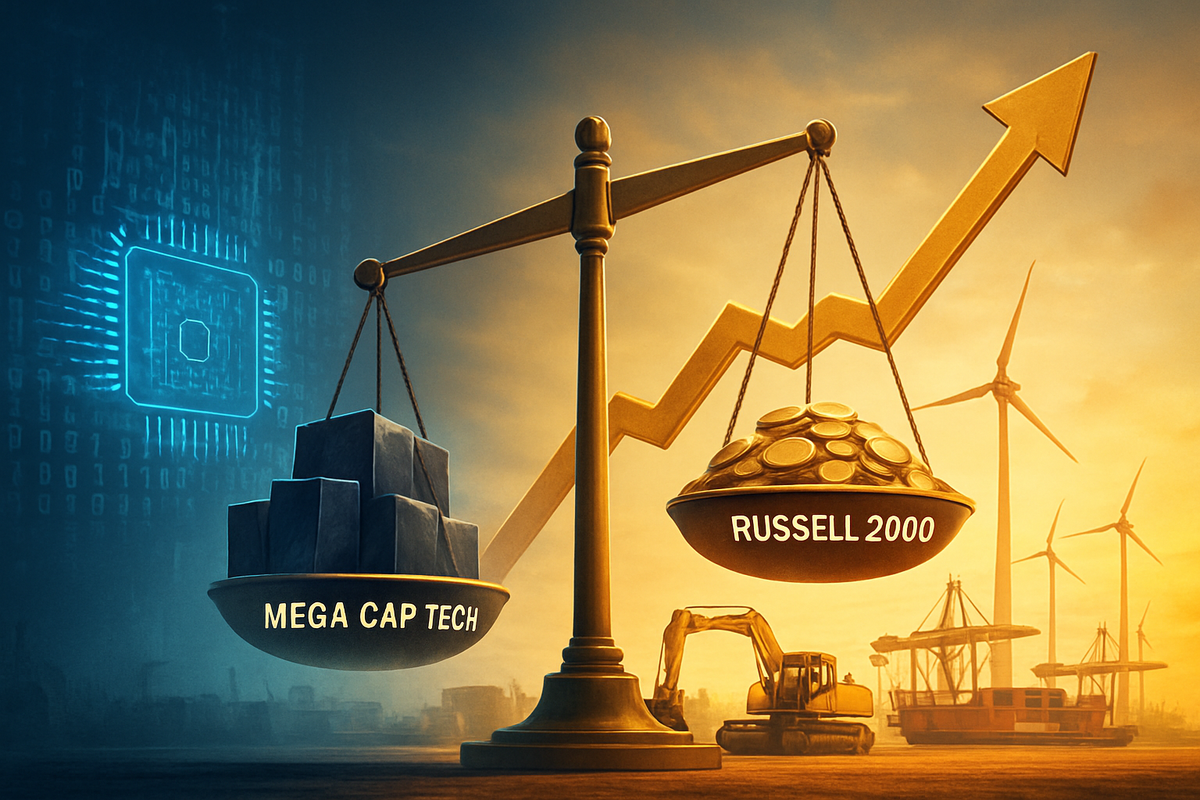
The financial landscape of early 2026 has been defined by a definitive "Great Rotation," as investors aggressively pivot away from the mega-cap technology giants that dominated the previous decade in favor of long-neglected small-cap stocks. In a dramatic reversal of the "Magnificent Seven" era, the Russell 2000 Index (NYSE: IWM) delivered a powerhouse performance in January, surging 5.4%—a figure that dwarfed the modest 1.5% gain posted by the S&P 500 Index (NYSE: SPY). This shift marks a fundamental regime change, signaling that the broader market is finally catching up to the tech leaders.
The implications of this movement are profound for institutional and retail investors alike. For years, the market’s health was tied to a handful of trillion-dollar companies, creating a top-heavy vulnerability that many analysts feared. The early 2026 rally suggests a healthy "breadth" expansion, where capital is being redistributed into the "real economy"—sectors like domestic manufacturing, regional banking, and energy—rather than being concentrated in artificial intelligence speculation. As the winning streak for small-caps extended to an unprecedented 15 consecutive sessions in January, the narrative of "tech exceptionalism" has been replaced by a quest for value and domestic resilience.
A Fifteen-Day Streak and the Death of "AI Fatigue"
The catalyst for this rotation was a perfect storm of technical breakouts and fundamental shifts that began in the final weeks of 2025. Following the Federal Reserve's December meeting, where the central bank lowered the federal funds rate to a range of 3.50% to 3.75%, the cost of capital for debt-sensitive smaller firms plummeted. This move, combined with the lingering effects of the "One Big Beautiful Bill Act" (OBBBA) passed in mid-2025—which made several key corporate tax cuts permanent—provided a massive fiscal tailwind for companies with purely domestic operations. By the first trading day of 2026, the dam finally broke.
From early to mid-January, the Russell 2000 embarked on a historic 15-session winning streak, the longest since the mid-1990s. While mega-cap stalwarts like Nvidia (NASDAQ: NVDA) and Microsoft (NASDAQ: MSFT) saw their valuations stall amid "AI capex fatigue," investors began hunting for "unloved" assets. The trigger for the final leg of the rotation occurred in early February, when Alphabet (NASDAQ: GOOGL) issued a massive bond offering to fund further infrastructure, leading many to question the immediate return on investment for such staggering capital expenditures. In contrast, small-cap earnings for the fourth quarter of 2025 showed a surprising 65% beat rate, proving that the "median stock" was fundamentally stronger than the indices had previously suggested.
The Winners of the New Regime: Energy, Industrials, and Small-Caps
The primary beneficiaries of this rotation are firms that have long lived in the shadow of Big Tech’s growth multiples. The Russell 2000 ETF (NYSE: IWM) has become the new vehicle of choice for momentum traders, attracting record inflows in the first six weeks of the year. Within this space, regional banks—represented by the SPDR S&P Regional Banking ETF (NYSE: KRE)—have seen a resurgence as falling short-term rates helped stabilize net interest margins and lower the risk of commercial real estate defaults. For these smaller lenders, the environment of 2026 represents a return to a "Goldilocks" scenario of stable growth and manageable borrowing costs.
Beyond small-caps, the rotation has invigorated "Old Economy" value sectors. The Energy sector, led by giants such as ExxonMobil (NYSE: XOM) and Chevron (NYSE: CVX), outperformed the broader market by double digits in early February as geopolitical stability and steady demand bolstered cash flows. Simultaneously, Industrials have surged on the back of a "reshoring" boom. Companies like Caterpillar (NYSE: CAT) and GE Aerospace (NYSE: GE) have seen their order books swell, thanks to domestic infrastructure projects and the OBBBA’s 100% bonus depreciation incentives. Conversely, the "losers" of this period are the highly concentrated indices like the Nasdaq-100 (NASDAQ: QQQ), which have struggled to find new buyers at record-high multiples.
A 31% Discount and the Widening of the Bull Market
The broader significance of this shift lies in the staggering valuation gap that had developed between 2023 and 2025. By the start of 2026, small-cap stocks were trading at a nearly 31% valuation discount compared to their large-cap counterparts on a forward price-to-earnings basis. This gap was a historical anomaly, representing a "coiled spring" that only required a minor catalyst—falling rates—to release. This event marks the transition from a "narrow" bull market to a "broad" one, which is historically a more sustainable and less volatile environment for long-term growth.
This transition also reflects a major policy shift toward domestic production and fiscal stimulus for middle-market companies. Unlike the tech giants, which rely heavily on global supply chains and international revenue, the constituents of the Russell 2000 are predominantly U.S.-focused. The "Great Rotation" is, in many ways, a bet on the American consumer and the revitalization of domestic manufacturing. It mirrors historical precedents like the post-dotcom era of 2000-2002, where value stocks and small-caps thrived for years after the "growth at any price" bubble finally burst.
The Path Ahead: Can the Small-Cap Rally Sustain Its Momentum?
As we move toward the second quarter of 2026, the question is whether this rotation is a temporary rebalancing or a permanent regime change. Short-term, the Russell 2000 faces some technical resistance after such a rapid ascent, and any resurgence in inflation could force the Federal Reserve to pause its rate-cutting cycle, which would disproportionately hurt smaller firms. However, if the "soft landing" narrative continues to hold and corporate earnings for small-caps continue to outpace the tech sector's growth, the trend could persist throughout the year.
Strategic pivots are already underway at major hedge funds and asset managers, many of which were caught "underweight" on small-caps during the January surge. We should expect a continued flow of capital into equal-weighted indices, such as the Invesco S&P 500 Equal Weight ETF (NYSE: RSP), as investors seek to diversify away from concentration risk. The primary challenge for the market will be maintaining this momentum without overheating, as a sudden spike in commodity prices or a disruption in the labor market could derail the domestic growth story that currently fuels the small-cap fire.
Summary and Final Outlook
The early 2026 market rotation has fundamentally altered the investment landscape, rewarding those who looked past the AI hype to find value in the broader economy. The Russell 2000's 5.4% January jump and its historic 15-session winning streak have provided the most convincing evidence yet that the era of mega-cap dominance is taking a backseat to a more inclusive, diversified rally. Driven by a 31% valuation discount and a favorable interest rate environment, sectors like Energy and Industrials are reclaiming their roles as market leaders.
Moving forward, investors should watch the Federal Reserve's rhetoric closely. While the "Great Rotation" has the wind at its back, it remains sensitive to any shifts in monetary policy or spikes in long-term bond yields. The true test for this new bull market will be the Q1 2026 earnings season, where small-cap companies must prove that their recent stock performance is backed by tangible profit growth. For now, the "real economy" is back in the driver's seat, and the market appears healthier for it.
This content is intended for informational purposes only and is not financial advice.