NEW YORK — In a historic realignment of global capital, investors have flooded into precious metals exchange-traded funds (ETFs) at a scale not seen in decades. As of February 25, 2026, the migration of liquidity from high-growth technology and consumer discretionary sectors into hard assets has reached a fever pitch, driven by a combination of AI-related valuation exhaustion and heightened geopolitical instability.
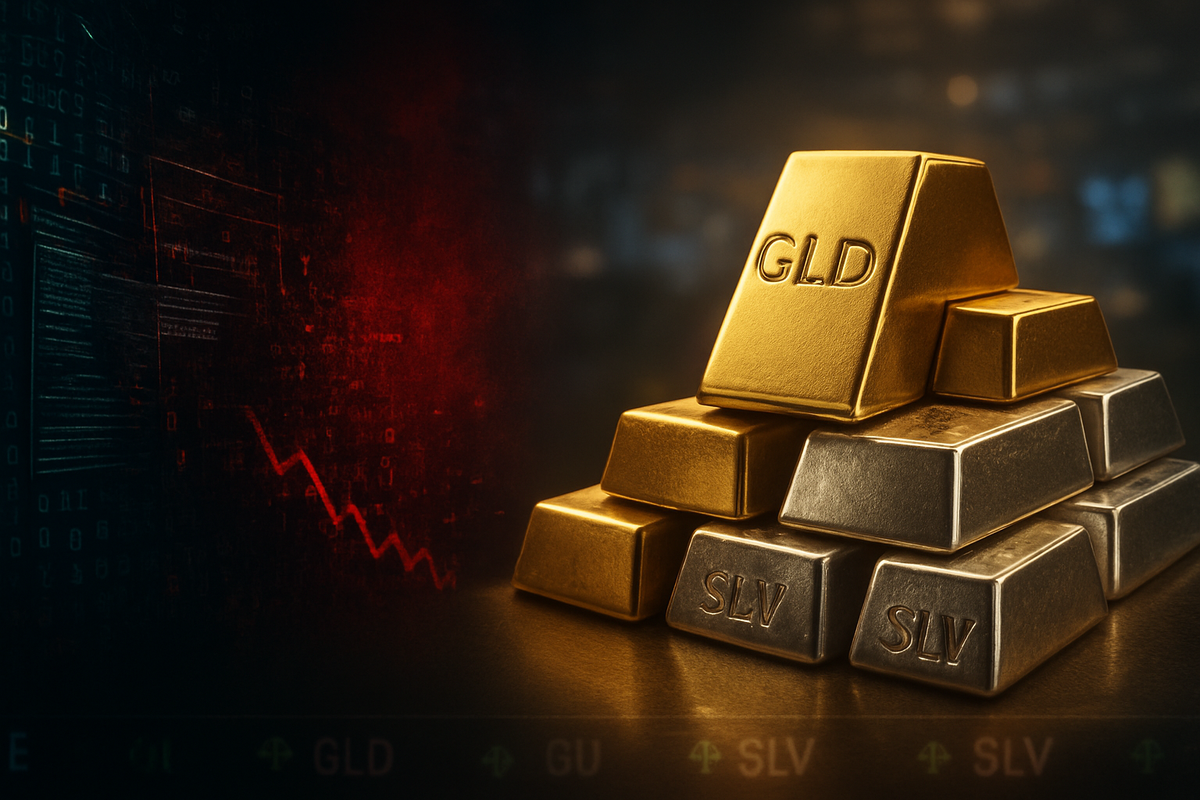
The SPDR Gold Shares (NYSE Arca: GLD), the world’s largest gold-backed ETF, saw its assets under management (AUM) swell to a record $174.5 billion this week, while the iShares Silver Trust (NYSE Arca: SLV) has experienced a massive resurgence of interest following a volatile start to the year. This aggressive rotation marks a definitive end to the 'AI-at-any-cost' era that dominated the previous two years, as the market pivots toward the perceived safety of "sound money" amid a broader equity rout.
The 'SaaSpocalypse' and the Genesis of the Rotation
The timeline leading to today’s record inflows began in late 2025, when the "Great Rotation" shifted from a theoretical market forecast to an institutional reality. The catalyst was the "SaaSpocalypse" of January 2026, a violent sector-wide sell-off in business-to-business software. Investors grew wary of the seat-based licensing models used by giants like Salesforce (NYSE: CRM) and ServiceNow (NYSE: NOW), fearing that autonomous AI agents would eventually render traditional per-user pricing obsolete. This skepticism quickly bled into the broader Nasdaq-100, prompting a massive exit from tech-heavy portfolios.
Simultaneously, a 2026 Supreme Court ruling striking down specific emergency trade provisions led to the White House imposing a 15% global tariff, injecting a fresh dose of trade policy chaos into the markets. In this environment, the "Magnificent Seven" trade, which had already begun to show signs of valuation fatigue, buckled. As tech giants faced scrutiny over their $400 billion annual AI capital expenditures, institutional "smart money" began looking for a place to hide. Gold, which hit 53 separate price records in 2025, became the primary beneficiary, testing the $5,200 per ounce level this morning.
Winners in the Commodity Supercycle and Losers in the Tech Rout
The immediate beneficiaries of this capital flight are the precious metals ETFs and the firms that manage them. State Street Corp (NYSE: STT), the parent of the GLD trust, and BlackRock (NYSE: BLK), which manages the SLV trust, have seen their fee-generating AUM in commodities reach all-time highs. Silver-based ETFs have also displayed extraordinary performance, particularly in international markets. The HDFC Silver ETF (NSE: HDFCSILVER) and the Nippon India Silver ETF (NSE: SILVERBEES) reported one-year returns of 87.5% and 80.8% respectively, vastly outperforming the broader Indian and U.S. indices.
Conversely, the losers are concentrated in the high-multiple software and consumer discretionary sectors. While hardware and semiconductor firms like Nvidia (NASDAQ: NVDA) and Micron (NASDAQ: MU) have remained somewhat resilient due to ongoing data center demand, they have not been immune to the broader "risk-off" sentiment. The rotation has punished companies with high price-to-earnings ratios that lack the tangible collateral of the basic materials sector. Industrial demand for silver—fueled by the continued expansion of solar energy and EV infrastructure—has created a "dual-engine" rally for the metal, further pulling capital away from speculative digital growth.
Global Policy and the Commodity Supercycle 2.0
The current surge in gold and silver is not merely a reactionary flight to safety; it fits into a broader "Commodity Supercycle 2.0" that has been gathering steam for years. Analysts note that the structural supply deficits in silver—now in their fifth consecutive year—have created a fundamental floor for prices. Furthermore, emerging market central banks have continued to diversify away from the U.S. dollar, purchasing approximately 60 tonnes of gold per month. This institutional demand has neutralized the traditional headwinds of high interest rates, which typically dampen the appeal of non-yielding assets.
Historically, this period draws comparisons to the stagflationary environment of the late 1970s, where precious metals outperformed equities for a prolonged period. However, the 2026 context is unique due to the "AI Reality Check." Unlike the dot-com bubble of 2000, the current tech correction is driven by a debate over the ROI of AI, rather than its existence. As the US Dollar index (DXY) slips toward the 97.46 mark, currency debasement concerns are once again driving domestic investors to hedge with GLD and SLV, reinforcing the metals' status as the ultimate "insurance policy" against a fracturing global trade order.
What Lies Ahead: $6,000 Gold and the Path to Stability
Looking toward the remainder of 2026, the trajectory for precious metals remains aggressively bullish, though not without volatility. Short-term targets for gold are now reaching $5,400 to $6,000 per ounce, provided that geopolitical tensions in the Middle East—specifically involving renewed US-Iran nuclear concerns—remain unresolved. For silver, the challenge will be sustaining its breakout above $90 per ounce, a level that has historically triggered significant "air pockets" of profit-taking.
Market participants should expect a period of strategic pivots by major asset managers. We are likely to see the emergence of more sophisticated commodity-linked products as funds seek to capture the "industrial premium" of silver alongside the "monetary premium" of gold. The potential for a "parabolic" move in silver remains high, which could necessitate regulatory scrutiny or margin changes on major exchanges if volatility becomes systemic. For the tech sector, a "recovery" will likely depend on companies proving that AI can deliver immediate, bottom-line efficiency rather than just long-term promise.
A Final Assessment of the Precious Metals Resurgence
The massive inflows into GLD and SLV as of February 25, 2026, represent a watershed moment for modern markets. The transition from digital-centric growth to tangible-asset security reflects a fundamental shift in investor psychology. While the tech rout has been painful for many, the "Great Rotation" has provided a lucrative alternative for those positioned in the commodity space. The resilience of precious metals in the face of shifting trade policies and AI uncertainty suggests that the current rally is structurally sound and perhaps only in its middle innings.
Investors moving forward should keep a close eye on central bank activities and the monthly AUM reports of the major silver ETFs like HDFCSILVER and SILVERBEES. These will serve as the "canaries in the coal mine" for global liquidity. While the lure of the next tech breakthrough will always exist, for now, the market has sent a clear message: in an era of unprecedented digital and geopolitical uncertainty, there is still no substitute for the timeless security of gold and silver.
This content is intended for informational purposes only and is not financial advice.