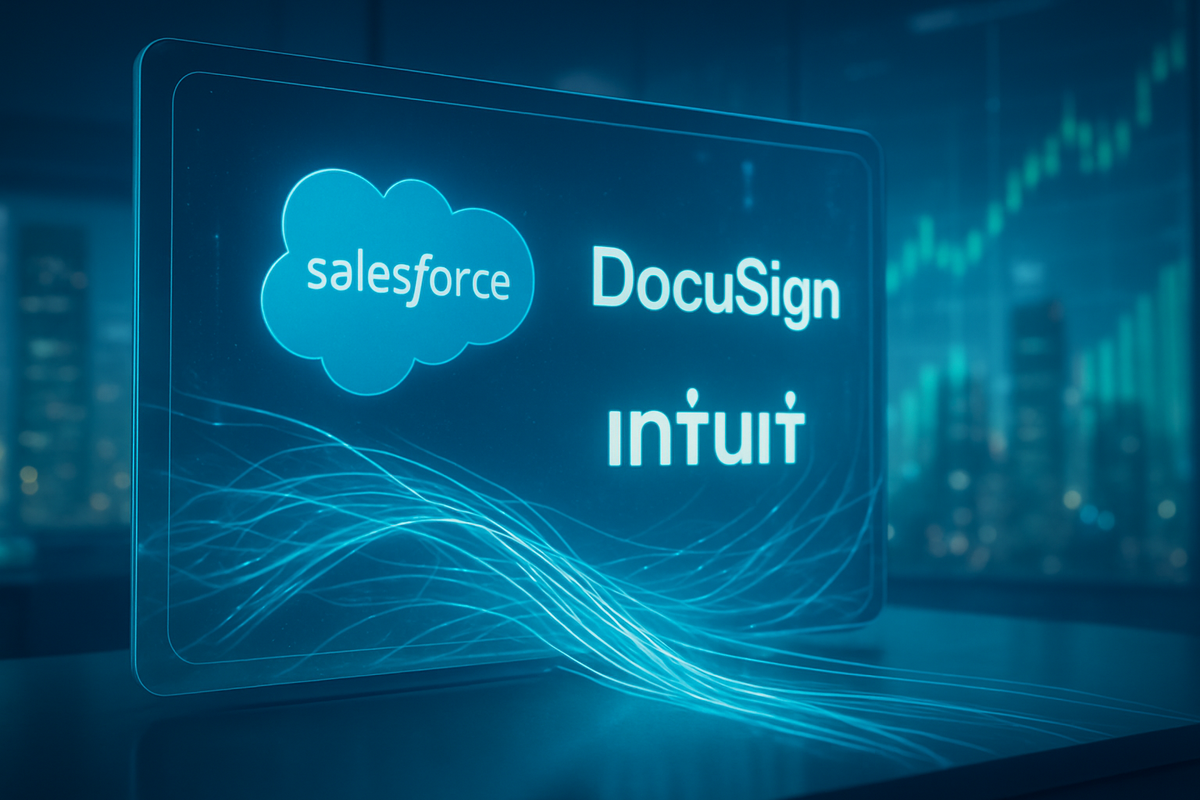
The enterprise software market, which just weeks ago was reeling from fears of an "AI-driven extinction event," staged a dramatic recovery today as the narrative surrounding generative artificial intelligence shifted from replacement to augmentation. A series of landmark partnership announcements between AI powerhouse Anthropic and industry stalwarts Salesforce (NYSE: CRM), DocuSign (NASDAQ: DOCU), and Intuit (NASDAQ: INTU) have signaled a new era where AI serves as the cognitive engine for existing software ecosystems rather than a substitute for them.
The rebound follows the introduction of Anthropic’s "Enterprise Integration Suite," a collection of 10 specialized tools designed to weave its Claude AI models directly into the fabric of corporate workflows. This strategic pivot has effectively halted a month-long selloff that saw billions in market capitalization evaporate, as investors begin to bet that the "System of Record" held by legacy SaaS (Software as a Service) providers is far more resilient—and valuable—than previously feared.
From 'SaaSpocalypse' to Strategic Synergy
The timeline of this market whiplash began in late January 2026, when Anthropic first teased its modular "Claude Plugins." Early demos showed the AI performing complex contract reviews and financial modeling with such autonomy that the market panicked, leading to what analysts dubbed the "SaaSpocalypse." During this period, Intuit (NASDAQ: INTU) saw its stock crater by 33% from yearly highs, while Salesforce (NYSE: CRM) slid 22% as investors worried that AI agents would soon bypass traditional software interfaces entirely. The fear was simple: if an AI can "think" through a sales pipeline or a tax return, why would a company need to pay for a Salesforce or QuickBooks license?
However, the tide turned on February 24, 2026, with a coordinated blitz of partnership reveals. Anthropic CEO Dario Amodei and Salesforce CEO Marc Benioff appeared together to unveil "Claude for Agentforce 360." This integration allows Anthropic’s latest models to natively access Salesforce Data Cloud, effectively turning Claude into a highly skilled employee that knows a company’s entire customer history. Similar deep-tier integrations were announced for DocuSign’s Intelligent Agreement Management platform and Intuit’s financial suite, moving the conversation from AI "replacing" software to AI "enhancing" it. The initial market reaction was swift: Intuit’s stock rebounded 4.13% in afternoon trading, while DocuSign and Salesforce both climbed roughly 5%, buoyed by a renewed sense of institutional confidence.
Winners and Losers in the New Intelligence Layer
The biggest winners in this shift appear to be the "data-rich" incumbents. Salesforce (NYSE: CRM) has successfully positioned its Data Cloud as the essential "fuel" for Anthropic’s "engine." By integrating Claude directly into Slack and Agentforce, Salesforce ensures that even if users stop clicking through its legacy menus, the AI is still querying Salesforce databases, maintaining the company’s subscription value. Similarly, DocuSign (NASDAQ: DOCU) has moved from being a simple e-signature tool to an "agreement intelligence" hub. Its partnership allows Claude to not just draft contracts but to understand a firm’s entire legal archive, flagging compliance risks based on decades of historical data that a standalone AI simply wouldn't possess.
On the other side of the ledger, companies that lack a deep proprietary data moat or specialized workflow logic remain vulnerable. Earlier in the month, Thomson Reuters (NYSE: TRI) saw its shares tumble 16% following the release of Anthropic’s Legal Plugin, as investors feared its high-margin research and compliance tools could be automated away. While the broader market is rebounding, the "winners" are increasingly defined by their ability to provide the "trusted logic" that AI models lack. Intuit (NASDAQ: INTU) is a prime example; by launching the Claude Agent SDK, they are empowering mid-market businesses to build custom agents on top of QuickBooks data, turning a potential threat into a platform expansion.
The 'SaaS as a Calculator' Paradigm Shift
This event marks a significant evolution in the broader technology landscape, fitting into a trend that experts are calling the "SaaS as a Calculator" logic. Much as a mathematician uses a calculator rather than reinventing the laws of arithmetic, AI agents are now being designed to use Salesforce or QuickBooks because those platforms already encode the complex, domain-specific "logic" of tax laws, sales workflows, and security protocols. This historical precedent mirrors the transition from mainframe computing to the cloud; while the interface changed, the underlying need for structured data and reliable execution stayed the same.
The wider significance also touches on regulatory and policy implications. As Anthropic’s tools become more embedded in sensitive financial and legal workflows through Intuit and DocuSign, the pressure for "AI transparency" and "data sovereignty" will likely intensify. Regulators are already eyeing how these integrations handle data privacy, especially when an AI model like Claude is "reading" an entire organization's contract library. This "AI plus SaaS" hybrid model provides a layer of accountability, as the legacy software companies provide the audit trails and security frameworks that pure-play AI startups often lack.
The Road Ahead: From Interfaces to Agents
In the short term, investors should expect a "gold rush" of similar integrations as other SaaS providers scramble to partner with LLM (Large Language Model) leaders like Anthropic or OpenAI. The strategic pivot required for these software companies is massive: they must transition from being "human-centric" tools to "agent-centric" platforms. This means developing more robust APIs and "skills" that AI agents can consume. Salesforce’s success with Agentforce 360 will likely serve as the blueprint for this transformation across the industry.
Long-term, the market may see a consolidation of "zombie" SaaS companies that failed to build a unique data layer. The challenge for the coming years will be monetization. If an AI agent does the work of ten humans, will software companies be able to maintain per-seat licensing models, or will they be forced to move toward "usage-based" or "outcome-based" pricing? This transition will be fraught with volatility as Wall Street adjusts its valuation models to reflect a world where software is measured by the intelligence it enables rather than the number of employees who log in.
A New Equilibrium for Enterprise Tech
The events of late February 2026 have provided a much-needed "reality check" for the AI hype cycle. The initial fear that generative AI would render specialized software obsolete has been replaced by a more nuanced understanding of how these technologies coexist. The "SaaSpocalypse" was not an end, but a metamorphosis. By partnering with Anthropic, companies like Salesforce, DocuSign, and Intuit have asserted that while AI provides the "reasoning," they provide the "context" and "execution" that enterprises require.
Moving forward, the market will likely reward companies that can prove their data is "AI-ready." Investors should keep a close watch on the adoption rates of these new integration tools and the upcoming quarterly earnings reports to see if this "enhancement" narrative translates into actual bottom-line growth. The lasting impact of this week is the realization that the software giants of the last decade are not going away; they are simply getting a massive, intelligence-driven upgrade.
This content is intended for informational purposes only and is not financial advice.