
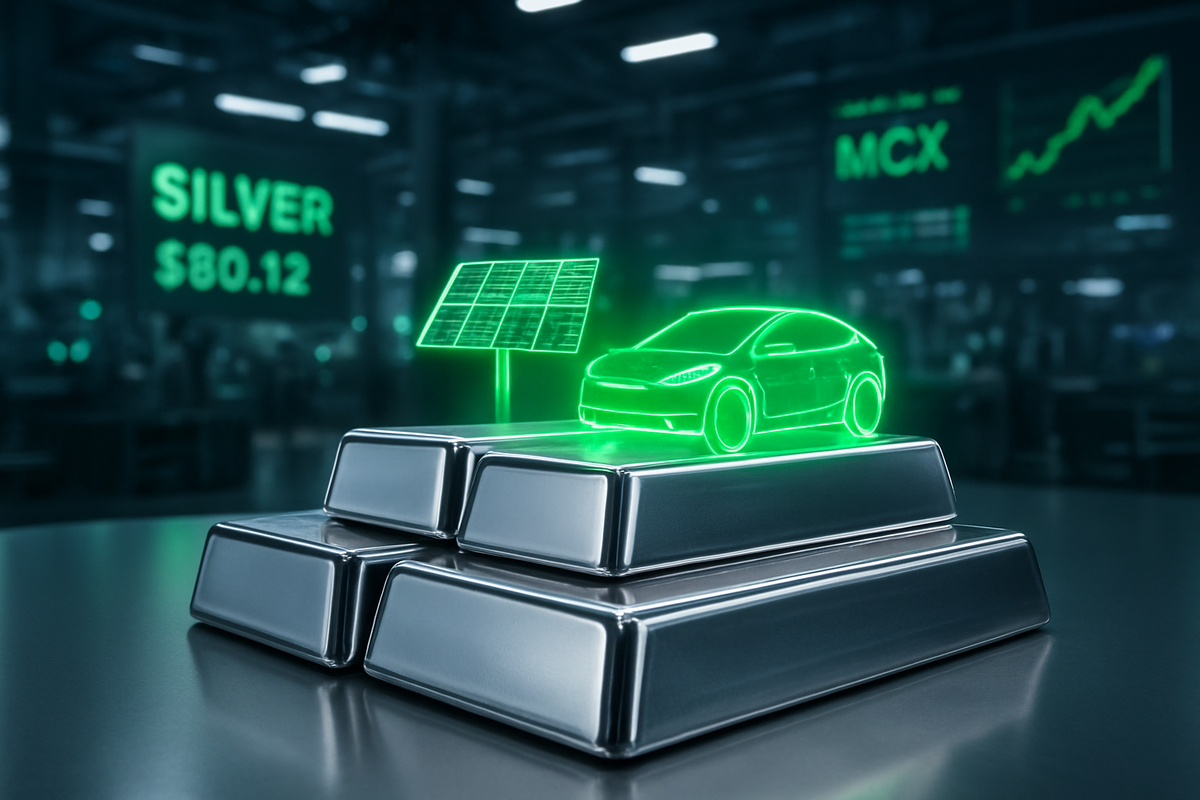
As of January 7, 2026, the global silver market has entered what analysts are calling an "Industrial Singularity." After five consecutive years of deepening structural supply deficits, the price of silver has decoupled from its historical role as "poor man’s gold," reinventing itself as a critical strategic mineral essential to the global energy transition. In the first week of 2026, spot silver prices reached a staggering global record of $82.58 per ounce, while on India’s Multi Commodity Exchange (MCX), the March 2026 contract hit an all-time high of ₹2,59,692 per kilogram.
This explosive rally is the culmination of a multi-year supply-demand mismatch that reached a breaking point in late 2025. With global silver stocks depleted by a cumulative deficit of over 800 million ounces since 2021, the market is now reacting to a "perfect storm" of inelastic industrial demand and sudden geopolitical supply shocks. For investors and industrial consumers alike, the current price environment represents a fundamental shift in the commodity's valuation framework, driven by the non-substitutable role of silver in high-growth sectors like solar photovoltaics (PV) and electric vehicles (EVs).
The Road to $80: A Timeline of the Great Silver Squeeze
The journey to the current record highs began in earnest during 2024, when silver averaged $28.27 per ounce, a 21% increase from the previous year. However, it was 2025 that saw the market truly ignite. Throughout the past year, silver prices surged by more than 140%, breaching the psychological $50 barrier in the summer and eventually crossing $70 by December. The rally was further accelerated on January 1, 2026, when China—which controls roughly 60% of the world's refined silver supply—implemented a restrictive new licensing regime for silver exports. This move effectively locked out all but 44 state-approved firms from the international market, creating an immediate physical shortage.
The supply crunch was exacerbated by geopolitical instability in Latin America. Throughout late 2025 and into the first week of 2026, a diplomatic crisis between the U.S. and Venezuela, combined with naval tensions in the Caribbean, disrupted shipping routes from major producers in Mexico and Peru. This "geopolitical premium" added fuel to an already volatile market. By the time the MCX opened for the first full week of trading in January 2026, domestic prices in India had crossed the milestone of ₹2.6 lakh per kilogram in some physical markets, reflecting a desperate scramble for material among industrial users and retail investors.
Winners and Losers: The Great Margin Migration
The dramatic repricing of silver has created a stark divide between the companies that extract the metal and those that require it for their products. On the winning side, major silver miners have seen their balance sheets transformed. Wheaton Precious Metals Corp. (NYSE: WPM) reported record-breaking results in late 2025, with its streaming business model allowing it to maintain fixed acquisition costs while selling at $80+ prices. Similarly, Pan American Silver Corp. (NYSE: PAAS) emerged as a cash-flow powerhouse, utilizing its windfall to acquire MAG Silver and Gatos Silver in late 2025, consolidating its control over high-grade assets in Mexico. Hecla Mining Company (NYSE: HL) and First Majestic Silver Corp. (NYSE: AG) have also seen their stocks more than double, with Hecla fast-tracking its Polaris Exploration Project in Nevada to meet the surging demand.
Conversely, the "Silver Trap" has begun to snap shut on industrial consumers. For solar manufacturers like First Solar, Inc. (NASDAQ: FSLR), silver has become a primary pain point. The industry’s shift to high-efficiency N-type TOPCon and HJT cells, which require up to 50% more silver than older technologies, has caused First Solar’s gross margins to erode from 46% to 38% in the last year. In the automotive sector, Tesla, Inc. (NASDAQ: TSLA) and BYD Co. Ltd. (OTCMKTS: BYDDF) are facing similar pressures. Tesla’s automotive gross profit fell by an estimated $2.2 billion in 2025, partly due to the doubling of silver costs in battery management systems and power electronics. BYD, meanwhile, reported a 33% plunge in Q3 2025 profit, forcing the company to pivot toward higher-margin luxury models to offset rising raw material input costs.
A Structural Shift: Beyond the Speculative Bubble
The current rally is fundamentally different from the speculative spikes of the past. It is underpinned by a structural deficit that the Silver Institute estimates will exceed 100 million ounces again in 2026. This is no longer a "monetary" event but an "industrial" one. Silver’s unique electrical conductivity makes it irreplaceable in the green energy transition. A standard internal combustion engine car uses about 15–28 grams of silver, but an EV requires 25–50 grams. As global EV adoption continues to scale, this demand remains inelastic regardless of price, as there is currently no viable substitute for silver in high-voltage contactors and safety switches.
Furthermore, the solar industry has entered a phase where "thrifting"—the process of using less silver per cell—has reached its physical limits. While manufacturers have successfully reduced silver loading per watt over the last decade, the sheer scale of global solar installations (now targeting over 500GW annually) has overwhelmed these efficiency gains. This has forced a reckoning in global policy, with the U.S. and EU increasingly viewing silver as a strategic mineral on par with lithium and rare earth elements. The historical precedent of the 1970s "Hunt Brothers" era is often cited, but today’s market is driven by millions of solar panels and millions of EVs, not a single family’s attempt to corner the market.
The 2026 Outlook: Scarcity as the New Normal
Looking ahead through the remainder of 2026, the market appears poised for continued volatility with an upward bias. Analysts at major investment banks are now setting price targets of $100 per ounce, a figure that seemed impossible just two years ago. For industrial users, the strategic pivot has already begun; companies like First Solar are pouring R&D into copper-based metallization, but these technologies are not expected to reach mass-market scale until late 2027 at the earliest. In the short term, the market will remain at the mercy of physical availability.
The primary challenge for 2026 will be the depletion of exchange-monitored stocks. With London and New York vaults at multi-decade lows, any further disruption in supply—whether from labor strikes in Peru or further export curbs from China—could trigger a "force majeure" event in the physical delivery market. Investors should also watch for potential regulatory intervention, as governments may consider strategic silver stockpiling to protect their domestic green energy industries from price shocks.
Conclusion: Navigating the New Silver Landscape
The silver market of 2026 is a testament to the unforeseen costs of the global energy transition. The key takeaway for the market is that the "cheap silver" era is officially over. The combination of five years of structural deficits, a technological shift toward silver-intensive solar cells, and the weaponization of supply chains has created a new price floor that is significantly higher than historical norms.
Moving forward, the market will be defined by a race between mineral scarcity and technological innovation. Investors should keep a close eye on the Silver Institute’s 2026 World Silver Survey and the progress of "thrifting" technologies in the solar sector. While the current record highs on the MCX and global exchanges may invite profit-taking, the underlying structural imbalance suggests that silver’s rally is far from a speculative bubble—it is the sound of a world realizing that the "green" future is paved in white metal.
This content is intended for informational purposes only and is not financial advice