
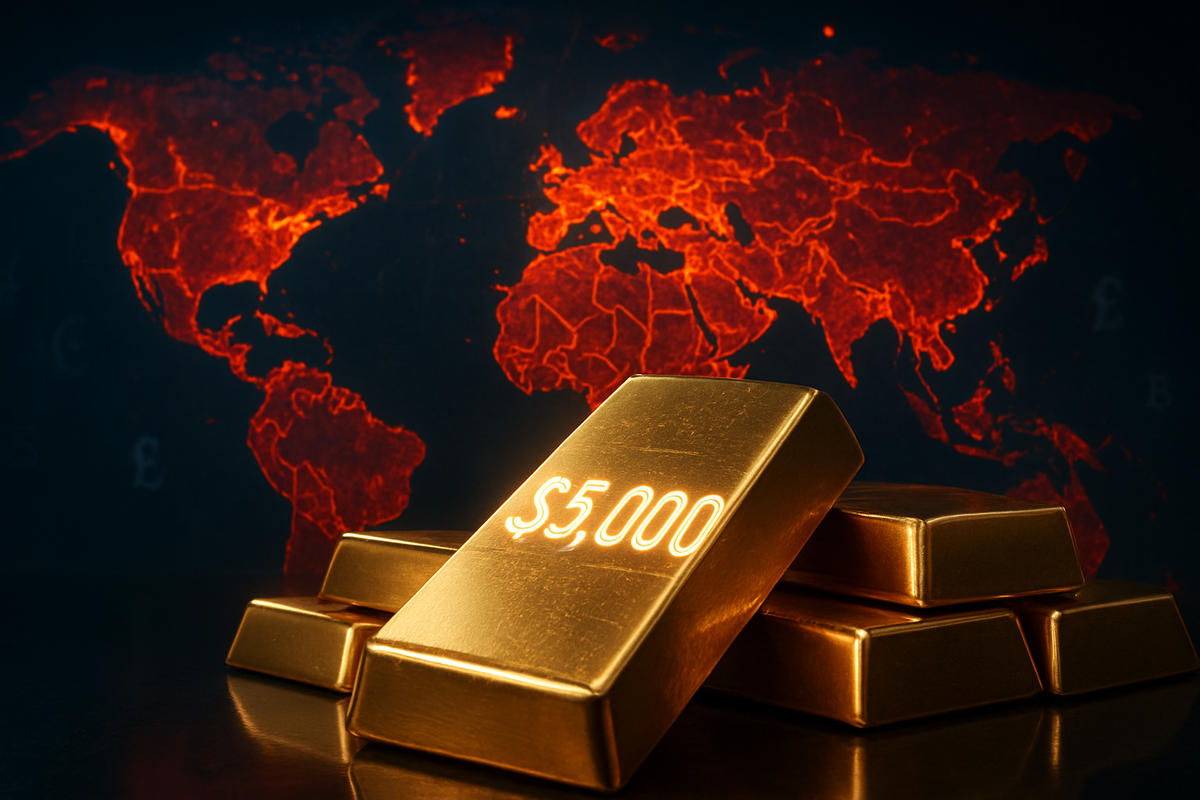
In a historic move that has sent shockwaves through global financial centers, spot gold prices officially breached the $5,000 per ounce milestone on January 26, 2026. This unprecedented ascent represents a 65% surge over the last calendar year, signaling a radical shift in investor sentiment as the "barometer of fear" reaches heights once thought impossible. The precious metal, long favored as a safe-haven asset, is now being treated as a necessary hedge against a crumbling international order and the accelerating devaluation of fiat currencies.
The breach of the psychological $5,000 barrier was not a slow climb but a frantic sprint. Driven by a combination of aggressive central bank purchasing and a sudden breakdown in trans-Atlantic diplomacy, gold has effectively decoupled from traditional market indicators like real interest rates. As of this morning, gold continues to trade in the $5,058 to $5,111 range, forcing major institutions and sovereign wealth funds to rethink the very foundations of the modern monetary system.
A Perfect Storm: The Path to $5,000
The journey to this historic high was catalyzed by a series of escalating geopolitical crises that began in late 2024 and reached a fever pitch in early 2026. The most immediate trigger was the "Greenland Gambit," a diplomatic standoff where the U.S. administration threatened a 25% tariff on European allies—specifically Denmark, France, and Germany—following failed negotiations over the strategic acquisition of Greenland. This move effectively nullified the 2025 "Turnberry Agreement," which had briefly stabilized global trade, and sent investors fleeing to the perceived safety of "politically neutral" assets.
Beyond the trade wars, a timeline of military interventions and domestic political instability in the United States fueled the fire. The capture of Nicolás Maduro during a U.S. military operation in Venezuela and heightened friction with Tehran kept the geopolitical risk premium at record levels throughout 2025. Simultaneously, a domestic crisis regarding the independence of the Federal Reserve—marked by a high-profile criminal investigation into Chair Jerome Powell—eroded confidence in the U.S. dollar, which saw its index (DXY) fall nearly 10% in a single year.
Central banks have been the primary architects of this price floor. Leading the charge, the People’s Bank of China has increased its gold holdings for 14 consecutive months, while the National Bank of Poland and other emerging markets have added over 1,000 metric tons annually for three years running. These institutions are no longer just diversifying; they are actively "de-dollarizing" their reserves to protect against sovereign debt "black swan" events and the weaponization of the dollar-based financial system.
Initial market reactions have been a mix of exhilaration and dread. While gold bugs celebrate the validation of their long-held theories, mainstream analysts are scrambling to adjust their models. Bank of America (NYSE: BAC) has already raised its price target to $6,000 per ounce by spring 2026, while Goldman Sachs (NYSE: GS) adjusted its year-end forecast to $5,400, citing "irreversible shifts" in the demand for non-fiat stores of value.
Winners and Losers in the New Gold Era
The most obvious beneficiaries of this rally are the major gold producers, whose profit margins have expanded to levels never before seen in the mining industry. Newmont (NYSE: NEM), the world's largest gold producer, saw its stock reach a record $125.92 this week, with earnings expected to grow by nearly 60% annually. With "All-In Sustaining Costs" (AISC) remaining relatively stable around $1,550 per ounce, Newmont and its peers are effectively printing cash at a $3,500 margin per ounce produced.
Barrick Gold (NYSE: GOLD) and Agnico Eagle (NYSE: AEM) have similarly outperformed the broader market, with Barrick tripling its share returns over the last 12 months. Agnico Eagle, focused on high-quality "Tier One" jurisdictions, reported a 35% year-over-year revenue increase, propelled by its massive Odyssey project. Meanwhile, Gold Fields (NYSE: GFI) has seen its ADRs jump 187% as it targets a 3-million-ounce annual production goal by 2030, and Hecla Mining (NYSE: HL) surged nearly 50% in January alone due to its significant leverage to both gold and silver, the latter of which recently tested the $100 mark.
However, the rapid rise of gold presents a double-edged sword for the broader economy. Industrial sectors that rely on gold—including high-end electronics and aerospace—are facing crushing input costs. Furthermore, the "Sell America" sentiment that has driven gold higher is a direct threat to the U.S. Treasury market. As international investors rotate out of U.S. debt and into bullion, the cost of borrowing for the U.S. government is expected to rise, potentially leading to a fiscal squeeze that could dampen consumer spending and capital investment in traditional equities.
Broader Significance and Historical Precedents
This event marks a definitive end to the "low volatility" era of the 2010s and fits into a broader trend of global fragmentation. The move to $5,000 is being compared to the gold rush of 1979-1980, when stagflation and the Iranian hostage crisis drove prices to then-unthinkable highs. However, the current rally is considered more fundamental; it is not just about inflation, but about the structural integrity of the international financial architecture.
The ripple effects are already visible among competitors and partners in the commodities space. Copper and silver have seen "sympathy rallies," as investors view all hard assets as a hedge against currency debasement. This has led to a "commodity super-cycle" that is reshaping global trade routes and forcing a re-evaluation of national security policies. Governments are now treating gold mines as strategic national assets, leading to increased regulatory oversight and, in some cases, talks of nationalization in volatile regions.
Historically, such sharp moves in gold often precede major shifts in the global reserve currency. The current "de-dollarization" trend, led by the BRICS+ nations, has finally reached a tipping point where the dollar's dominance is no longer taken for granted. This shift has massive policy implications, as the Federal Reserve may find itself forced to maintain higher interest rates to defend the currency, even if the domestic economy is slowing, creating a classic "policy trap."
What Comes Next: The Road to $6,000 and Beyond
In the short term, market participants should expect high volatility as the price of gold "consolidates" around the $5,000 level. Strategic pivots are already occurring within the investment community; many "60/40" portfolio models are being discarded in favor of "All-Weather" allocations that include 10% to 15% physical gold. We may also see the emergence of new gold-backed digital currencies or "stablecoins" as nations seek ways to facilitate trade outside of the SWIFT system without the logistical burden of moving physical bars.
A potential challenge for the market is the risk of a "liquidity crunch" if the dollar continues to weaken too rapidly. If the U.S. government moves to stabilize the dollar through aggressive interventions or capital controls, gold could face a temporary but sharp correction. Conversely, if the Federal Reserve is forced to pivot back to quantitative easing to prevent a government default, the $6,000 target could be reached before the end of the second quarter of 2026.
Long-term, the $5,000 milestone may be viewed as the moment the world returned to a de facto gold standard. As central banks continue to hoard the metal, the "free float" available for private investors will shrink, leading to a perpetual supply-demand imbalance. Scenarios involving the total "remonetization" of gold are no longer confined to the fringes of economic theory; they are now being discussed in the halls of the IMF and the World Bank.
Assessing the Market Moving Forward
The breach of $5,000 per ounce is more than just a price update; it is a signal that the global financial system is in a state of profound transition. The key takeaways for investors are clear: geopolitical risk is no longer a temporary noise but a permanent fixture of the market, and the traditional safety of the U.S. dollar is being challenged by a hard-asset alternative that has survived for millennia.
Moving forward, the market will likely remain in a "buy the dip" regime, supported by relentless central bank demand. However, investors must watch for signs of "regulatory pushback." If gold continues to drain liquidity from the bond market, governments may introduce new taxes or restrictions on gold ownership to protect their own fiat systems.
For the next several months, the focus will remain on the Federal Reserve and the ongoing diplomatic tensions in Europe and the Middle East. If the Greenland standoff or the Fed independence controversy remains unresolved, the upward trajectory for gold appears not only likely but inevitable. The "barometer of fear" is at a record high, and for now, it shows no signs of falling.
This content is intended for informational purposes only and is not financial advice