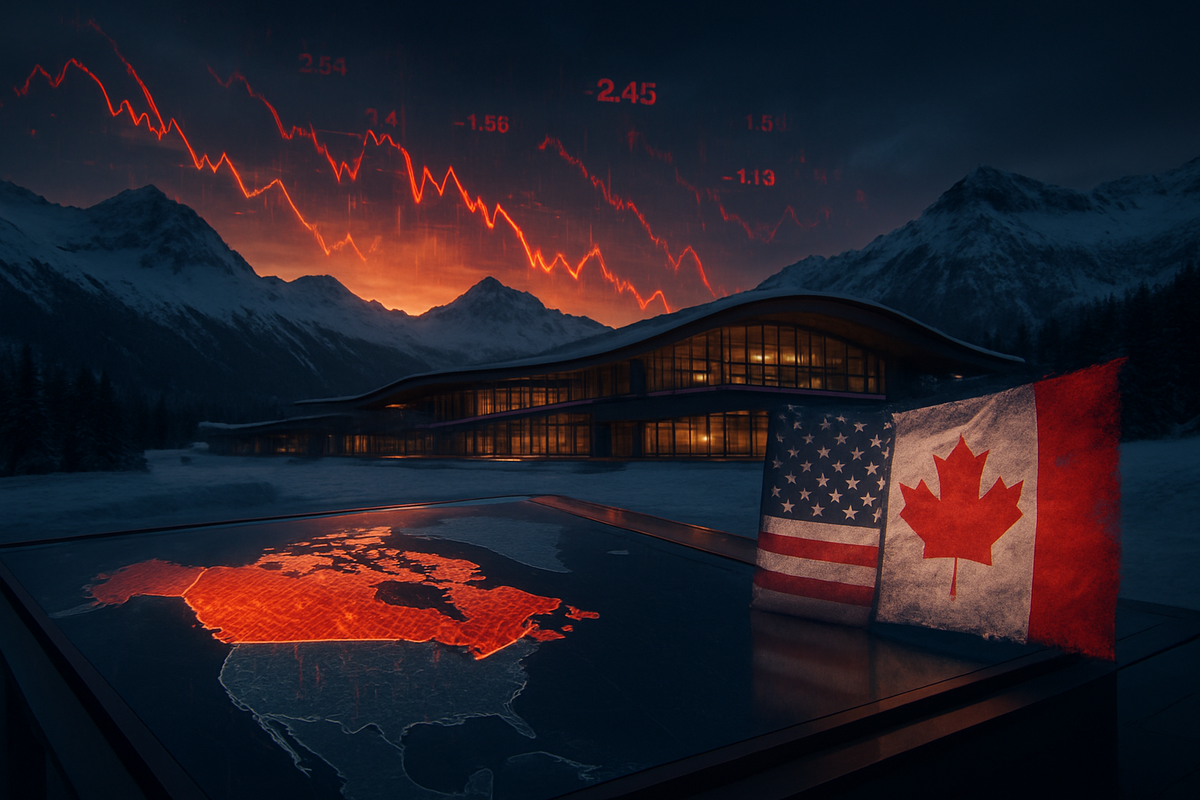
The global financial landscape has been sent into a tailspin following a series of high-stakes diplomatic confrontations at the World Economic Forum in Davos, Switzerland. As of today, January 26, 2026, investors are grappling with the potential for a total economic decoupling between the United States and its northern neighbor after President Donald Trump threatened to impose 100% tariffs on all Canadian goods. This drastic escalation, combined with a renewed and aggressive push for the "acquisition" of Greenland, has sparked significant market volatility, leaving trade-sensitive sectors in a state of high alert.
The immediate implications are profound. The S&P 500 has experienced sharp intraday swings, while the Canadian Dollar—commonly known as the "Loonie"—faces immense downward pressure against the Greenback. The threat of a 100% levy effectively signals the potential collapse of the U.S.-Mexico-Canada Agreement (USMCA) just as its mandatory review period begins, threatening to dismantle one of the world's most integrated regional supply chains.
A Week of Rhetorical Firestorms and Diplomatic Deadlocks
The current crisis began in earnest on January 21, 2026, when President Trump took the stage at Davos to deliver a keynote address that shifted from a victory lap on the U.S. economy to a stern warning for global allies. The President claimed a 77% reduction in the U.S. trade deficit over the past year, attributing the success to his administration's "America First" policies. However, the mood soured as he pivoted to his long-standing ambition of acquiring Greenland, describing it as a "strategic necessity" for North American security and critical mineral independence. While he explicitly ruled out military force—a move that provided a temporary "relief rally" for nervous markets—he insisted that European nations must cooperate with the U.S. on "right, title, and ownership" or face retaliatory trade measures.
The situation escalated further between January 24 and January 26, when the focus shifted toward Canada. The catalyst was a preliminary trade deal between Canadian Prime Minister Mark Carney and Beijing, which would see Canada lower tariffs on 49,000 Chinese electric vehicles (EVs) in exchange for China easing restrictions on Canadian agricultural exports like canola and lobster. President Trump responded with a "Backdoor" accusation, claiming Canada was being used as a "drop-off port" for Chinese goods to circumvent U.S. barriers. By the morning of January 26, the threat of a 100% tariff on all Canadian imports had become a central pillar of the administration's stance, sending shockwaves through the automotive and energy sectors.
Commerce Secretary Howard Lutnick has supported the President’s hardline stance, suggesting that Canada’s pivot toward China "upends" the spirit of the USMCA. Meanwhile, a fragile "framework deal" announced with NATO Secretary-General Mark Rutte regarding Arctic security and mineral rights has done little to soothe the concerns of Denmark and Greenlandic officials, who maintain that the territory is "not for sale."
Winners and Losers: Trade-Sensitive Sectors Under the Microscope
The threat of 100% tariffs has created a bifurcated outlook for public companies, with those reliant on cross-border supply chains facing an existential crisis. The automotive sector is perhaps the hardest hit. Magna International (NYSE: MGA), a linchpin of North American auto manufacturing based in Ontario, saw its shares tumble as the prospect of a complete halt in duty-free cross-border parts movement became a real possibility. Similarly, General Motors (NYSE: GM) and Ford Motor Company (NYSE: F), which operate deeply integrated plants in both the U.S. and Canada, are bracing for massive cost increases and production bottlenecks.
In the energy sector, the implications for Canadian heavy hitters like Suncor Energy (NYSE: SU) and Enbridge (NYSE: ENB) are staggering. Canada provides nearly 4 million barrels of oil per day to the U.S.; a 100% tariff would effectively price Canadian crude out of the American market, leading to a supply shock in the U.S. and a price collapse for Canadian producers. Conversely, some domestic U.S. producers might see a short-term benefit from reduced competition, though the broader economic slowdown could dampen overall demand.
On the "Greenland Narrative" front, the focus on critical minerals has put a spotlight on diversified miners like Rio Tinto (NYSE: RIO). If the U.S. secures a framework for mineral extraction in Greenland, companies with the expertise and capital to develop remote Arctic projects could stand to gain significant long-term concessions. However, in the near term, the geopolitical uncertainty acts as a drag on the entire sector. Agricultural giants like Nutrien (NYSE: NTR) are also in the crosshairs, as Canadian farmers face the prospect of losing their primary export market in the U.S. while being caught in the crossfire of the U.S.-China trade war.
Wider Significance: The End of Globalized Stability?
This event represents a significant departure from traditional trade diplomacy and fits into a broader trend of "geoeconomic fragmentation." The 100% tariff threat against a close ally like Canada marks a shift from targeted trade protectionism to total economic leverage. It suggests that the USMCA, once thought to be a bedrock of North American stability, is now being used as a tactical tool in a larger geopolitical struggle with China.
The "Greenland acquisition" narrative, while often dismissed as posturing, highlights the increasing importance of the Arctic as the next frontier for both resource extraction and national security. By linking Arctic sovereignty to NATO cooperation and trade tariffs, the administration is effectively redrawing the map of global alliances. This mirrors the trade wars of the late 1920s and early 1930s, where aggressive protectionism led to a breakdown in international cooperation, though modern financial markets are far more integrated and sensitive to such shifts.
Regulatory and policy implications are equally vast. If these tariffs are enacted, the World Trade Organization (WTO) would likely be rendered obsolete, as the world's largest economy bypasses traditional dispute resolution mechanisms in favor of unilateral action. For competitors in Europe and Asia, the U.S.-Canada rift offers both a warning and an opportunity to court a Canada looking to diversify its trade portfolio away from its southern neighbor.
The Path Forward: Escalation or Negotiation?
In the short term, markets will be looking for any sign of a de-escalation between the White House and Ottawa. A strategic pivot by Prime Minister Carney—perhaps a suspension of the China EV deal—might be the only way to avert the 100% tariff. However, such a move would be a significant political blow to the Canadian government and could invite retaliation from Beijing. Investors should expect continued volatility as "Twitter diplomacy" remains the primary driver of market sentiment.
In the long term, companies must adapt by "friend-shoring" or diversifying their supply chains away from high-friction borders. This could lead to a significant reshuffling of manufacturing hubs, with a potential surge in U.S. domestic investment at the cost of higher consumer prices. The "Greenland Framework" may evolve into a series of bilateral mining and security agreements that gradually integrate the Arctic more closely with the North American economic sphere, regardless of formal sovereignty changes.
The potential scenarios range from a "Grand Bargain" that preserves the USMCA in exchange for Canadian alignment on China, to a full-blown "Trade Wall" that bifurcates the North American continent. Market participants will be watching the bond market closely; if yields continue to rise on inflation fears, the administration may face internal pressure to moderate its stance.
Closing Assessment: A New Era of Trade Volatility
The events of this past week at Davos have fundamentally altered the risk profile for investors in 2026. The key takeaway is that no trade relationship—no matter how historical or integrated—is immune to being used as leverage in broader geopolitical strategies. The threat of 100% tariffs on Canada serves as a stark reminder that the "rules-based order" of the past several decades is being replaced by a more transactional and unpredictable era of international relations.
Moving forward, the market will likely remain in a state of "wait-and-see," with heightened sensitivity to every headline coming out of the White House and the Prime Minister’s Office in Ottawa. Investors should watch for the official start of the USMCA review, as this will provide the legal and political stage for these threats to either materialize or be negotiated away. For now, the "Davos Shock" remains the dominant theme, and the integration of the North American economy hangs in the balance.
This content is intended for informational purposes only and is not financial advice.