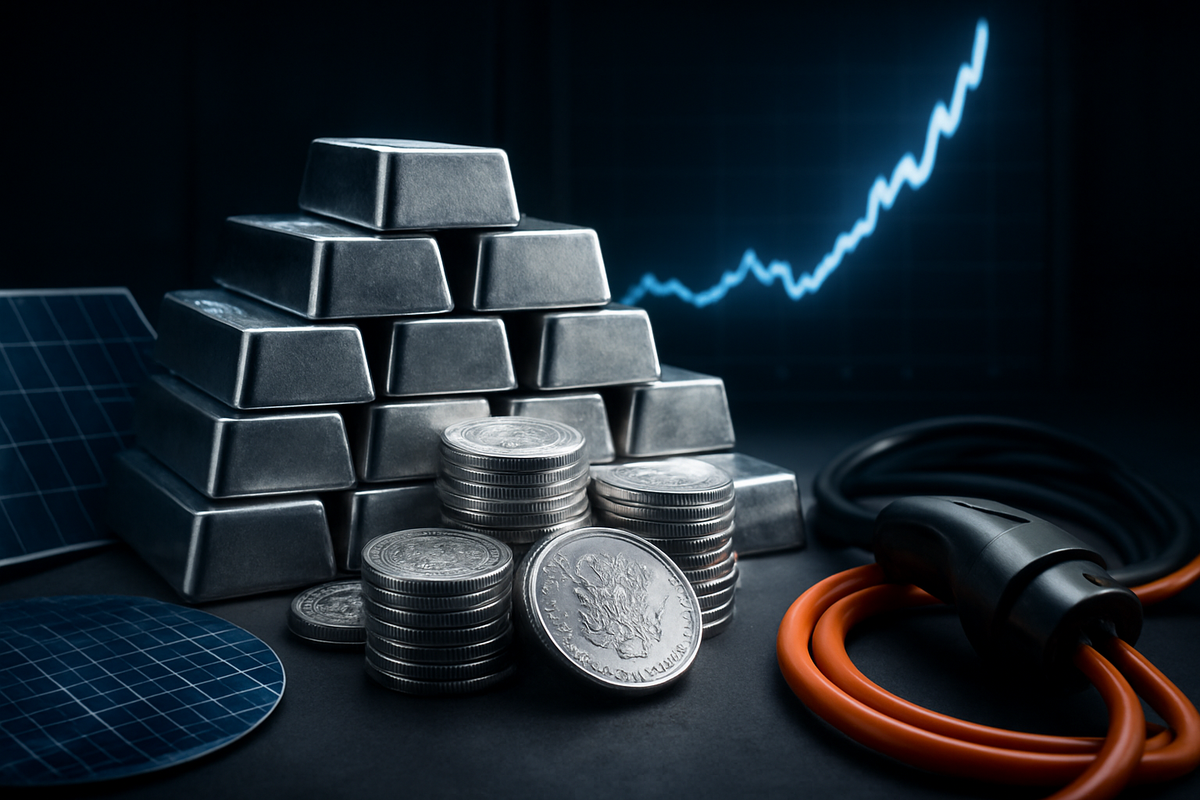
In a week that will be etched into the history of commodity markets, silver has shattered all previous records, surging past the $90 per ounce milestone and currently testing resistance near the $95 level. This explosive move represents a 147% rally over the past 12 months, the metal's strongest performance since the legendary Hunt Brothers-led bull market of 1979. The surge is no longer viewed as a mere speculative bubble but as a fundamental "structural re-rating" driven by an agonizing physical supply deficit that has left global inventories at their lowest levels in modern history.
The immediate implications are reverberating through the global economy. On January 14, 2026, the United States Mint took the unprecedented step of suspending sales of all silver numismatic products, citing an inability to source physical metal at costs that align with its currency-denominated pricing. This move, which many analysts are calling a "sovereign physical default," has sent a shockwave through the investment community, signaling that the era of cheap, abundant silver has come to a definitive end.
The Perfect Storm: Supply Deficits and Sovereign Hoarding
The journey to $90 silver began in earnest in early 2025, as the market entered its fifth consecutive year of a structural supply deficit. While demand has skyrocketed, global mine production has remained largely stagnant. Approximately 70% of the world’s silver is produced as a byproduct of lead, zinc, and copper mining, meaning that even as silver prices skyrocket, miners cannot simply "turn on the taps" without significantly increasing the production of other base metals. This inelasticity has created a bottleneck that the market is finally forcing to a head.
Compounding the supply issue is the rapid depletion of global stockpiles. In London, the clearing house for the world’s silver, "eligible" silver inventories held by the London Bullion Market Association (LBMA) plummeted to record lows of approximately 155 million ounces in early 2026. This scarcity is reflected in silver lease rates, which spiked to an unheard-of 8% this month, indicating that industrial users are so desperate for physical bars that they are paying massive premiums just to borrow the metal. Furthermore, the COMEX exchange in New York saw a massive withdrawal of nearly 26% of its registered inventory in a single week this January, as traders opted for physical delivery over paper settlement.
The geopolitical landscape has also shifted dramatically. On January 1, 2026, China implemented a new licensing regime that reclassified silver as a "Strategic Material," effectively curbing exports to ensure its domestic solar and semiconductor industries remain supplied. Meanwhile, India has become the world’s largest consumer, importing a record 6,000 metric tons in 2025 alone. Under its "Production Linked Incentive" (PLI) scheme, the Indian government has prioritized silver for its burgeoning solar gigafactories, turning the nation into a vacuum for global physical supply.
Winners and Losers: From Mining Profits to Manufacturing Pain
The stratospheric rise in silver prices has created a stark divide in the corporate world. Primary silver miners are currently the darlings of the market, benefiting from massive margin expansion. Pan American Silver (NYSE: PAAS), which recently reported record output from its La Colorada Skarn project, is seeing its free cash flow reach levels previously thought impossible. Similarly, First Majestic Silver (NYSE: AG) and Endeavour Silver (NYSE: EXK) have seen their market caps swell as high-grade production from mines like Terronera in Mexico captures the full force of the $90+ spot price. Wheaton Precious Metals (NYSE: WPM), a streaming giant with fixed-cost contracts often below $6 per ounce, is enjoying peerless margins, though it lacks the direct operational leverage of the primary miners.
On the other side of the ledger, industrial giants are facing a supply chain crisis. For First Solar (NASDAQ: FSLR), silver now accounts for nearly 29% of the total manufacturing cost of a solar panel, up from a mere 4% just two years ago. This has forced the industry into aggressive "thrifting"—using less silver per cell—or pivoting toward inferior copper-paste alternatives. In the automotive sector, Tesla (NASDAQ: TSLA) is reportedly launching "Project Redwood," a strategic initiative to secure its own silver reserves to bypass the volatile spot market. An average electric vehicle now uses between 25 and 50 grams of silver for its power electronics and sensors, making silver a primary driver of EV inflation.
The technology sector is equally exposed. NVIDIA (NASDAQ: NVDA) and Samsung Electronics (KRX:005930) are seeing rising costs for high-end AI chips and hardware. Silver’s unmatched electrical and thermal conductivity makes it essential for the thermal interface materials (TIMs) and high-speed interconnects used in AI data centers. As these companies race to build the next generation of AI infrastructure, the cost of the "silver glue" holding these systems together has become a significant headwind.
A Structural Shift in the Global Economy
The current silver rally is not just a repeat of history; it is a fundamental shift in how the metal is valued. While the 1979 rally was driven by the cornering of the market by a few wealthy individuals, the 2026 surge is driven by a global transition to green energy and advanced computing. Silver has officially transitioned from a precious metal that occasionally acts as an industrial commodity to a strategic industrial metal that happens to be precious.
This event mirrors the "rare earths" crisis of a decade ago, but on a much larger scale. The U.S. government’s decision to add silver to its Critical Minerals List in late 2025 underscores the regulatory shift. Policymakers are now viewing silver through the lens of national security and energy independence. The ripple effects are being felt in the currency markets as well, as silver's rise challenges the traditional gold-to-silver ratio, which has collapsed from its historical average of 80:1 to nearly 30:1 in just 14 months.
The regulatory implications are also growing. We are seeing early signs of "resource nationalism" beyond China, as other producing nations in Latin America consider higher royalties or export taxes to capture the windfall of $90 silver. For global manufacturers, this means the era of just-in-time inventory for industrial metals is over, replaced by a new era of strategic stockpiling and long-term vertical integration.
The Road to $100: What Comes Next?
As silver approaches the psychological $100 barrier, the market is bracing for extreme volatility. In the short term, the US Mint’s suspension and the LBMA’s inventory crisis suggest that a "short squeeze" of physical metal could drive prices even higher in the coming weeks. However, the high price levels are also likely to trigger a wave of "scrap" silver entering the market—jewelry and silverware being melted down—which could provide a temporary ceiling for prices.
Long-term, the market will require a massive investment in new mining capacity. Yet, because most silver is a byproduct, the silver market is essentially waiting for higher copper and zinc prices to justify new mine construction. This suggests that the supply deficit may persist for several more years, regardless of the price of silver. Investors should expect a move toward "substitution" as a major theme for 2026, with companies like Tesla (NASDAQ: TSLA) and First Solar (NASDAQ: FSLR) pouring billions into R&D to find silver-free alternatives, though such transitions often take years to perfect and certify.
Market participants should also watch for potential intervention from commodity exchanges. If the physical delivery demands continue to drain COMEX and LBMA vaults, we may see "liquidation-only" trading orders or massive margin hikes designed to cool the market. However, such measures often only serve to drive the "real" price of physical silver even higher in the over-the-counter and retail markets.
Final Assessment: A New Era for the White Metal
The surge of silver past $90 per ounce is a watershed moment for the global financial and industrial systems. It marks the point where the physical reality of resource scarcity has finally overridden the paper-heavy pricing mechanisms of the past several decades. The 147% annual rally is a testament to the metal's indispensable role in the 21st-century economy—from the panels capturing the sun's energy to the chips powering the AI revolution.
For investors, the coming months will be defined by a search for "security of supply." The companies that own the metal in the ground, such as Pan American Silver (NYSE: PAAS) and Coeur Mining (NYSE: CDE), are in a position of unprecedented strength. Conversely, the high-tech manufacturers that rely on silver must adapt or face significant margin erosion. As we move through 2026, the key metric to watch will not just be the spot price on a screen, but the physical inventory levels in London and New York. If those continue to bleed, $100 silver may only be the beginning.
This content is intended for informational purposes only and is not financial advice