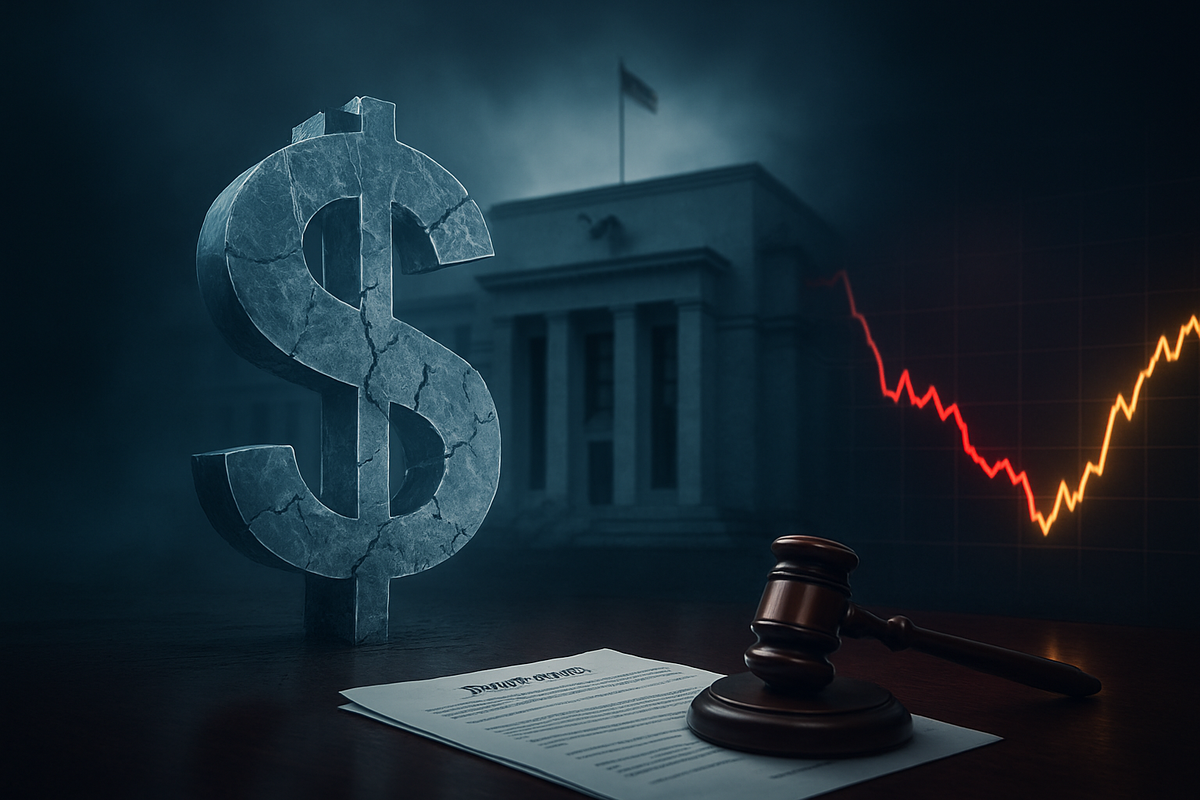
The US Dollar plummeted in early trading on January 12, 2026, as global investors reacted with alarm to the news that the Department of Justice (DOJ) has launched a formal criminal inquiry into the Federal Reserve. The US Dollar Index (DXY), which tracks the greenback against a basket of major currencies, fell 0.34% to 98.79, breaking through critical support levels as the prospect of a direct confrontation between the executive branch and the nation’s central bank introduced a massive "political risk premium" into American assets.
The immediate implications are far-reaching, as the move threatens to dismantle the long-standing wall of independence between the White House and monetary policy. With safe-haven assets like gold soaring to record highs above $4,600 per ounce, the market is signaling a profound loss of confidence in the institutional stability of the United States. Analysts suggest that the dollar's slide is not merely a technical correction but a fundamental reassessment of the currency's reliability in an era of unprecedented regulatory and political uncertainty.
The Subpoena That Shook the Street
The crisis reached a boiling point on January 11, 2026, when Fed Chair Jerome Powell announced that the DOJ, led by U.S. Attorney Jeanine Pirro and Attorney General Pam Bondi, had served the Federal Reserve with grand jury subpoenas. The investigation officially centers on allegations that Powell and other senior officials misled Congress during a June 2025 testimony regarding the multi-billion dollar renovation of the Marriner S. Eccles Building. What began as a $1.9 billion project reportedly ballooned to over $2.5 billion, with OMB Chair Russell Vought alleging that the Fed intentionally obscured these cost overruns to avoid oversight.
However, the timeline suggests a much deeper conflict. Throughout 2025, the administration repeatedly and publicly demanded aggressive interest rate cuts to stimulate the economy ahead of the 2026 midterms, despite the Fed’s insistence on maintaining a restrictive stance to combat persistent 2.7% inflation. In a defiant video statement released shortly after the subpoenas were served, Chair Powell characterized the probe as a "pretext" for political intimidation. The confrontation follows a failed attempt by the executive branch in late 2025 to remove Governor Lisa Cook from the Board of Governors, a move that was only halted by an emergency intervention from the Supreme Court.
Initial market reactions have been chaotic. Beyond the slide in the DXY, U.S. Treasury yields experienced a "bear steepening," with the 10-year yield surging to 4.20% as investors demanded higher compensation for the risk of holding long-term U.S. debt. Major financial institutions, including Goldman Sachs (NYSE: GS) and Evercore ISI (NYSE: EVR), have issued notes to clients warning that the investigation represents a "major crisis for markets" that could permanently impair the Fed's credibility.
Corporate Winners and Losers in the Wake of Volatility
The sudden weakening of the dollar has created a bifurcated landscape for public companies. Large-scale multinational exporters, such as Apple (NASDAQ: AAPL) and Boeing (NYSE: BA), may see a short-term boost as their products become more price-competitive abroad and their international earnings are translated back into fewer, more valuable dollars. However, these gains are being tempered by the broader market sell-off, as the Nasdaq 100 fell over 1% in the hours following the announcement.
On the losing side, major financial institutions like JPMorgan Chase (NYSE: JPM) and Bank of America (NYSE: BAC) are facing a dual threat. The volatility in the bond market makes it increasingly difficult to price loans and manage interest rate risk, while the potential for a "shadow Fed" or a politicized central bank threatens the very foundation of the global financial system they anchor. Furthermore, companies that rely heavily on imported components or raw materials are seeing their costs spike instantly as the dollar's purchasing power wanes.
Conversely, the primary beneficiaries of this institutional chaos have been precious metals and alternative assets. Mining giants such as Newmont (NYSE: NEM) and Pan American Silver (NASDAQ: PAAS) saw their share prices jump as gold and silver reached multi-year or all-time highs. Investors are fleeing to hard assets as a hedge against what many fear is the beginning of a prolonged period of American institutional decay.
A Historic Breach of Central Bank Independence
This event fits into a broader, more troubling trend of eroding institutional norms that has accelerated over the last decade. Historically, the Federal Reserve has operated with a high degree of autonomy to ensure that monetary policy is driven by economic data rather than election cycles. The use of the DOJ to investigate the Fed Chair over administrative costs is being viewed by many as a "weaponization" of the regulatory apparatus, a move that has few historical precedents in the United States but is common in emerging markets where central bank independence is weak.
The ripple effects are already being felt among international partners. Central banks in Europe and Japan are reportedly monitoring the situation closely, fearing that a weakened or politicized Fed could lead to a "race to the bottom" in currency devaluations. If the dollar’s status as the world’s primary reserve currency is called into question, the long-term cost of borrowing for the U.S. government could rise permanently, affecting everything from infrastructure spending to social programs.
The Road to May 2026
The short-term outlook remains focused on the legal battle ahead. Legal experts anticipate that the Federal Reserve will challenge the subpoenas in court, potentially leading to another Supreme Court showdown. In the meantime, the Fed is expected to maintain its current policy path to prove it will not be intimidated, which could lead to even higher interest rates and further friction with the White House.
The long-term pivot will likely occur in May 2026, when Chair Powell’s term is set to expire. The administration has already begun floating names like Kevin Hassett and Kevin Warsh as potential successors—individuals perceived as more aligned with the executive branch's economic vision. Investors should prepare for a period of "monetary regime change," where the traditional rules of the Fed's reaction function may no longer apply.
Navigating the New Economic Reality
The DOJ inquiry into the Federal Reserve marks a watershed moment for the American economy. The key takeaway for investors is that the "Fed Put"—the idea that the central bank will always step in to support markets—may be compromised by political infighting. The market is no longer just trading on inflation data and employment reports; it is now trading on constitutional law and executive orders.
Moving forward, the market will likely remain in a state of heightened volatility until the scope of the DOJ's investigation is fully understood. Investors should watch for the 10-year Treasury yield's movement and any signs of a coordinated response from the G7 central banks. The lasting impact of this week’s events may not be the 0.34% slip in the dollar, but the permanent shift in how the world views the independence and reliability of the U.S. financial system.
This content is intended for informational purposes only and is not financial advice.