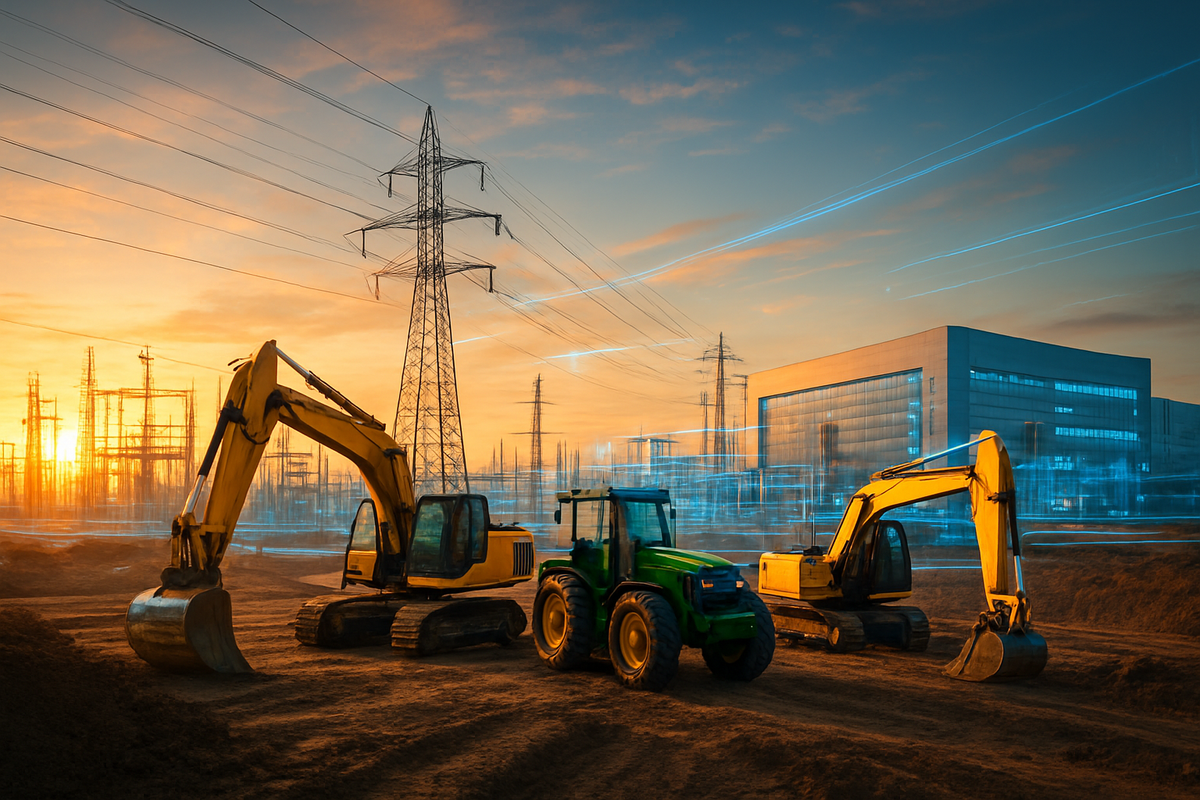
As the sun rises on January 1, 2026, the United States industrial sector stands at the precipice of what many economists are calling a "Golden Age" of manufacturing and infrastructure. Following a 2025 defined by tariff-related volatility and supply chain recalibrations, the new year brings a potent mix of fiscal tailwinds, peak infrastructure spending, and a massive surge in energy demand driven by the artificial intelligence revolution. The "soft landing" narrative of previous years has evolved into a robust "re-industrialization" reality, positioning heavy machinery and electrical equipment at the center of the American economic story.
The immediate implications are clear: the sector is no longer just a cyclical play but a structural growth engine. With the passage of the "One Big Beautiful Bill Act" (OBBBA) in July 2025, which permanently extended 100% bonus depreciation and immediate R&D expensing, domestic capital expenditure is hitting record levels. For investors, this has turned the industrial watchlist—specifically titans like Caterpillar (NYSE: CAT), Deere & Company (NYSE: DE), and Eaton Corporation plc (NYSE: ETN)—into a primary focus for the 2026 portfolio.
Peak Spending and Policy Tailwinds
The primary catalyst for the current industrial surge is the convergence of two massive legislative cycles. The Infrastructure Investment and Jobs Act (IIJA), passed years ago, is entering its final authorized year in 2026. This is the "peak impact" phase, with an estimated $209 billion in federal funds scheduled for disbursement this year alone. Unlike the early years of the bill, which were bogged down by planning and environmental reviews, 2026 is characterized by "shovels-in-the-ground" activity on massive bridge, rail, and tunnel projects across the country.
The timeline leading to this moment was marked by a stagnant 2025, where high interest rates and trade uncertainties led to significant inventory destocking. However, the July 2025 signing of the OBBBA acted as a massive liquidity injection, allowing firms to modernize facilities and reshore operations with unprecedented tax efficiency. This policy shift has effectively insulated the domestic industrial sector from global headwinds, creating a "Fortress America" manufacturing environment. Market reactions in the final quarter of 2025 saw industrial indices outperforming the broader S&P 500 by nearly 8%, a trend expected to accelerate as Q1 2026 earnings reports begin to reflect these record backlogs.
The Winners: CAT, DE, and ETN
Caterpillar (NYSE: CAT) has emerged as the clear leader in this new era, recently crowned as a top performer in the Dow Jones Industrial Average. While traditionally known for its yellow excavators, Caterpillar's "Energy & Transportation" segment is now its primary growth engine, accounting for nearly 48% of total revenue. The company is capitalizing on the insatiable power demand from AI data centers, holding a staggering $40 billion backlog for large-scale backup generators and reciprocating engines. As the world builds the physical infrastructure for the digital age, Caterpillar has transitioned from a construction company to a power-generation powerhouse.
Deere & Company (NYSE: DE) enters 2026 in a "trough-and-recovery" phase. While the large agricultural equipment cycle remained soft throughout 2025 due to lower commodity prices, management has signaled that early 2026 marks the definitive bottom. The company's "Construction & Forestry" division is picking up the slack, projected to grow by 10% this year as it supplies the heavy machinery required for IIJA-funded infrastructure projects. Furthermore, Deere’s aggressive push into autonomous, precision-agriculture technology is beginning to pay off, as farmers look to technology to offset labor shortages and increase margins in a tight commodity market.
Eaton Corporation plc (NYSE: ETN) is perhaps the most strategically positioned of the trio, acting as the "pure play" for the electrification of the U.S. economy. With a "Strong Buy" consensus heading into 2026, Eaton is struggling to keep up with demand for electrical switchgear, transformers, and grid modernization components. The company’s backlog is so deep that some critical components are reportedly sold out through late 2027. As data centers and the domestic manufacturing base require more reliable and complex power solutions, Eaton’s role as the "backbone of the grid" has made it a favorite for institutional investors seeking stable, high-margin growth.
The Wider Significance: Reshoring and the AI Footprint
This industrial boom is not merely a temporary spike in spending; it represents a fundamental shift in the global economic order. The trend of "reshoring"—moving manufacturing back to North America—has moved from a corporate buzzword to a structural reality. By the start of 2026, over 45% of U.S. manufacturers have relocated portions of their international operations to mitigate tariff exposure and supply chain risks. This has created a secondary demand market for industrial automation and specialized factory equipment, benefiting the entire ecosystem of suppliers and partners.
Furthermore, the "AI revolution" has finally found its physical footprint. While 2023 and 2024 were about software and chips, 2025 and 2026 are about the steel, concrete, and copper required to house and power those chips. The massive power requirements of data centers are forcing a total overhaul of the U.S. electrical grid, a task that aligns perfectly with the current regulatory environment favoring "all-of-the-above" energy independence. This has created a historical precedent where heavy industry and high technology are more intertwined than at any point since the first Industrial Revolution.
The Road Ahead: 2026 and Beyond
In the short term, the primary challenge for these industrial giants will be labor and capacity. With backlogs reaching multi-year highs, the ability to deliver machines and components on time will be the defining factor for stock performance. Investors should expect a series of strategic pivots toward "as-a-service" models, where companies like Caterpillar and Deere use IoT and AI to provide predictive maintenance and performance optimization, creating recurring revenue streams that are less sensitive to economic cycles.
Long-term, the focus will shift to what happens after the IIJA funds are fully exhausted in late 2026. The market will be watching closely for signs of a "fiscal cliff" or, more likely, a transition toward private-sector-led infrastructure investment. The emergence of autonomous construction and mining equipment will likely be the next major frontier, as companies look to automate high-cost, high-risk operations in an increasingly tight labor market.
Final Assessment for the 2026 Market
The industrial sector has entered 2026 with more momentum than it has seen in decades. The combination of peak federal spending, pro-growth tax policies, and the physical requirements of the AI boom has created a "perfect storm" for companies like Caterpillar, Deere, and Eaton. While the agricultural sector remains a point of caution, the strength in construction, power generation, and grid infrastructure more than compensates for any localized weakness.
For investors, the coming months will be about monitoring backlog conversion and margin expansion. As these companies navigate the "Roaring 2020s," the industrial watchlist will remain a cornerstone of the market. The lasting impact of this period will likely be a more resilient, technologically advanced, and domestically focused American industrial base that is capable of powering both the physical and digital economies of the future.
This content is intended for informational purposes only and is not financial advice.