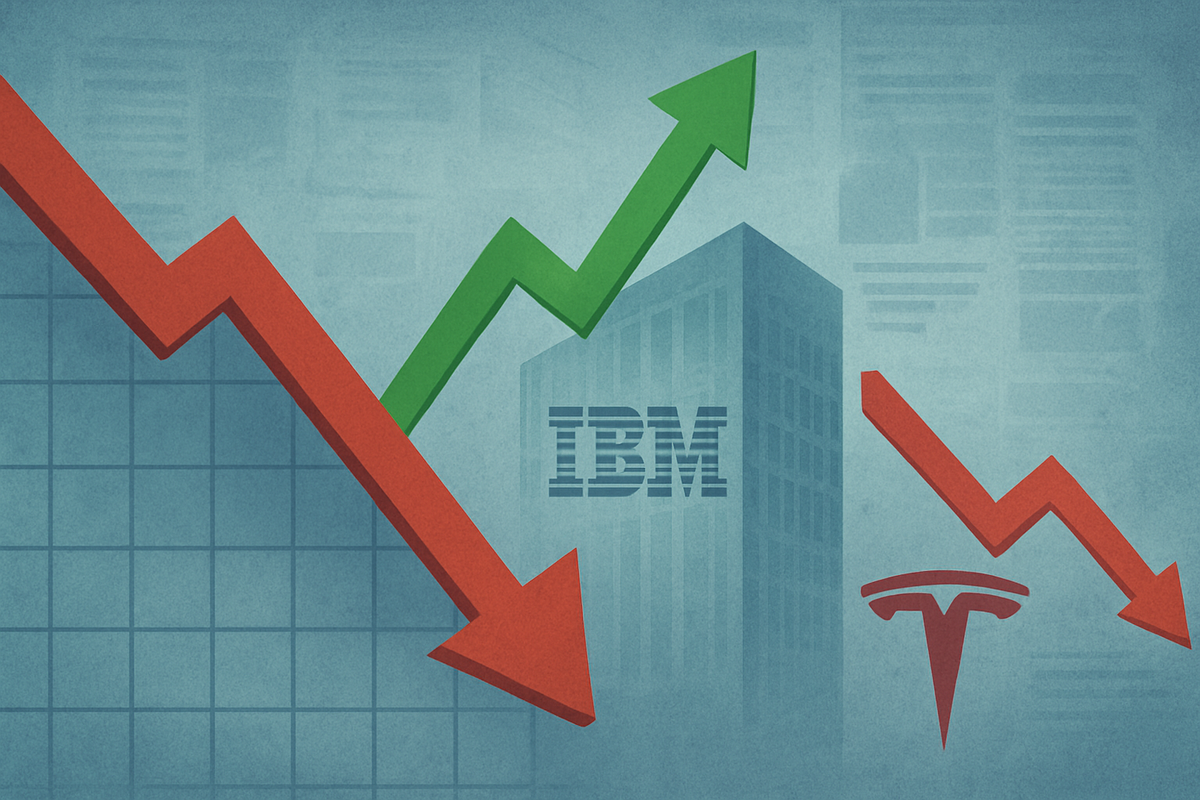
The financial markets experienced a day of stark contrasts on December 8, 2025, as the Dow Jones Industrial Average (DJIA) saw a notable decline, signaling broader market apprehension. Amidst this downturn, technology giant International Business Machines (NYSE: IBM) emerged as a significant gainer, propelled by news of an impressive $11 billion deal. Conversely, electric vehicle pioneer Tesla (NASDAQ: TSLA) faced a challenging session, with its stock sliding in the wake of a significant analyst downgrade.
This divergent performance across key market players underscores a complex economic landscape, where company-specific catalysts and industry-specific headwinds are creating distinct trajectories. While the broader market grapples with macroeconomic uncertainties, individual corporate actions and analyst sentiments are proving to be powerful determinants of stock performance, shaping the immediate fortunes of investors and setting the stage for potential shifts in market leadership.
A Day of Divergence: Dow's Descent, IBM's Ascent, and Tesla's Tumble
December 8, 2025, proved to be a volatile day for investors, characterized by a significant downturn in the broader market, epitomized by the Dow Jones Industrial Average's (DJIA) notable fall. The decline in the Dow reflected a confluence of factors, likely including ongoing concerns about inflation, potential interest rate adjustments by central banks, and geopolitical tensions that have been simmering. This market-wide trepidation led to a broad sell-off across various sectors, with investors moving towards safer assets and pulling back from riskier equities. The initial market reaction was one of caution, as traders assessed the potential for a deeper correction or a prolonged period of uncertainty, with many analysts pointing to a lack of immediate positive catalysts to reverse the trend.
In stark contrast to the broader market's woes, International Business Machines (NYSE: IBM) saw its stock surge following the announcement of an $11 billion deal. While the specific details of the deal are still emerging, preliminary reports suggest it involves a major strategic acquisition or a significant long-term contract in a high-growth sector such as artificial intelligence, cloud computing, or quantum technology. This substantial investment signals IBM's aggressive push to solidify its position in cutting-edge technological domains, moving beyond its traditional enterprise software and services. Key stakeholders in this deal likely include the acquired entity's shareholders, IBM's strategic partners, and, ultimately, its clientele who stand to benefit from enhanced offerings. The market reacted enthusiastically, viewing the deal as a strong indicator of IBM's future growth potential and a smart strategic pivot.
On the other end of the spectrum, electric vehicle (EV) titan Tesla (NASDAQ: TSLA) experienced a considerable stock slide, triggered by an analyst downgrade. The downgrade, reportedly from a prominent investment bank, cited concerns over increasing competition in the EV market, potential delays in new product rollouts, and a perceived saturation in some of its key markets. Furthermore, the analyst report highlighted challenges in maintaining profit margins amidst aggressive pricing strategies by competitors and rising manufacturing costs. The downgrade prompted a wave of selling pressure, as investors re-evaluated Tesla's growth trajectory and its ability to sustain its premium valuation in an increasingly crowded and competitive landscape. This event underscores the sensitivity of high-growth stocks to shifts in analyst sentiment and market perception.
Winners and Losers in a Shifting Landscape
The $11 billion deal announced by International Business Machines (NYSE: IBM) is poised to create both winners and losers within the technology sector. IBM itself is clearly positioned as a significant winner, with the deal expected to bolster its market share, expand its technological capabilities, and potentially open new revenue streams. This strategic move could put pressure on direct competitors in the specific niche the deal addresses, such as other cloud service providers (e.g., Amazon Web Services (NASDAQ: AMZN), Microsoft Azure (NASDAQ: MSFT)) or AI solution providers. However, it could also create opportunities for partners who integrate with IBM's expanding ecosystem, such as software developers or hardware manufacturers that complement IBM's new offerings. The deal signals a renewed competitive vigor from IBM, potentially forcing rivals to re-evaluate their own investment strategies and market positioning.
Tesla's (NASDAQ: TSLA) stock slide, following its analyst downgrade, reverberates throughout the electric vehicle (EV) market. While Tesla's immediate investors are facing losses, this event could be a mixed bag for its competitors. Companies like Ford (NYSE: F), General Motors (NYSE: GM), and a host of international EV manufacturers could see this as an opportunity to gain market share, especially if the downgrade points to fundamental challenges for Tesla that are not shared by its rivals. However, a significant downturn for Tesla, as the market leader, could also cast a shadow over the entire EV sector, leading to broader investor skepticism and potentially impacting the valuations of other EV startups and established automakers transitioning to electric. The market will be closely watching if this is a Tesla-specific issue or a harbinger of tougher times for the broader EV industry.
The broader market's fall, as reflected by the Dow's performance, indicates a general risk-off sentiment that impacts most public companies. Companies with strong balance sheets, stable earnings, and defensive characteristics, such as those in utilities or consumer staples, might be seen as relative winners as investors seek safety. Conversely, highly leveraged companies, those in cyclical industries, or growth stocks with high valuations are more likely to be among the losers in a declining market. This widespread market downturn can also affect initial public offerings (IPOs) and secondary offerings, as investor appetite for new issues diminishes, making it harder for companies to raise capital.
Wider Significance and Market Implications
Today's market movements, particularly IBM's (NYSE: IBM) strategic acquisition and Tesla's (NASDAQ: TSLA) downgrade, fit into broader industry trends that are reshaping the technological and automotive landscapes. IBM's $11 billion deal underscores the ongoing consolidation and intense competition within the enterprise technology sector, particularly in high-growth areas like AI, cloud, and specialized software. This trend reflects companies' urgent need to acquire innovative capabilities and expand their market reach to remain competitive against agile startups and established tech giants. It also highlights a broader shift towards integrated solutions, where companies seek to offer comprehensive platforms rather than siloed products, thereby creating ripple effects on smaller tech firms and potentially spurring further M&A activity across the industry.
Tesla's downgrade, on the other hand, speaks to the maturing yet increasingly competitive electric vehicle market. While EVs are undoubtedly a long-term trend, the initial "gold rush" phase is giving way to a more discerning market where differentiation, cost efficiency, and sustainable profitability are paramount. This event could trigger a re-evaluation of valuation multiples across the entire EV sector, potentially impacting competitors and partners alike. Legacy automakers investing heavily in EV transitions (e.g., Volkswagen (FWB: VOW3), Mercedes-Benz Group (FWB: MBG)) might find their efforts scrutinized more closely, while battery suppliers and charging infrastructure companies could face revised demand forecasts. Regulatory bodies might also pay closer attention to market dominance and fair competition within the rapidly evolving EV space, especially concerning pricing strategies and technological advancements.
Historically, periods of broad market downturns, similar to the Dow's fall today, often precede shifts in economic policy or reflect underlying macroeconomic adjustments. Comparisons can be drawn to previous periods of rising interest rates or inflationary pressures, where markets initially react with volatility before finding a new equilibrium. Large corporate deals, like IBM's, often serve as bellwethers for industry direction, much like significant acquisitions in the dot-com era or during the early days of cloud computing. Similarly, a prominent analyst downgrade of a market leader like Tesla can have a disproportionate impact, reminiscent of past instances where investor sentiment shifted dramatically for other high-growth companies following critical assessments. These events highlight the cyclical nature of markets and the constant interplay between corporate strategy, investor perception, and macroeconomic forces.
What Comes Next: Navigating the Future
In the short term, the market will likely continue to digest the implications of today's events. For the Dow, investors will be closely watching for any signs of stabilization or further decline, with particular attention paid to upcoming economic data releases, central bank announcements, and geopolitical developments. A sustained period of market volatility could prompt investors to reallocate capital towards more defensive sectors or safe-haven assets. International Business Machines (NYSE: IBM) will face the immediate challenge of integrating its new acquisition, demonstrating synergies, and delivering on the promised value. The market will scrutinize quarterly reports and management commentary for updates on the deal's progress and its contribution to IBM's financial performance. For Tesla (NASDAQ: TSLA), the immediate focus will be on how management addresses the concerns raised in the downgrade, potentially through strategic pivots in product development, pricing, or market expansion.
Looking further ahead, the long-term possibilities present a more complex picture. The Dow's performance will be heavily influenced by the trajectory of global economic growth and inflation. A successful integration and execution of the $11 billion deal could significantly transform IBM's competitive standing, positioning it as a dominant player in emerging tech fields and potentially leading to sustained stock appreciation. This could also spur further consolidation in the tech sector as other companies seek to keep pace. For Tesla, the challenge lies in navigating an increasingly competitive EV market while maintaining its innovation edge and profitability. Strategic adaptations might include diversifying its product portfolio, expanding into new geographical markets, or focusing on cost leadership to counteract competitive pressures.
Market opportunities and challenges will emerge from these dynamics. Opportunities might arise for investors to identify undervalued companies in sectors that have been unfairly impacted by the broader market downturn, or to capitalize on IBM's renewed growth trajectory. Challenges will include managing increased market volatility, discerning genuine long-term trends from short-term noise, and adapting investment strategies to a potentially shifting economic paradigm. Potential scenarios range from a quick market rebound if economic data improves and corporate earnings remain robust, to a more prolonged period of sideways trading or even a deeper correction if macroeconomic headwinds intensify. Investors should watch for corporate earnings reports, analyst revisions, and policy decisions that could provide clarity on the future direction of the market and individual stocks.
Comprehensive Wrap-up: Assessing the Market's Trajectory
Today's stock market activity on December 8, 2025, offers several key takeaways. Firstly, the broad market, as reflected by the Dow's fall, remains susceptible to macroeconomic uncertainties, highlighting the importance of a diversified portfolio and a cautious approach to investing. Secondly, company-specific news, particularly strategic acquisitions and analyst sentiments, continues to be a powerful driver of individual stock performance, as evidenced by IBM's (NYSE: IBM) impressive gains and Tesla's (NASDAQ: TSLA) decline. These contrasting movements underscore a market where fundamental corporate actions and perceived value can significantly diverge from broader market trends.
Moving forward, the market is likely to remain in a state of flux, influenced by a delicate balance of economic indicators, corporate developments, and investor sentiment. The success of IBM's $11 billion deal will be a critical factor in shaping its future trajectory and could serve as a bellwether for M&A activity in the tech sector. Similarly, Tesla's response to the analyst downgrade and its ability to navigate increasing competition will be pivotal for its stock performance and its leadership position in the EV market. The broader market will continue to grapple with inflation concerns, interest rate expectations, and geopolitical risks, all of which will contribute to ongoing volatility.
The lasting impact of today's events could be a further stratification of the market, where companies with clear growth strategies, strong balance sheets, and resilient business models outperform, while those facing significant headwinds or lacking clear direction struggle. Investors should watch for signs of economic stability, corporate earnings growth, and any shifts in central bank policy. Additionally, close attention should be paid to industry-specific trends, such as the evolution of AI and cloud computing, and the intensifying competition in the electric vehicle market, as these will likely dictate the winners and losers in the coming months and years.
This content is intended for informational purposes only and is not financial advice