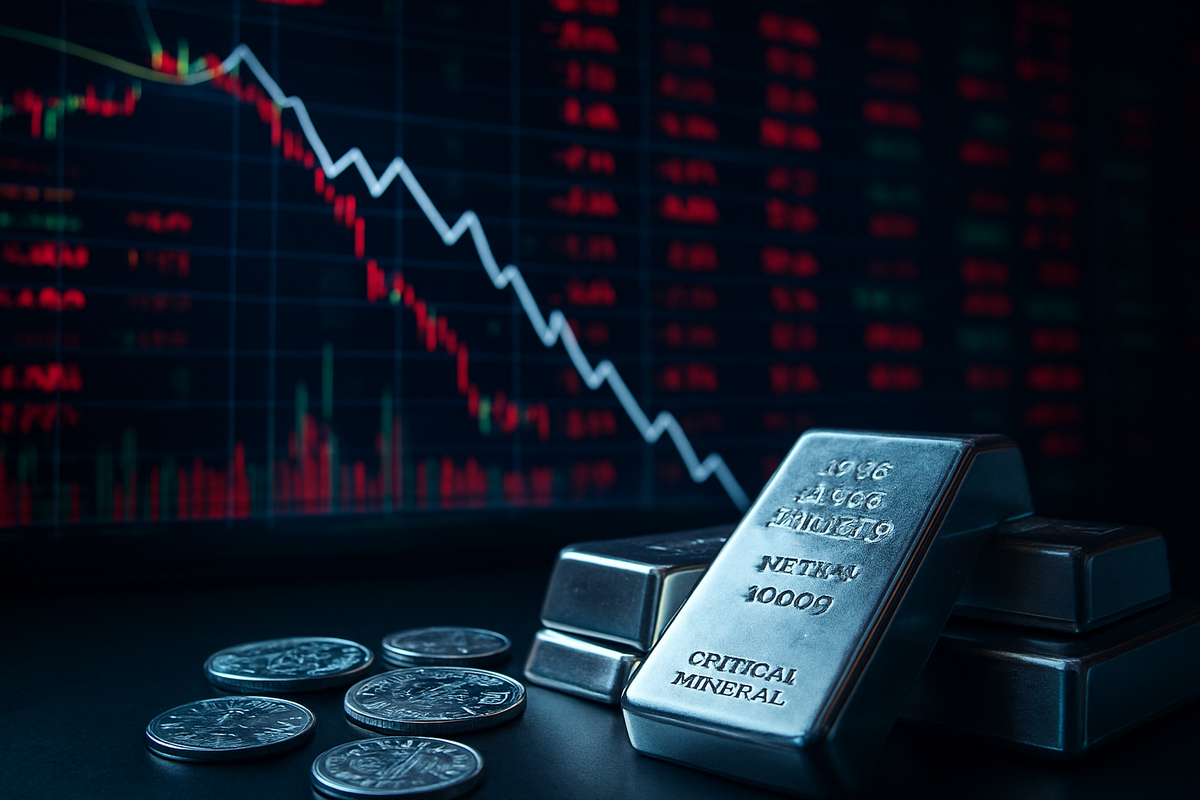
The silver market, which spent much of 2025 in a state of parabolic euphoria, has been dealt a sobering blow in the final week of the year. After reaching a historic all-time high of $85.87 per ounce just days ago, the white metal suffered a dramatic 11% intraday "flash crash" on December 29, 2025, sending shockwaves through the commodities sector. As of today, December 31, 2025, silver is struggling to stabilize near the $72.00 mark, leaving investors to grapple with the sudden evaporation of paper gains and a rapidly shifting technical landscape.
The immediate catalyst for this correction was not a shift in the underlying physical deficit—which remains acute—but rather a series of aggressive regulatory interventions by the CME Group (NASDAQ: CME). By hiking margin requirements for the second time in a fortnight, the exchange effectively drained liquidity from the market, forcing highly leveraged traders into a "liquidity trap" and triggering a cascade of stop-loss orders that shattered key technical support levels.
The Anatomy of the Year-End Liquidation
The slide began in earnest on the morning of December 29, following the implementation of CME Advisory No. 25-393. This directive, issued late on Friday, December 26, raised the initial margin for March 2026 silver contracts to $25,000 per contract—a significant jump from the $20,000 required at the start of the month. This regulatory "cooling" was aimed at curbing the speculative excess that had pushed silver’s 14-day Relative Strength Index (RSI) well above 80, a level historically associated with imminent reversals.
Technically, the breakdown was clinical and brutal. The first line of defense at $80.00, which had served as a psychological floor during the Christmas rally, gave way within minutes of the New York open. This breach accelerated the selloff toward the $75.00 level, a critical technical juncture that had previously acted as resistance during the November ascent. When $75.00 failed to hold, the "paper" market entered a freefall, only finding a temporary floor near $70.25, where the 50-day Simple Moving Average (SMA) and a cluster of institutional buy orders finally provided some price support.
This timeline of events marks the end of a historic run that began in October 2025, when silver decisively broke out of a 45-year "Cup and Handle" pattern dating back to the Hunt Brothers era. While the long-term structural breakout remains technically intact on a monthly chart, the short-term damage is extensive. Market participants, ranging from retail speculators to institutional hedge funds, were caught off guard by the speed of the CME's margin adjustments, which many have criticized as being overly aggressive during a low-liquidity holiday week.
Winners and Losers in the Silver Shakeout
The primary "losers" in this event are the leveraged longs and the exchange-traded products that track the spot price. The iShares Silver Trust (NYSE Arca: SLV), the world’s largest silver ETF, saw massive outflows as the price plummeted, reflecting a broader retreat from "paper" silver. Similarly, silver mining equities, which usually trade as a high-beta play on the metal, were hit hard. Major producers like Pan American Silver (NYSE: PAAS) and First Majestic Silver (NYSE: AG) saw their share prices retreat by double digits as investors reassessed the sustainability of the $80+ price environment. Even streaming companies like Wheaton Precious Metals (NYSE: WPM), typically seen as more resilient, were not spared in the broad-based sector rotation.
Conversely, the "winners" are found among industrial end-users and physical bullion accumulators. Tech giants and EV manufacturers, such as Tesla (NASDAQ: TSLA) and Samsung Electronics (KRX: 005930), have faced ballooning input costs throughout 2025 due to silver's essential role in photovoltaic cells, 5G infrastructure, and advanced electronics. A retreat to the $70 range provides a much-needed reprieve for procurement departments looking to hedge their 2026 requirements. Furthermore, physical "stackers" in the retail market have viewed the dip as a generational buying opportunity, particularly as the "Great Divergence" between COMEX paper prices and physical premiums in the East continues to widen.
The divergence is particularly stark in the Shanghai market, where silver continues to trade at a significant premium to the New York price. This suggests that while the "paper" price has been suppressed by margin hikes, the physical demand—driven by a 200-million-ounce global supply deficit—remains unsatisfied. For companies that rely on physical delivery rather than futures speculation, this price drop is a tactical window to secure supply before the next leg of the bull market begins.
Broader Industry Trends and Historical Precedents
This event fits into a broader trend of "commodity weaponization" and regulatory oversight that has defined the 2025 trading year. Earlier this year, the U.S. Geological Survey officially designated silver as a "Critical Mineral," placing it on the same strategic footing as lithium and rare earth elements. This shift in status has brought more scrutiny to the market, with regulators like the CME Group under pressure to prevent the kind of "short squeeze" volatility that could disrupt the green energy transition.
Historically, this selloff bears a striking resemblance to the May 2011 "Silver Sunday" crash, where five margin hikes in nine days sent silver tumbling from nearly $50 to $35. However, the 2025 context is different due to the lack of available physical inventory. Unlike 2011, global exchange vaults are at multi-decade lows, and the industrial demand floor is significantly higher due to the massive scaling of solar energy and AI-driven hardware requirements.
The "China Factor" also adds a layer of complexity. With Beijing announcing strict export licensing for refined silver effective January 1, 2026, the late-December selloff may be the "calm before the storm." Competitors in the mining and refining space are closely watching how these trade restrictions will impact global liquidity. If China, the world's largest consumer and a major refiner, restricts supply just as Western exchanges are making it harder to hold long positions, the result could be a permanent decoupling of the physical and paper markets.
The Road Ahead: Scenarios for 2026
In the short term, silver is likely to enter a period of consolidation between $68.00 and $75.00 as the market digests the margin hikes. A successful defense of the $70.00 psychological level is paramount for the bullish case; a weekly close below this mark could signal a deeper correction toward the $60.00 breakout zone. However, if the market can absorb the excess "paper" supply and hold the 50-day SMA, the stage will be set for a recovery attempt in early Q1 2026.
Long-term, the strategic pivot for many investors will be moving away from leveraged futures and toward physical ownership or non-leveraged equity positions. The "margin-induced shakeout" has demonstrated the risks of playing in the COMEX arena when prices become parabolic. Market opportunities may emerge in mid-tier miners that were unfairly punished during the crash, as their 2026 earnings projections remain robust even at $70 silver.
The most critical scenario to watch is the implementation of China’s export restrictions on New Year’s Day. If these restrictions lead to a physical shortage in London or New York, the CME Group may find itself in the difficult position of having to further raise margins to prevent a "melt-up" or, conversely, being forced to allow prices to rise to attract more scrap metal into the vaults. The tension between regulatory control and physical reality will be the defining theme of the coming months.
Summary and Investor Outlook
The recent slide in silver prices serves as a potent reminder that in the world of commodities, the "paper" market often dictates the short-term price, regardless of the physical reality. The CME Group's decision to hike margin requirements at the peak of a historic rally effectively pricked the speculative bubble, leading to a breakdown of key support levels at $80 and $75. While the 11% crash was painful for those caught on the wrong side of the trade, it has arguably created a healthier market structure by flushing out weak hands and over-leveraged positions.
Moving forward, the market remains in a precarious but potentially lucrative position. The fundamental deficit and silver’s new status as a "Critical Mineral" provide a strong long-term tailwind, but the technical damage from the December crash will take time to repair. Investors should watch for a consolidation phase in early January and pay close attention to the $70.00 support level and the 50-day moving average.
The lasting impact of this event will likely be a shift in how market participants approach silver. With the threat of margin hikes always looming during periods of high volatility, the preference for physical metal and "un-leveraged" exposure is expected to grow. As we head into 2026, the "Sterling Fall" of December 2025 may be remembered not as the end of the bull market, but as the moment the market moved from speculative mania to a more grounded, fundamentally driven ascent.
This content is intended for informational purposes only and is not financial advice.