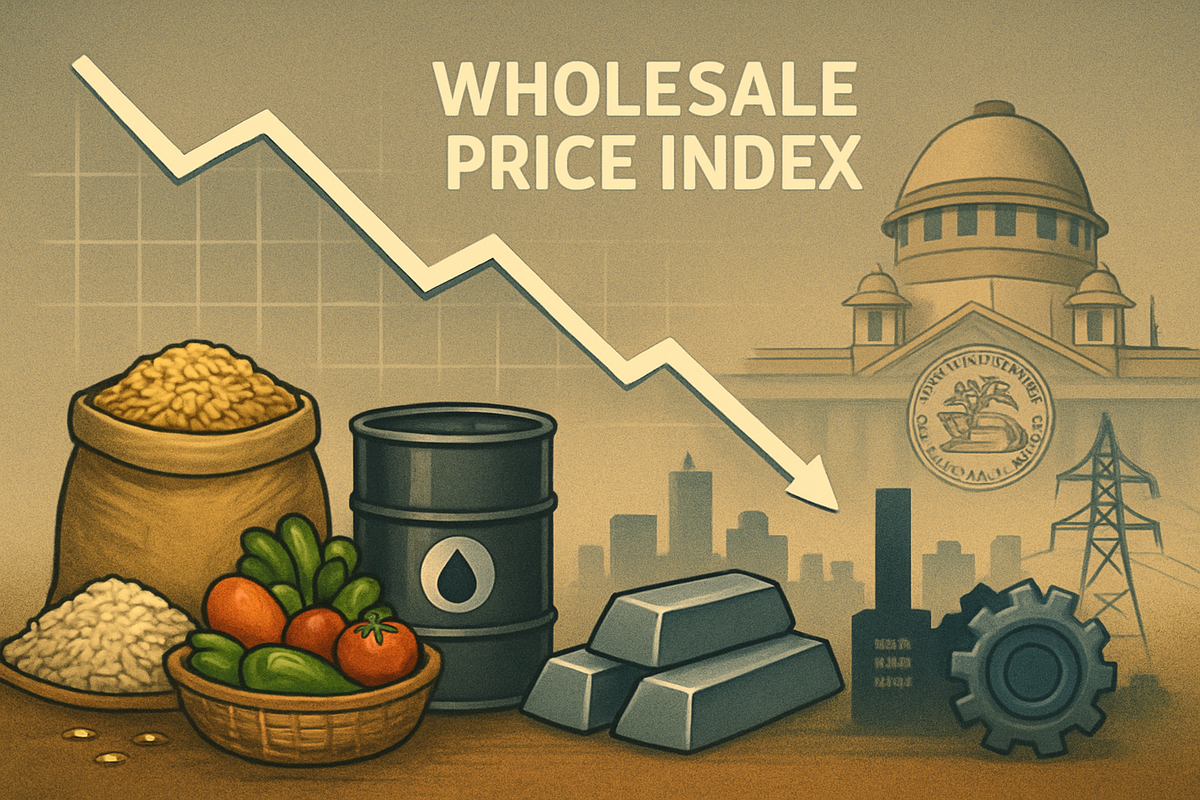
India's Wholesale Price Index (WPI) has continued its downward trend, registering negative inflation for the second consecutive month in November 2025. This sustained period of easing price pressures, with the WPI standing at (-) 0.32 per cent in November, following a (-) 1.21 per cent dip in October (a 27-month low), signals a significant shift in the nation's economic landscape. The data, released by the Ministry of Commerce and Industry on December 15, 2025, highlights a complex interplay of factors, primarily driven by declining prices in food articles, mineral oils, and basic metals.
While offering a welcome reprieve for the Reserve Bank of India (RBI) (RBI:NSE), which has already responded with a 25 basis point repo rate cut and a revised, lower inflation projection of 2 per cent for FY2025-26, the persistent negative WPI raises questions for various stakeholders. For commodity producers, it could translate into squeezed margins and reduced profitability, while consumers might experience enhanced purchasing power. This "Goldilocks period" of strong growth and moderating inflation presents both opportunities and challenges, shaping the strategic decisions of businesses and the daily lives of citizens.
Sustained Deflationary Pressures Reshape Economic Outlook
The latest figures reveal a WPI-based inflation of (-) 0.32 per cent on an annual basis for November 2025. This follows an even steeper decline in October 2025, which saw WPI inflation at (-) 1.21 per cent, marking a 27-month low. The sequential month-on-month data, however, indicates a slight uptick, with the overall WPI index rising by 0.71 per cent in November from October, suggesting some underlying price momentum at the wholesale level despite the year-on-year deflation.
The primary drivers behind this sustained negative WPI are diverse. Food articles, a significant component, continued their deflationary trend for the sixth consecutive month in November 2025, albeit with a narrowing contraction of (-) 3.91 per cent compared to (-) 8.31 per cent in October. Deflation in key food items like vegetables, pulses, potatoes, and onions also narrowed. Beyond food, substantial contributions to the overall negative WPI came from a decline in prices of mineral oils, crude petroleum & natural gas, basic metals, and electricity.
Inflation in manufactured products also eased to 1.33 per cent in November, while the fuel and power group experienced deflation of 2.27 per cent. This broad-based easing of wholesale prices has provided the Reserve Bank of India (RBI:NSE) with significant monetary policy flexibility. The central bank has already responded by cutting the repo rate by 25 basis points to 5.25 per cent and has revised its inflation projection for the 2025-26 fiscal year downwards to a benign 2 per cent from an earlier 2.6 per cent. This proactive stance underscores the RBI's confidence in the moderating inflation trajectory, allowing it to pivot towards growth supportive measures.
Corporate Fortunes Diverge: Winners and Losers in a Deflationary Landscape
A sustained negative Wholesale Price Index (WPI) in India creates a dual-edged sword for the corporate sector, forging both winners and losers. Generally, industries that are significant consumers of raw materials and energy stand to benefit substantially. Manufacturers, particularly those with high commodity input costs, find their operational expenses reduced. Sectors like automobiles (Maruti Suzuki India Ltd.:NSE, Tata Motors Ltd.:NSE), consumer durables (Voltas Ltd.:NSE, Havells India Ltd.:NSE), chemicals (Pidilite Industries Ltd.:NSE, UPL Ltd.:NSE), and Fast-Moving Consumer Goods (FMCG) (Hindustan Unilever Ltd.:NSE, ITC Ltd.:NSE) could see a boost in their profit margins due to cheaper raw materials and energy, assuming consumer demand remains robust. Lower fuel prices also provide a direct advantage to transport and logistics companies, including aviation (IndiGo:NSE) and road transport players.
Conversely, primary commodity producers are likely to bear the brunt of the deflationary environment. Agricultural producers, especially farmers, are among the biggest losers, facing significantly reduced selling prices for their produce. Reports indicate plummeting prices for essential vegetables like onions and potatoes, often falling below the cost of production, leading to severe income compression and potential losses. Similarly, producers in the mining and energy sectors face lower revenue realizations. Companies involved in crude oil and natural gas exploration and production (Oil and Natural Gas Corporation:NSE (ONGC), Reliance Industries Ltd.:NSE) would see their top lines impacted by falling global and domestic prices.
The basic metals sector is another significant loser. Producers of steel (Tata Steel Ltd.:NSE, JSW Steel Ltd.:NSE) and non-ferrous metals (Hindalco Industries Ltd.:NSE, Vedanta Ltd.:NSE) would contend with downward pressure on their selling prices, directly affecting their revenues and profitability. While lower input costs can be beneficial for some, the inability to pass on costs or maintain pricing power in a deflationary environment becomes a critical challenge. Furthermore, commodity traders and wholesalers might face inventory losses if they hold substantial stocks of goods whose prices are consistently declining.
Wider Significance: A 'Goldilocks' Economy Navigates Deflationary Currents
India's sustained negative WPI in November 2025, alongside robust real GDP growth of 8.2% in Q2 FY26, paints a picture of a "Goldilocks period" – strong economic expansion coupled with remarkably low inflation. While this environment provides immediate relief from input cost pressures for manufacturers, potentially boosting profit margins, a prolonged period of wholesale deflation also carries inherent risks. It can signal underlying weaknesses in demand, potentially leading to a slowdown in industrial growth and overall income realizations if not managed carefully. The divergence between WPI and CPI is also notable, with retail inflation (CPI) remaining low but positive at 0.71% in November, indicating that while wholesale prices are falling, the consumer still experiences some price increases, albeit muted.
This benign inflation environment has significantly influenced the Reserve Bank of India's (RBI:NSE) monetary policy. The central bank has capitalized on the low inflationary pressures, including the negative WPI, to cut the policy repo rate by 25 basis points to 5.25 per cent. Furthermore, the RBI has revised its inflation projection for FY2025-26 downwards to 2 per cent, well within its mandated target band. While the RBI primarily targets CPI for its policy decisions, the negative WPI reinforces the disinflationary trend and provides ample room for an accommodative stance aimed at fostering economic growth. The government, on its part, faces the crucial task of supporting agricultural incomes, which are severely impacted by falling farm-gate prices, potentially through measures like dynamic stock management and import duties on certain pulses.
The deflationary trend in wholesale prices could enhance the competitiveness of Indian export-oriented industries by reducing domestic input costs. However, this advantage might be partially offset by similar disinflationary pressures on global commodity prices, driven by factors like oversupply. India's trade dynamics remain complex, with a growing trade deficit with key partners like China. The global economic environment, marked by uncertainties in trade agreements and geopolitical factors like European tariffs on Russian oil impacting India's refining exports, adds layers of complexity to the broader economic outlook.
India has experienced negative WPI in the past, such as in April 2023 and June 2020, often linked to global commodity price declines. However, the current "Goldilocks" scenario of high growth coupled with low inflation is a unique distinguishing factor. A significant historical shift occurred in 2014 when the RBI adopted CPI as its primary inflation measure, meaning that while negative WPI is a vital indicator of input cost trends, its direct influence on RBI's rate decisions is secondary to CPI. This current period, therefore, presents a distinct challenge and opportunity for policymakers to leverage a favorable macroeconomic environment while mitigating risks, particularly for vulnerable sectors.
What Comes Next: Navigating a New Economic Equilibrium
The trajectory of India's WPI in the coming months will be keenly watched. In the short term, while November 2025 saw a softening of the WPI decline compared to October, experts anticipate a gradual move back into positive territory. Projections suggest WPI could be around 0.5% year-on-year in December 2025 and average above 1.5% in Q4 FY26, though some forecasts suggest it might remain negative for most of the remaining fiscal year. Looking further ahead, the long-term outlook for wholesale inflation remains benign, with the RBI (RBI:NSE) revising its FY26 inflation forecast to 2%. Trading Economics projects WPI to trend around 2.30% in 2026 and 2.40% in 2027, indicating a trajectory of low but positive wholesale inflation in the medium to long term.
This environment of low wholesale inflation and strong growth necessitates strategic pivots for businesses. Companies must prioritize cost efficiency, supply chain optimization, and innovation to maintain profitability, as significant price increases will be challenging. There's an opportunity to focus on increasing sales volumes and market share through competitive pricing, especially in sectors like FMCG and auto. Industries planning expansion can leverage lower borrowing costs due to accommodative monetary policy. Opportunities also emerge in domestic consumption revival, manufacturing and infrastructure push, and continued digital transformation. However, businesses heavily reliant on rural markets must carefully monitor income trends and adapt their offerings to cater to price-sensitive consumers, given the pressure on farmers' incomes.
Despite the "Goldilocks" narrative, challenges persist. The benefits of low inflation are not uniformly distributed, with farmers facing significant economic pressure. Global headwinds, such as a slowdown in the US economy or delays in global recovery, could disrupt India's growth. The most optimistic "Goldilocks Sustained" scenario sees robust growth with low inflation continuing, driven by efficient supply chains and accommodative policy. A "Moderate Growth with Persistent Low Inflation" scenario suggests healthy but slightly moderated growth with WPI remaining low. A more pessimistic "Deflationary Spiral" where demand collapses and prices continue to fall is considered less likely given current growth, but remains a tail risk. Conversely, an "Inflationary Rebound" due to unforeseen shocks could force the RBI to reverse its accommodative stance.
A Balanced View: India's Deflationary Dance
India's WPI remaining in negative territory for the second consecutive month in November 2025, at (-) 0.32 per cent, underscores a significant easing of wholesale price pressures. This sustained disinflation is primarily driven by declines in food articles, mineral oils, crude petroleum & natural gas, basic metals, and electricity. While the year-on-year WPI contracted, a month-on-month increase of 0.71 per cent in November suggests some underlying sequential price momentum. This benign inflation outlook has empowered the Reserve Bank of India (RBI:NSE) to adopt an accommodative monetary policy, including a 25 basis point repo rate cut and a revised, lower inflation forecast for FY26.
The market is currently navigating a "Goldilocks period" of robust growth and low inflation, which offers opportunities for credit expansion and investment. However, the prolonged wholesale deflation presents a nuanced picture. While lower input costs benefit many manufacturers, primary commodity producers, especially farmers, face significant income pressure. The lasting impact will depend on whether this disinflation is a temporary phenomenon driven by supply-side factors or a symptom of deeper demand weaknesses. Historically, sustained negative WPI has sometimes coincided with market downturns, but the current strong GDP growth distinguishes this period.
For investors, the coming months demand a watchful and selective approach. Key indicators to monitor include the WPI's trajectory (expected to turn positive soon), CPI inflation (which saw a slight month-on-month increase in November), and the RBI's future monetary policy actions. The movement of global commodity prices, especially crude oil and metals, will directly influence WPI. Furthermore, the rupee's performance and foreign institutional investor (FII) flows will be crucial for overall market sentiment. Investors should identify sectors benefiting from lower input costs (e.g., manufacturing, auto, FMCG) and those facing challenges from squeezed margins or depressed demand (e.g., primary commodity producers, segments of banking sensitive to lower lending rates). The ultimate test will be if India can sustain its high growth trajectory while effectively managing the distributional impacts of low inflation, ensuring that the "Goldilocks" phase truly translates into inclusive and stable economic prosperity.
This content is intended for informational purposes only and is not financial advice