Your birth certificate, property deed, original will, family jewellery, and emergency cash share one trait: losing them hurts, and some are impossible to replace. Yet many households still keep these items in a bedroom drawer or a basic home safe.
The risks are not hypothetical. In the United States, FBI figures recorded more than 779,000 burglaries in 2024, and natural disasters routinely destroy the very paperwork families need to recover afterward. A safety deposit box in Singapore is one way to move valuables out of harm’s way, but it is not the only option, and it is not right for everything.
This guide compares the main choices: home safes, a bank safe deposit box, a private vault, and digital backups, so you can match each valuable to the right level of protection.
Why protecting your documents and valuables matters
Some losses are an inconvenience; others are permanent. Replacing a passport or title deed after a fire or flood can take weeks of paperwork across multiple agencies, and sentimental items cannot be reissued at all.
Home storage carries a particular weakness. The US Federal Deposit Insurance Corporation notes plainly that a burglar can break into a home and open a safe more easily than reach a safe deposit box at a bank. A safe is convenient, but convenience and security pull in opposite directions.
The goal is not to pick a single “best” location. It is to understand the trade-offs and use the right tool for each item.
Comparing your storage options: home safe, bank box, and private vault
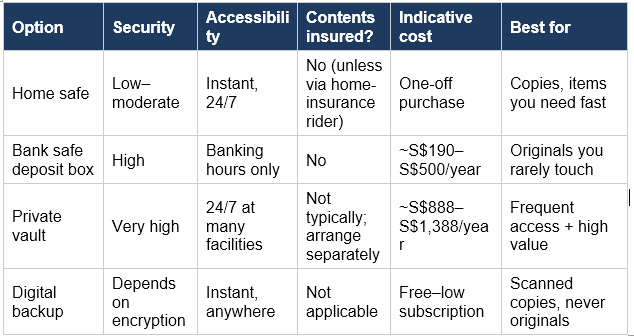
Each method scores differently on security, accessibility, insurance, and cost. The table below summarises the practical differences.
 b
b
A key point across all physical options: in Singapore, banks generally store box contents at the customer’s own risk and do not insure them, so arrange separate cover for anything valuable regardless of where it sits.
Can foreigners open a safe deposit box in Singapore?
Yes, but the route matters. With a bank, you usually need a qualifying account first, and non-residents often struggle to open a Singapore bank account at all. Foreigners who do qualify typically need a valid passport plus an ICA pass, such as an Employment Pass, Work Permit, Dependant's Pass, Student Pass, or Long-Term Visit Pass.
A private vault in Singapore removes that hurdle. Independent operators are open to locals, permanent residents, and foreigners alike, with no banking relationship required. Verification is usually a simple phone or email step. This makes a private vault the more accessible choice for expatriates and frequent travellers.
How much is a safe deposit box in Singapore?
Pricing depends on whether you go with a bank or a private vault, and on box size.
• Bank route (e.g., DBS): annual fees run from about S$190.75 to S$501.40, paid yearly in advance with a one-year minimum, GST included.
• Private vault route (e.g., Vault@268): published rates are S$888 a year for a small box and S$1,388 for a large box, plus a one-time administration charge and a refundable S$200 deposit.
Private vaults cost more, but the premium buys round-the-clock access, stronger security, and independence from banking hours. Always confirm current rates directly, as fees are periodically revised.
Can you legally keep money in a safe deposit box?
In most jurisdictions, storing legally obtained cash is not against the law, but many banks prohibit it through their own rental terms. There is a second catch: box contents are not covered by deposit insurance, and cash held this way earns no interest, so its value erodes with inflation.
Private vaults are often more flexible. Some non-bank operators explicitly allow cash, currency, coins, and bullion, alongside most other legal items. Whichever you choose, keep proof of origin for large sums, and remember that a court can compel a box to be opened under a valid order.
The practical takeaway: a small emergency float belongs at home; a savings account is better for bulk cash; and a vault suits bullion, collectibles, and documents.
How to open a safe deposit box in Singapore?
The steps differ by provider.
With a bank:
- Hold a qualifying savings or current account.
- Visit a branch that offers the service, with your NRIC or passport and ICA pass.
- Check availability; popular branches often keep months-long waiting lists.
- Pay the annual fee upfront and collect your keys.
With a private vault:
- Book a viewing or walk-in.
- Verify your identity (often a quick OTP step).
- Choose your box size, pay the fee, and deposit.
- Set up your access at Vault@268, for example, retrieval is via biometric and card verification, a PIN, and a personal key, with a robot delivering your box. For a closer look at the biometric access and robotic retrieval behind these modern facilities, see how technology is reshaping private vault security.
Best practice: layered protection
The strongest approach combines methods rather than relying on one.
• Keep encrypted digital scans of every key document for instant reference.
• Use a home safe for copies and anything you may need at short notice, such as a passport if you travel often.
• Store originals and high-value items off-site in a bank box or private vault.
• Tell a trusted person where things are, and appoint a co-renter or authorised representative for emergencies.
This last point is where many plans fail. There is a strong case that an original will should not sit in a bank box at all: on death, the bank seals the box until an executor proves legal authority, delaying the estate.
That risk is personal for Vault@268’s founder and executive director, Charlene Kang. She has recounted that when she was 13, her late mother’s will was locked in a bank box and “everything was frozen,” forcing her aunt to spend roughly a year obtaining a Grant of Letters of Administration, the court order that lets someone manage an estate when access is blocked.
Conclusion
Choosing where to store your valuables is really two questions, not one. The first is obvious: where are my documents and valuables safest from theft, fire, and flood? The second is the one people forget: could the people I trust actually reach them when it matters most?
A layered plan, digital copies, a home safe for fast access, and an off-site box or 24/7 private vault such as Vault@268 for originals and high-value items, answers both. So before you lock anything away, ask yourself: if I could not get there tomorrow, would my family still be able to?