Today’s Date: April 13, 2026
Introduction
Tesla, Inc. (NASDAQ: TSLA) stands at the most pivotal juncture in its twenty-three-year history. Long the standard-bearer for the global transition to electric vehicles (EVs), the company is currently mid-pivot, evolving from a high-volume automaker into a vertically integrated physical artificial intelligence (AI) and robotics powerhouse. As of April 2026, the market’s focus has shifted away from quarterly delivery numbers and toward the execution of "Project Redwood"—Tesla’s sub-$25,000 vehicle—and the industrialization of the Cybercab (Robotaxi). With the energy storage business now contributing nearly a quarter of the firm's gross profit, Tesla is no longer a "car company" in the eyes of its most ardent supporters, even as it faces rigorous regulatory scrutiny and intensifying competition from Chinese tech giants.
Historical Background
Founded in 2003 by Martin Eberhard and Marc Tarpenning, and transformed by early investor and longtime CEO Elon Musk, Tesla’s journey began with the high-end Roadster in 2008. The company’s "Master Plan" was famously simple: build an expensive car to fund a mid-priced car (Model S/X), which would in turn fund an affordable car (Model 3/Y).
The 2017–2019 period, often described by Musk as "production hell," nearly bankrupted the company during the Model 3 ramp-up but ultimately cemented Tesla as the first successful new American automaker in decades. By 2021, Tesla achieved a $1 trillion valuation, fueled by record deliveries and a dominant position in the S&P 500. However, the 2024–2025 "transition years" saw a cooling of the global EV market, forcing Tesla to slash prices and refocus its strategy on AI infrastructure, end-to-end neural network driving, and the humanoid robot, Optimus.
Business Model
Tesla operates through four primary revenue segments:
- Automotive Sales & Leasing: The core driver, encompassing the Model S, 3, X, Y, Cybertruck, and the newly launched Model 2 pilot units.
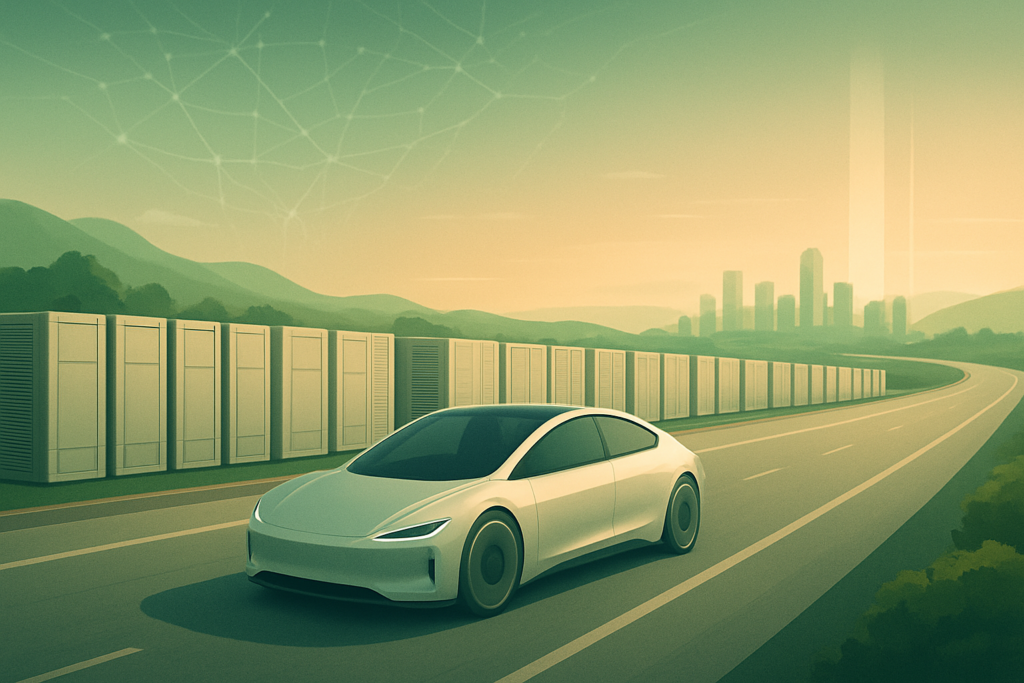
- Energy Generation & Storage: This segment has seen exponential growth through 2025, selling Powerwalls for homes and Megapacks for utility-scale storage. It currently boasts the highest margins in the company’s portfolio.
- Services & Other: Includes Supercharging (now a multi-brand industry standard), insurance, vehicle service, and the burgeoning FSD (Full Self-Driving) subscription revenue.
- Licensing and AI Services (Emerging): Tesla has begun preliminary talks with legacy automakers to license its FSD software and NACS charging hardware.
Tesla’s model is defined by vertical integration. Unlike traditional OEMs (Original Equipment Manufacturers), Tesla produces its own batteries, designs its own chips (D1/D2), and owns its entire distribution and service network, bypassing the traditional dealership model.
Stock Performance Overview
Tesla’s stock performance has been a study in extreme volatility and high-reward investing:
- 10-Year Performance (2016–2026): Investors who bought a decade ago have seen gains exceeding 2,000%, as the stock rose from a split-adjusted ~$16 in April 2016 to current levels.
- 5-Year Performance (2021–2026): A more turbulent journey. After peaking in late 2021, the stock weathered a significant downturn in 2024 due to high interest rates and falling margins, only to begin a robust recovery in mid-2025 as the AI narrative took hold.
- 1-Year Performance: Over the last 12 months, TSLA has outperformed the S&P 500, buoyed by the successful ramp of the Cybertruck and the first production units of the Cybercab.
Financial Performance
Tesla’s fiscal year 2025 was marked by "margin discipline."
- Revenue: FY 2025 revenue hit ~$94.8 billion, a slight dip from 2024 as the company prioritized engineering over unit volume.
- Margins: Automotive gross margins, which dipped below 16% in 2024, rebounded to 20.1% by Q4 2025, thanks to lower lithium costs and the efficiency of the "Unboxed" manufacturing process.
- Cash Position: Tesla maintains a fortress balance sheet with over $30 billion in cash and investments, despite a projected $20 billion capital expenditure plan for 2026 focused on the Dojo supercomputer and Giga Texas expansion.
- Q1 2026 Preview: Analysts expect revenue of ~$24.5 billion for the first quarter, with deliveries totaling approximately 358,000 units.
Leadership and Management
Elon Musk remains the dominant figure at Tesla, serving as CEO and "Technoking." While his involvement in other ventures (X, SpaceX, xAI) continues to be a point of contention for some institutional investors, his focus on Tesla’s "AI-first" strategy has been reaffirmed by the 2024 compensation package re-approval.
Key executives include CFO Vaibhav Taneja, who has been credited with the 2025 cost-cutting initiatives, and Tom Zhu, who oversees global production. The board has recently faced calls for more independent oversight, though it remains closely aligned with Musk’s long-term vision of autonomous transport.
Products, Services, and Innovations
Tesla’s current product lineup is evolving rapidly:
- Cybercab (Robotaxi): The crown jewel of Tesla’s 2026 strategy. A steering-wheel-less vehicle built for autonomous ride-hailing, mass production began this month in Giga Texas.
- Model 2 (Project Redwood): A $25,000 compact EV aimed at the mass market, currently in pilot production in Europe and the US.
- FSD v14: The latest iteration of Tesla’s software, utilizing massive transformer-based neural networks trained on billions of miles of real-world video.
- Optimus (Gen 3): Tesla’s humanoid robot is now being tested in Giga Nevada for simple logistics tasks, with a goal of external sales starting in late 2027.
- Megapack 3: A high-density energy storage solution that has become the backbone of the Tesla Energy segment’s profitability.
Competitive Landscape
Tesla faces a two-front war:
- Chinese OEMs: BYD, Xiaomi, and Huawei have emerged as formidable rivals, offering high-tech EVs at lower price points in Asian and European markets.
- Legacy Automakers: While Ford (F) and General Motors (GM) have scaled back some EV ambitions, luxury players like Porsche and Mercedes-Benz continue to compete at the high end.
- Autonomous Tech: Alphabet's (GOOGL) Waymo remains Tesla's primary rival in the Robotaxi space, currently leading in total miles driven with "Level 4" autonomy in several US cities.
Tesla's competitive edge lies in its data flywheel: with millions of vehicles on the road collecting video data, it possesses a training set for AI that rivals cannot easily replicate.
Industry and Market Trends
The "First Wave" of EV adoption (early adopters) has concluded, and the "Second Wave" (mass market) is proving more price-sensitive. This has led to a trend of hybrid resurgence in some markets, though Tesla remains committed to a pure-BEV (Battery Electric Vehicle) strategy. Additionally, the convergence of energy storage and grid stabilization has turned Tesla into a de-facto utility provider in regions like South Australia and Texas.
Risks and Challenges
- Regulatory Risk: The NHTSA’s "Engineering Analysis" into FSD performance in low-visibility conditions is the most significant near-term threat, with the potential for a forced software recall or operational restrictions.
- Geopolitical Tensions: Tesla’s heavy reliance on Giga Shanghai makes it vulnerable to shifting US-China trade policies and potential tariffs.
- Execution Risk: The "Unboxed" manufacturing process for the Cybercab is unproven at massive scale.
- Key-Man Risk: The company’s valuation is inextricably linked to Elon Musk; any change in his status or focus remains a primary concern for the "Bear" case.
Opportunities and Catalysts
- FSD Licensing: A single licensing deal with a major legacy automaker could provide a high-margin revenue stream with no additional hardware cost.
- Unsupervised FSD Launch: Regulatory approval for unsupervised driving in Texas or California would be a "ChatGPT moment" for Tesla’s valuation.
- IRA 2.0: Continued or expanded US tax credits for the $25,000 Model 2 could drive unprecedented volume in 2027.
Investor Sentiment and Analyst Coverage
Wall Street remains deeply divided. As of April 2026, the consensus rating is a "Hold."
- Bulls (Price Target ~$550): Argue that Tesla is an AI company being valued as a car company. They focus on the potential for a $10 trillion market cap driven by Robotaxis and Optimus.
- Bears (Price Target ~$120): Argue that Tesla is a maturing hardware company facing a "race to the bottom" in pricing, with FSD being "perpetual vaporware."
Institutional ownership remains high at ~44%, with retail investors continuing to show intense loyalty.
Regulatory, Policy, and Geopolitical Factors
In early 2026, the European Union provided a major tailwind by approving FSD (Supervised) for use across the continent under new UN regulations. Conversely, in the US, the policy environment is mixed; while federal incentives support domestic battery production, increased safety scrutiny of Level 2+ systems has slowed the rollout of "Unsupervised" features.
Conclusion
Tesla in April 2026 is a company of contradictions: its vehicle deliveries have plateaued, yet its technological lead in AI and energy storage has never looked more formidable. For investors, Tesla represents a high-conviction bet on the future of autonomous intelligence. The success of the "Cybercab" and the "Model 2" over the next 18 months will determine whether Tesla justifies its premium valuation or if it will be forced to compete on the thin margins of a traditional manufacturer.
Investors should closely watch the Q1 2026 earnings call on April 22 for updates on the Giga Texas Cybercab ramp and any commentary regarding the NHTSA’s final Engineering Analysis report.
This content is intended for informational purposes only and is not financial advice.