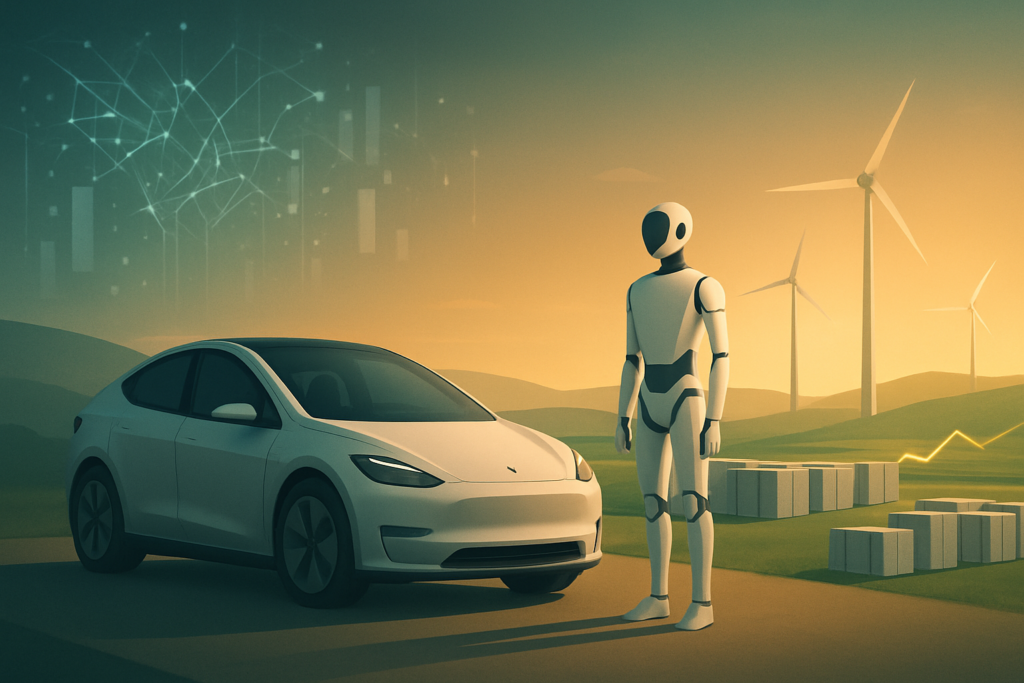
As of March 23, 2026, Tesla (NASDAQ: TSLA) finds itself at the most significant crossroads in its two-decade history. Once the undisputed champion of the electric vehicle (EV) revolution, the Austin-based giant is no longer just a car company—it is a "Physical AI" powerhouse in the midst of a high-stakes metamorphosis. While the "Core Auto" business faces stiff headwinds from global oversupply and aggressive Chinese competition, Tesla’s valuation is increasingly untethered from vehicle deliveries, anchored instead to the promise of autonomous transport and humanoid robotics. Today, investors are no longer asking how many cars Tesla can build, but rather how quickly it can solve the puzzle of unsupervised autonomy.
Historical Background
Founded in 2003 by Martin Eberhard and Marc Tarpenning, and later steered into the stratosphere by Elon Musk, Tesla’s journey began with the Roadster in 2008. The company’s trajectory has been defined by "bet-the-company" moments: the 2012 launch of the Model S, which proved EVs could be luxury status symbols, and the "Production Hell" of 2017–2018 during the Model 3 ramp-up. By 2020, Tesla had achieved sustained profitability, leading to its inclusion in the S&P 500 and a peak market capitalization exceeding $1.2 trillion in 2021. The period from 2022 to 2025 saw the company diversify with the Cybertruck and the massive scaling of its Energy division, though it also faced the "Lost Year" of 2024, where slowing demand forced a radical shift in corporate strategy.
Business Model
Tesla’s business model is a multi-pronged ecosystem centered on vertical integration.
- Automotive Sales & Leasing: Historically the primary revenue driver, encompassing the Model 3, Model Y, Cybertruck, and the aging Model S/X lines.
- Software (FSD): A high-margin recurring revenue stream via Full Self-Driving subscriptions and upfront payments.
- Energy Generation and Storage: Deployment of Megapacks for utilities and Powerwalls for homes, which has recently emerged as a high-growth, high-margin pillar.
- Services & Other: Including the global Supercharger network (now the industry standard via NACS), insurance, and vehicle repairs.
- Robotics (Optimus): The newest segment, currently focused on internal industrial deployment within Tesla’s own gigafactories.
Stock Performance Overview
The last decade of TSLA performance has been a masterclass in volatility.
- 10-Year Horizon: Investors who held since 2016 have seen returns exceeding 1,500% (split-adjusted), outperforming the S&P 500 by a staggering margin.
- 5-Year Horizon: The stock has faced a "bumpy plateau." After hitting record highs in late 2021, the shares suffered through 2024 as margins compressed, only to recover in late 2025 following the "Cybercab" unveil.
- 1-Year Horizon: Over the past 12 months, the stock has climbed roughly 15%, trading today in the $370–$380 range. This recovery is largely attributed to the market pricing in the "Unboxed" manufacturing process and FSD licensing potential rather than current vehicle sales volume.
Financial Performance
In the full fiscal year 2025, Tesla reported total revenue of $94.8 billion, a slight 3% decline from the previous year. This revenue dip reflects the reality of a maturing EV market and the impact of sustained price cuts. Net income fell sharply by 46% to $3.8 billion as the company prioritized R&D for AI and the "Project Redwood" (Model 2) platform. Automotive gross margins (excluding credits) have stabilized at a leaner 16.8%. However, the Energy segment provided a crucial buffer, growing 25% and deploying a record 46.7 GWh of storage. Tesla maintains a fortress balance sheet with significant cash reserves, though free cash flow has been tempered by massive capital expenditures on the Dojo supercomputer and Giga Texas expansions.
Leadership and Management
While Elon Musk remains the visionary CEO and the primary driver of the "technoking" brand, 2025 marked a shift toward a more traditional corporate leadership structure to appease institutional investors. Vaibhav Taneja (CFO) and Ashok Elluswamy (VP of AI) have taken on more prominent roles in earnings calls and regulatory negotiations. The board of directors continues to face scrutiny over Musk’s divided attention between Tesla, X (formerly Twitter), and SpaceX, yet the leadership team has remained remarkably cohesive through the 2024 restructuring.
Products, Services, and Innovations
Tesla’s current pipeline is arguably the most ambitious in the industrial world:
- Model 2 (Project Redwood): Utilizing the revolutionary "Unboxed" assembly process, this $25,000–$28,000 compact car is slated for volume production in late 2026.
- Cybercab: Purpose-built for autonomy without a steering wheel or pedals, with pilot units now testing in Austin and San Francisco.
- Optimus Gen 3: The latest iteration of Tesla’s humanoid robot features "V3 Hands" with 50 actuators, allowing for near-human dexterity in assembly tasks.
- FSD V14: Expected by mid-2026, this version aims for "unsupervised" capability in select geofenced environments.
Competitive Landscape
Tesla no longer operates in a vacuum. In 2025, China's BYD (OTC: BYDDY) officially surpassed Tesla as the world’s largest BEV seller by volume, leveraging its vertical battery integration and budget-friendly models like the Seagull. Meanwhile, Western legacy automakers like Ford (NYSE: F) and Volkswagen (OTC: VWAGY) have partially retreated from their "all-EV" targets, pivoting back to hybrids to protect their margins. This has left Tesla as the sole premium Western manufacturer still fully committed to a pure-BEV and AI-first future, albeit at the cost of losing market share in the budget segment.
Industry and Market Trends
The "EV Winter" of 2024–2025 saw a cooling of consumer enthusiasm for electric cars in North America and Europe, driven by high interest rates and "range anxiety" in the used car market. However, a new trend has emerged: the AI-fication of Transport. Investors are shifting focus from battery chemistry to compute power. Additionally, the industrial sector is seeing a massive uptick in energy storage demand as aging power grids struggle to integrate renewable energy, a trend Tesla is uniquely positioned to capitalize on through its Megapack business.
Risks and Challenges
Tesla’s risks are as outsized as its ambitions.
- Regulatory Scrutiny: On March 18, 2026, the NHTSA upgraded its FSD investigation to an "Engineering Analysis," the final step before a potential mandatory recall.
- Margin Erosion: Continued price wars in China could further compress automotive margins before the lower-cost Model 2 arrives.
- Key Person Risk: The company remains heavily dependent on Musk’s reputation and focus; any further distractions or controversies remain a primary concern for the "Tesla Bulls."
- Execution Risk: The "Unboxed" manufacturing process is unproven at scale and could face unforeseen "Production Hell" scenarios in late 2026.
Opportunities and Catalysts
- FSD Licensing: Several legacy OEMs are rumored to be in "advanced discussions" to license Tesla’s FSD software, which could transform Tesla into the "Windows of Autonomous Driving."
- Optimus Commercialization: Moving Optimus from Tesla’s factories to external third-party logistics and manufacturing firms represents a multi-trillion-dollar total addressable market (TAM).
- Next-Gen Platform: The launch of the $25,000 car could reignite volume growth and help Tesla reclaim its title as the world's top-selling EV maker.
Investor Sentiment and Analyst Coverage
Wall Street remains deeply divided. "Value" analysts point to the declining earnings and high P/E ratio as a sign of a maturing industrial company, while "Growth" analysts argue that Tesla should be valued as a software and robotics firm. Institutional ownership remains high, though some hedge funds trimmed positions in late 2025 citing the slow ramp of the Cybertruck. Retail sentiment, however, remains fervently bullish, buoyed by the progress of FSD and the impending launch of the Model 2.
Regulatory, Policy, and Geopolitical Factors
Tesla sits at the heart of the "US-China tech cold war." While Giga Shanghai remains its most efficient plant, increased tariffs on Chinese-made components and potential retaliatory measures from Beijing pose a constant threat. In the US, the 2026 political landscape remains focused on domestic manufacturing incentives. Tesla’s ability to navigate the complex regulatory approvals for "unsupervised" FSD in Europe and China will be the primary catalyst for its software revenue in the coming 24 months.
Conclusion
Tesla in 2026 is no longer the scrappy startup that defied Detroit, nor is it the hyper-growth automaker of the early 2020s. It is a mature tech conglomerate attempting one of the most difficult pivots in corporate history: transitioning from selling hardware to selling intelligence. With the discontinuation of the Model S and X lines in Q2 2026, the company is stripping away its past to make room for a future of $25,000 EVs, autonomous "Cybercabs," and humanoid labor. For investors, Tesla remains a high-beta bet on the future of physical AI—a company that requires both a long-term horizon and a high tolerance for regulatory and execution risk.
This content is intended for informational purposes only and is not financial advice.