Shares of bedding manufacturer and retailer Sleep Number Corporation (SNBR) have been in deep trouble for a while, and now the pressure is mounting fast. The company is scrambling for rescue financing to avoid bankruptcy, as weak housing demand, rising competition, tariffs, and falling showroom traffic continue to drag down sales. And the warning signs are hard to ignore. In its annual filing with the U.S. Securities and Exchange Commission last month, Sleep Number warned there is “substantial doubt” about its ability to stay in business, pointing to heavy debt, weak sales, and the risk of breaching financial covenants.
In fact, management is now scrambling to stabilize the business. During the earnings call, CFO Amy O’Keefe said the company is working with advisors to address its credit facility and explore alternatives, including refinancing and evaluating inbound interest. Additionally, it has tapped Guggenheim Securities to assess strategic options.
As the clock ticks and the company races to avoid bankruptcy, could this beaten-down stock become the next meme rally candidate?
About Sleep Number Stock
Founded in 1987, Minnesota-based Sleep Number positions itself as a leader in personalized sleep wellness, with mattresses engineered to adapt to individual sleepers over time. Its products feature adjustable firmness, pressure-relieving support, and temperature-balancing capabilities, allowing the beds to respond to users’ changing needs night after night and over the long term.
The company’s platform is built on nearly four decades of innovation, supported by more than 1,000 patents and pending patents, along with billions of hours of sleep data. To date, Sleep Number says it has served over 16 million customers. Its vertically integrated model spans design, manufacturing, and delivery, aiming to maintain control over product quality, durability, and ongoing customer support.
To tackle its ongoing financial strain, Sleep Number rolled out its biggest product reset in nearly a decade last month. The company cut its lineup from 12 to just seven beds, regrouping them into three simplified collections - ComfortMode, ComfortNext, and Climate - to make its offerings more clear and focused.
Management says early customer response has been positive, with buyers drawn to improved comfort, better materials, and personalized adjustability at more attractive price points. The company believes this early momentum could support its broader turnaround efforts. However, despite its positioning and ongoing turnaround efforts, the pressure is clearly reflected in Sleep Number stock.
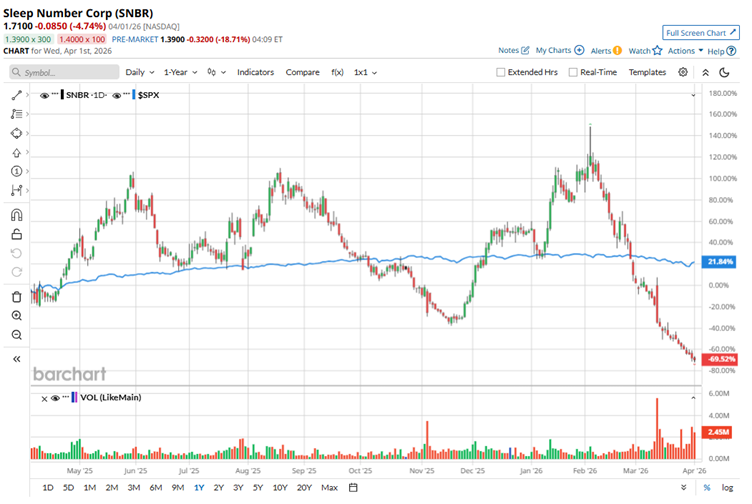
Now sitting at a market capitalization of roughly $39.1 million, the shares have been crushed, plunging an eye-watering 79.58% in 2025. And the slide has only accelerated in 2026. With bankruptcy fears intensifying, the stock has nosedived another 83.39% so far this year, underscoring the severity of the company’s challenges and the quick deterioration of investor confidence.
Sleep Number’s Q4 Earnings Snapshot
On March 12, Sleep Number reported its fiscal 2025 fourth-quarter results, and the numbers did little to reassure investors. A much wider-than-expected loss and mounting concerns around its financial health triggered a sharp 20% sell-off in the stock. For the quarter, net sales declined 8% year-over-year (YOY) to $347 million, weighed down by continued weakness in the mattress industry and lower showroom traffic. The only bright spot was that revenue still managed to come in ahead of Wall Street’s $328.7 million estimate.
However, losses deepened significantly. The company reported a net loss of $59 million, compared to just $5 million in the same period last year, although a large part of this was tied to a $47.9 million deferred tax adjustment. On a per-share basis, the pain was even more pronounced, with a GAAP loss of $2.55 per share, far worse than last year’s $0.21 loss and well below Wall Street’s expected $0.55 loss. Also, profitability took a hit. Gross profit fell to $193 million, down $32 million YOY, while gross margin contracted to 55.6% from 59.9%.
This decline was largely driven by a $9.6 million inventory obsolescence charge linked to the rollout of its new product lineup. More concerning were the balance sheet pressures. The company ended the quarter with $942.5 million in debt against just $1.69 million in cash, a stark imbalance for a business already operating at a loss, raising serious doubts about its ability to sustain operations without additional capital.
Despite the bleak picture, management pointed to aggressive cost-cutting efforts as part of its turnaround plan. The company has already achieved $185 million in annualized savings through a leaner corporate structure and more efficient marketing, with another $50 million in fixed cost reductions currently underway. CEO Linda Findley also noted that Sleep Number met its full-year adjusted EBITDA guidance of $78 million. However, reflecting the scale of ongoing changes, management chose not to provide any specific guidance for 2026.
Analysts' View of Sleep Number Stock
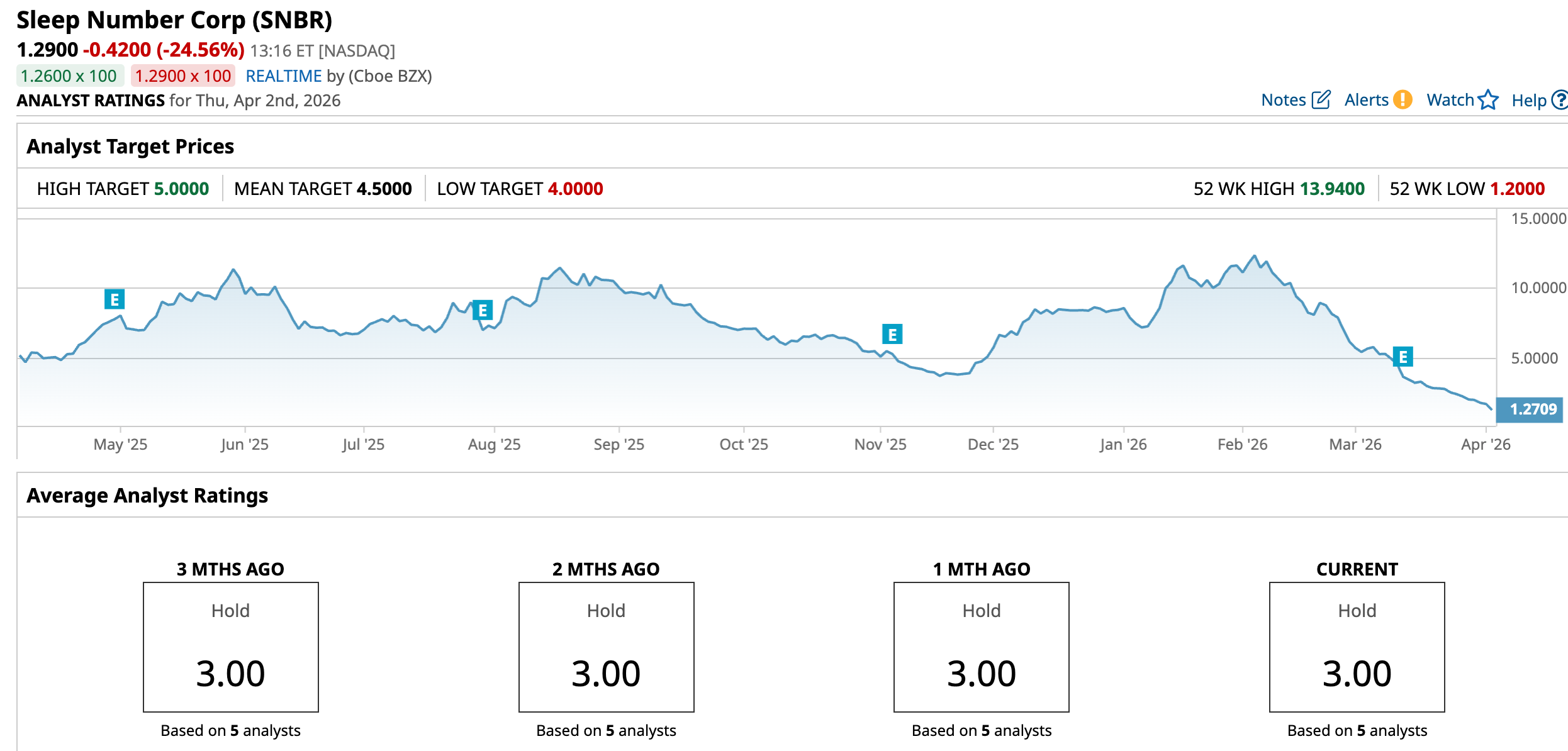
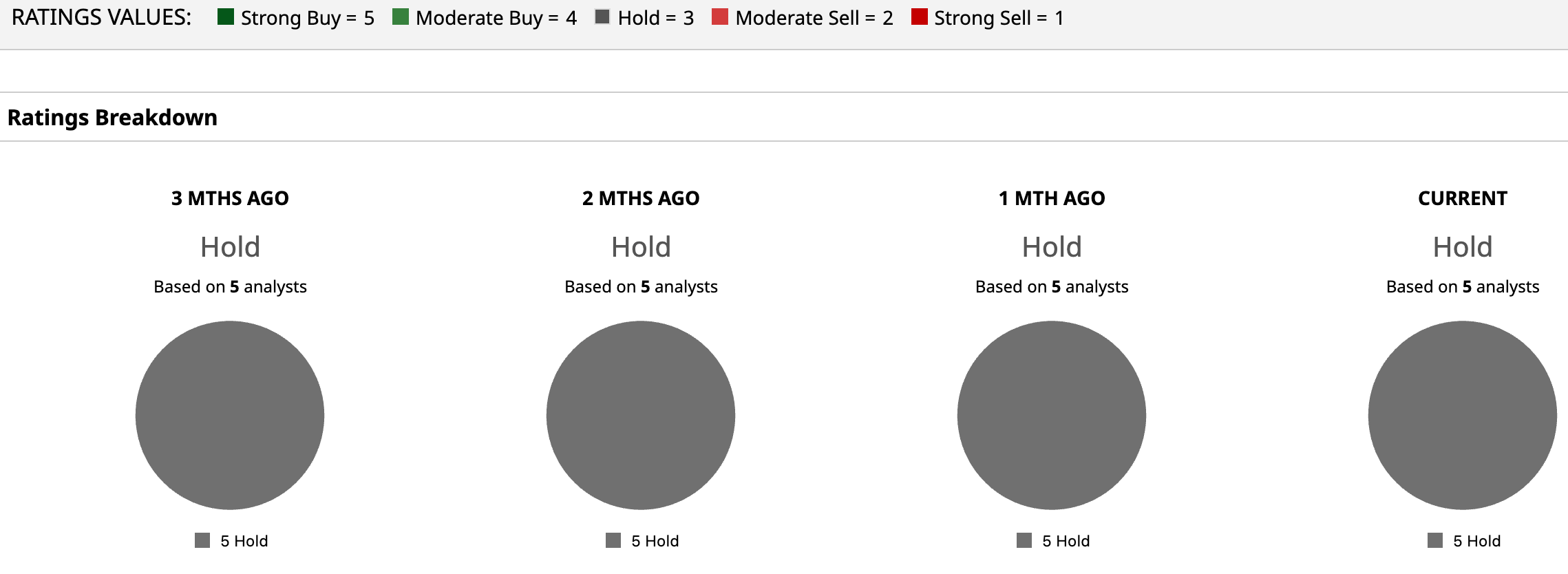
Given the company’s current fragile position, Wall Street’s cautious stance comes as little surprise. Sleep Number currently carries a consensus “Hold” rating, and notably, that view is unanimous across all five analysts covering the stock. Nevertheless, the upside projections tell a different story. The average price target of $4.50 implies a potential surge of over 248.8%, while the Street-high target of $5 suggests the stock could rally nearly 287.6% from current levels, highlighting the high-risk, high-reward nature of this deeply beaten-down name.
The Bottom Line
With Sleep Number buckling under heavy losses, towering debt, and rapidly eroding sales, the fundamentals point to a company in serious distress. Yet, paradoxically, that very collapse could make SNBR fertile ground for a meme-style surge, where sentiment, not fundamentals, drives sharp, short-lived rallies. While bankruptcy risks loom large and the downside remains significant, the stock’s extreme volatility and deeply discounted levels could attract speculative traders, making it a high-risk, high-reward play that deserves a spot on investors’ radar.
On the date of publication, Anushka Mukherji did not have (either directly or indirectly) positions in any of the securities mentioned in this article. All information and data in this article is solely for informational purposes. For more information please view the Barchart Disclosure Policy here.
More news from Barchart