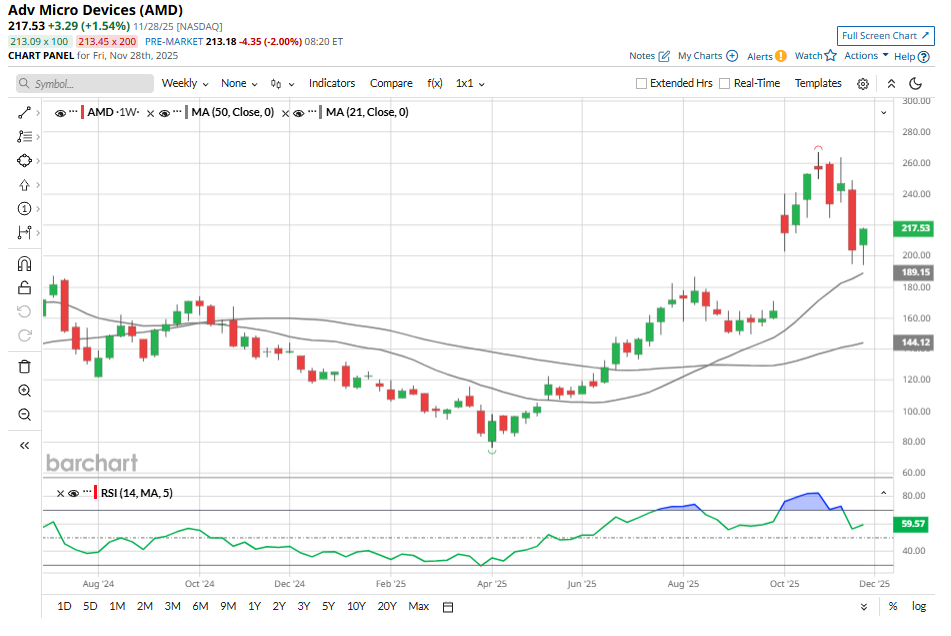
Shares of Advanced Micro Devices (AMD) have cooled off in recent weeks, slipping 15% over the past month. The pullback follows a remarkable run. Notably, AMD stock surged nearly 97% over the last six months, powered by excitement around artificial intelligence (AI) and the company’s growing share in the data center market.
Investors have also been encouraged by AMD’s expanding partnership network, including OpenAI and Oracle (ORCL). The company is positioning itself as the primary alternative to Nvidia (NVDA) in the race to supply high-performance GPUs for AI workloads. This has boosted investors’ sentiment on AMD stock.
A New Threat to AMD: Google AI Chips
But the competitive landscape is shifting. A recent report from The Information indicates that Meta Platforms (META) is considering a multibillion-dollar investment in Google’s (GOOGL) custom AI chips. If Google’s Tensor Processing Units (TPUs) continue gaining momentum, major buyers could start diverting spending away from GPU suppliers such as Nvidia and, importantly, from AMD, which has been capitalizing on the industry’s desire to avoid overreliance on a single vendor.
This potential shift adds uncertainty just as AMD is emerging as the top challenger in the AI chip arena. A growing appetite for Google-designed silicon could complicate that narrative in the near term.
AMD’s Long-Term Growth Story Still Intact
Still, AMD’s long-term story looks compelling. During its recent Financial Analyst Day, the company projected robust growth over the medium term, citing accelerating AI demand and continued innovation across its product lineup.
AMD’s management projects that total revenue will increase at a compound annual growth rate (CAGR) of more than 35% over the next three to five years. Profitability is also expected to scale meaningfully, with adjusted operating margin anticipated to surpass 35%, up from 24% at the end of Q3 2025. Additionally, the company forecasts adjusted earnings per share (EPS) to exceed $20 as operating leverage improves.
The biggest catalyst for its strong growth forecast is its booming data center business, projected to grow at a 60% CAGR. As the company continues to build out its multi-generational EPYC server CPU lineup, it aims to secure more than half of the server CPU revenue market and capitalize on the rising global demand for high-performance computing.
AMD expects its data center AI segment to deliver annual revenue growth of over 80%, driven by increased customer adoption and the rollout of new AMD Instinct accelerators. The Instinct MI350 Series GPU has ramped up fast and deployed at massive scale through major cloud partners such as Oracle. Looking ahead, AMD plans to introduce its Helios systems powered by MI450 GPUs, designed to deliver leadership rack-scale performance and memory capacity, in the third quarter of 2026. This momentum will continue with the MI500 Series in 2027, further extending AMD’s AI compute roadmap.
AMD is also expanding its reach in adaptive computing solutions. The company expects to capture more than 70% of the revenue share in this category while broadening its embedded segment to capture growth from x86-based designs and custom silicon markets.
If management delivers on its projections, investors could see substantial returns as the company moves deeper into high-margin segments and solidifies its leadership in AI infrastructure.
Is AMD Stock a Buy, Sell, or Hold?
AMD’s recent pullback reflects growing competitive pressure from Google AI chips. However, it does not necessarily undermine AMD’s long-term growth prospects. Management’s outlook, including >35% CAGR revenue growth and significant margin expansion, indicates that AMD’s opportunity in data center and AI hardware is still in the early innings. With next-generation Instinct accelerators gaining adoption and expected market share gains in server CPUs and adaptive computing, AMD is well-positioned to deliver strong growth.
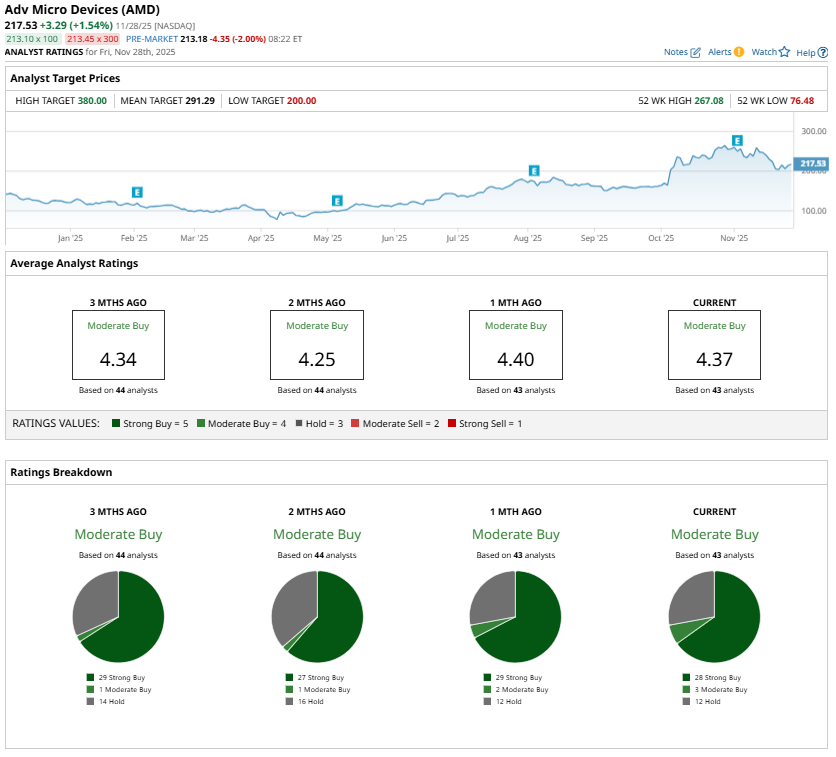
That said, its valuation remains high, which is why not all analysts are endorsing AMD stock. With AMD trading at 68.5 times forward earnings, the stock already bakes in a lot of optimism. For long-term investors, that’s not necessarily a deal-breaker, but it does suggest that short-term traders should proceed with caution.
On the date of publication, Amit Singh did not have (either directly or indirectly) positions in any of the securities mentioned in this article. All information and data in this article is solely for informational purposes. For more information please view the Barchart Disclosure Policy here.
More news from Barchart
- Lumentum Just Got a New Street-High Price Target. Should You Buy the Laser Stock Fueling the AI Boom?
- Apple Stock Looks Cheap Here Based on Strong FCF - Shorting OTM Put Options Has Worked
- As Robinhood Dives Into the Prediction Markets, Should You Buy, Sell, or Hold HOOD Stock?
- Morgan Stanley Just Named This Stock a Top Semiconductor Pick. Should You Buy Shares Now?