Passenger Cars and Infotainment Applications Drive Automotive Data Connector Adoption as OEMs Expand Connected Vehicle Platforms, ADAS Integration, and EV Communication Systems
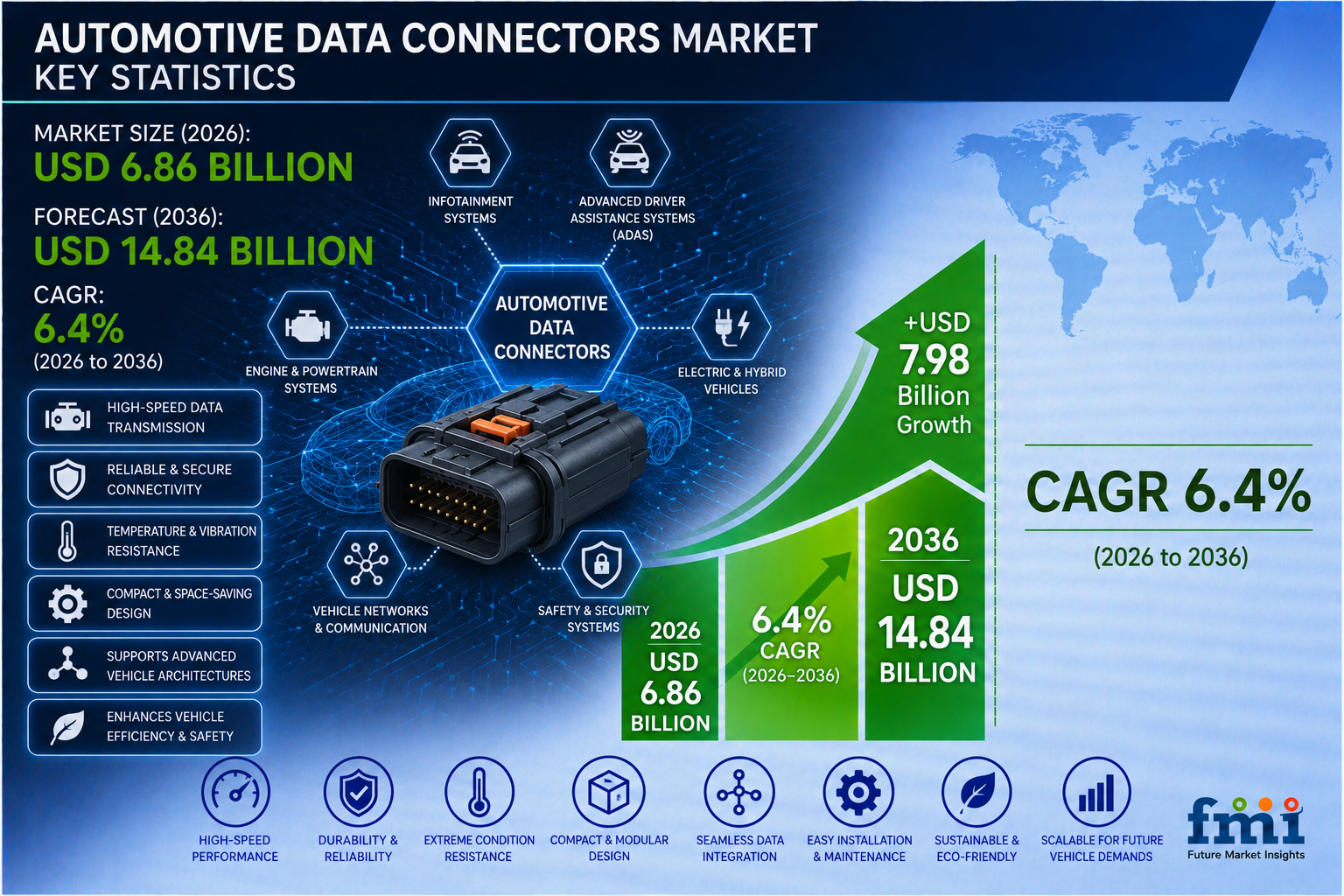
NEWARK, DE / ACCESS Newswire / May 8, 2026 / According to the latest analysis by Future Market Insights, the global automotive data connectors market is entering a steady growth phase as automakers accelerate the deployment of connected vehicle architectures, ADAS systems, infotainment platforms, and electric vehicle communication networks. The market was valued at USD 7.50 billion in 2025 and is projected to reach USD 8.02 billion in 2026. Over the forecast period from 2026 to 2036, the market is expected to expand significantly to USD 14.84 billion, registering a CAGR of 6.4%.
This growth reflects the increasing role of high-speed data transmission within modern vehicle platforms, where infotainment systems, advanced driver assistance technologies, telematics modules, and EV battery communication systems require reliable, high-bandwidth automotive-grade connectors. As vehicles become increasingly software-defined and electronically integrated, automotive data connectors are emerging as critical infrastructure components supporting next-generation mobility ecosystems.
Quick Stats: Automotive Data Connectors Market
Market Value (2025): USD 7.50 billion
Estimated Market Value (2026): USD 8.02 billion
Forecast Market Value (2036): USD 14.84 billion
CAGR (2026 to 2036): 6.4%
Incremental Opportunity: USD 6.86 billion
Leading Application Segment: Infotainment (24% share)
Leading Vehicle Type Segment: Passenger Cars (55% share)
Fastest Growing Markets: China (7.0% CAGR) and South Korea (6.8% CAGR)
Key Growth Driver: Increasing electronics content and high-speed data transmission requirements in connected and electric vehicles
Major Players: TE Connectivity, Rosenberger, Molex, Amphenol RF, Hirose Electric, Aptiv, JAE Electronics
Get detailed market forecasts, competitive benchmarking, and pricing trends:
https://www.futuremarketinsights.com/reports/sample/rep-gb-22343
Market Value Analysis: Vehicle Electronics Complexity Expands Connector Demand
Between 2026 and 2030, demand for automotive data connectors is expected to accelerate as automakers increase the deployment of digital cockpit systems, ADAS technologies, connected vehicle services, and EV communication platforms.
Automotive OEMs and suppliers are increasingly focusing on:
High-speed Ethernet connectors for software-defined vehicle architectures
RF coaxial connectors for antenna and communication systems
Data transmission solutions for ADAS sensors and camera systems
Connector miniaturization for compact vehicle architectures
Automotive-grade reliability under harsh operating conditions
High-bandwidth connectivity for infotainment and telematics systems
EV communication interfaces for battery management and thermal systems
Failure to support growing in-vehicle data transmission requirements may expose vehicle platforms to communication bottlenecks, system integration challenges, and reduced performance across connected and autonomous driving applications.
From 2030 to 2036, growth will be driven by EV production scaling, increasing sensor density in vehicles, rising adoption of software-defined architectures, and expanding deployment of connected mobility platforms.
Technology Evolution: High-Speed Connectivity and Automotive Ethernet Drive Innovation
The evolution of automotive data connectors is being shaped by advancements in automotive Ethernet, RF transmission systems, miniaturized connector assemblies, and high-speed vehicle communication protocols.
Key innovations include:
Automotive Ethernet connector systems
High-frequency RF coaxial connectors
Miniaturized high-density connector assemblies
Shielded connectors for EMI protection
High-speed camera and LiDAR data connectors
Connectors optimized for EV battery communication systems
Lightweight connector materials for vehicle efficiency
Advanced sealing technologies for automotive durability
A major challenge remains balancing bandwidth capability, miniaturization, durability, and cost efficiency across increasingly complex vehicle electronics architectures.
An industry analyst notes:
"Automotive data connectors are becoming foundational infrastructure within connected and software-defined vehicles. As vehicle electronics architectures evolve, connector performance and data reliability directly impact system integration, user experience, and vehicle functionality."
Data Connectivity Becomes Central to Modern Vehicle Architectures
As automakers continue integrating digital features and autonomous technologies, data connectors are becoming critical enablers of in-vehicle communication systems.
Core capabilities include:
Reliable high-speed data transmission
Support for infotainment and digital cockpit systems
ADAS sensor and camera connectivity
EV battery and powertrain communication support
Improved signal integrity and electromagnetic shielding
Enhanced connected vehicle functionality
Scalable architectures for future software updates
This transition is positioning automotive data connectors as strategic components across passenger cars, commercial vehicles, EV platforms, and autonomous mobility ecosystems.
Speak to Analyst: Customize insights for your business strategy:
https://www.futuremarketinsights.com/customization-available/rep-gb-22343
Segment Spotlight
Infotainment Leads Application Segment (24%)
Driven by increasing deployment of digital displays, navigation systems, smartphone integration, and connected entertainment platforms across modern vehicles.
Passenger Cars Lead Vehicle Type Segment (55%)
Supported by rising electronics integration, mass-market adoption of connected features, and expanding EV passenger vehicle production.
RF Coaxial Connectors Support High-Frequency Applications
Reflecting strong demand for antenna systems, telematics communication, and ADAS sensor connectivity requiring reliable high-frequency data transmission.
Regional Insights: EV Expansion and Connected Vehicle Adoption Fuel Global Growth
The automotive data connectors market is expanding globally, supported by rising vehicle electronics complexity, EV platform launches, and increasing adoption of connected mobility technologies.
Country |
CAGR (2026-2036) |
Key Growth Drivers |
China |
7.0% |
EV manufacturing scale and connected vehicle production |
South Korea |
6.8% |
Automotive electronics leadership and OEM innovation |
India |
6.7% |
Connected vehicle adoption and OEM localization |
Germany |
5.5% |
Premium EV platforms and ADAS integration |
United States |
5.1% |
EV production scaling and connected vehicle demand |
Regional growth reflects differences in EV adoption, automotive production scale, vehicle electronics integration, and local automotive supply-chain capability.
Opportunities: Connected Mobility and EV Architectures Unlock Connector Demand
Key opportunities shaping the market include:
Expansion of automotive Ethernet architectures
Growth in ADAS sensor and camera systems
Increasing EV battery communication requirements
Deployment of software-defined vehicle platforms
Miniaturization of automotive electronics systems
Rising demand for lightweight connector materials
Growth in connected vehicle communication networks
These opportunities are enabling connector manufacturers to improve bandwidth performance, reliability, and integration flexibility across evolving automotive platforms.
Competitive Landscape: Engineering Capability and OEM Qualification Define Leadership
The market remains competitive, with leadership shaped by manufacturing scale, automotive-grade reliability, high-speed data capability, and long-term OEM relationships.
Leading companies include:
TE Connectivity
Rosenberger
Molex
Amphenol RF
Hirose Electric
Aptiv
JAE Electronics
Competitive differentiation is driven by:
Automotive Ethernet and RF connector expertise
High-speed data transmission capability
OEM qualification and validation programs
Connector miniaturization and packaging innovation
Manufacturing scale and global supply-chain presence
Reliability under harsh automotive operating conditions
Future Outlook: Automotive Data Connectors Become Core Vehicle Infrastructure
Looking ahead to 2036, automotive data connectors will become increasingly critical as automakers continue integrating connected, autonomous, electric, and software-defined vehicle technologies.
Key trends include:
Wider adoption of automotive Ethernet networks
Expansion of connected cockpit architectures
Growth in EV communication systems
Increasing ADAS sensor density per vehicle
Higher demand for miniaturized high-speed connectors
Expansion of vehicle-to-cloud communication systems
Greater integration of AI-enabled vehicle electronics
As automotive platforms continue evolving toward connected and intelligent mobility ecosystems, automotive data connectors are expected to remain foundational infrastructure supporting high-speed communication, reliability, and next-generation vehicle functionality.
Key Developments in the Market
Automotive OEMs are increasing adoption of automotive Ethernet architectures to support software-defined vehicle platforms and advanced infotainment systems.
Connector manufacturers are expanding development of miniaturized high-speed connector assemblies optimized for EV and ADAS applications.
Automotive suppliers continue investing in RF and high-bandwidth connectivity solutions for autonomous driving sensors, telematics, and digital cockpit systems.
Unlock 360° insights for strategic decision making and investment planning:
https://www.futuremarketinsights.com/checkout/22343
Browse More Technology Industry Reports:
Small Satellite Market - https://www.futuremarketinsights.com/reports/small-satellite-market
Identity Verification Market - https://www.futuremarketinsights.com/reports/identity-verification-market
Communication Platform as a Service (CPaaS) Market - https://www.futuremarketinsights.com/reports/communications-platform-as-a-service-cpaas-market
5PL Solutions Market - https://www.futuremarketinsights.com/reports/5pl-solutions-market
Edtech Market - https://www.futuremarketinsights.com/reports/edutech-market
About Future Market Insights (FMI)
Future Market Insights (FMI) is a leading provider of market intelligence and consulting services, serving clients in over 150 countries. Headquartered in Delaware, USA, with a global delivery center in India and offices in the UK and UAE, FMI delivers actionable insights to businesses across industries including automotive, technology, consumer products, manufacturing, energy, and chemicals.
An ESOMAR-certified research organization, FMI provides custom and syndicated market reports and consulting services, supporting both Fortune 1,000 companies and SMEs. Its team of 300+ experienced analysts ensures credible, data-driven insights to help clients navigate global markets and identify growth opportunities.
For Press & Corporate Inquiries
Rahul Singh
AVP - Marketing and Growth Strategy
Future Market Insights, Inc.
+91 8600020075
For Sales - sales@futuremarketinsights.com
For Media - Rahul.singh@futuremarketinsights.com
For Web - https://www.futuremarketinsights.com/
For Web: https://www.factmr.com/
SOURCE: Future Market Insights, Inc.
View the original press release on ACCESS Newswire