Let’s dig into the relative performance of Hershey (NYSE: HSY) and its peers as we unravel the now-completed Q2 shelf-stable food earnings season.
As America industrialized and moved away from an agricultural economy, people faced more demands on their time. Packaged foods emerged as a solution offering convenience to the evolving American family, whether it be canned goods or snacks. Today, Americans seek brands that are high in quality, reliable, and reasonably priced. Furthermore, there's a growing emphasis on health-conscious and sustainable food options. Packaged food stocks are considered resilient investments. People always need to eat, so these companies can enjoy consistent demand as long as they stay on top of changing consumer preferences. The industry spans from multinational corporations to smaller specialized firms and is subject to food safety and labeling regulations.
The 17 shelf-stable food stocks we track reported a mixed Q2. As a group, revenues beat analysts’ consensus estimates by 0.8% while next quarter’s revenue guidance was 3.6% below.
Amidst this news, share prices of the companies have had a rough stretch. On average, they are down 8.9% since the latest earnings results.
Hershey (NYSE: HSY)
Best known for its milk chocolate bar and Hershey's Kisses, Hershey (NYSE: HSY) is an iconic company known for its chocolate products.
Hershey reported revenues of $2.79 billion, up 6.6% year on year. This print exceeded analysts’ expectations by 5.7%. Overall, it was an exceptional quarter for the company with an impressive beat of analysts’ gross margin estimates and a solid beat of analysts’ organic revenue estimates.
"We delivered a strong first half, with reported net sales up 8.7%, organic net sales up 5.8% and meaningful earnings recovery. We enter the second half with momentum, compelling growth plans, and increased investment behind our brands, merchandising, and innovation. With cost visibility and operating flexibility, we are well positioned to navigate dynamic markets and deliver on our full-year financial commitments," said Kirk Tanner, The Hershey Company President and Chief Executive Officer.
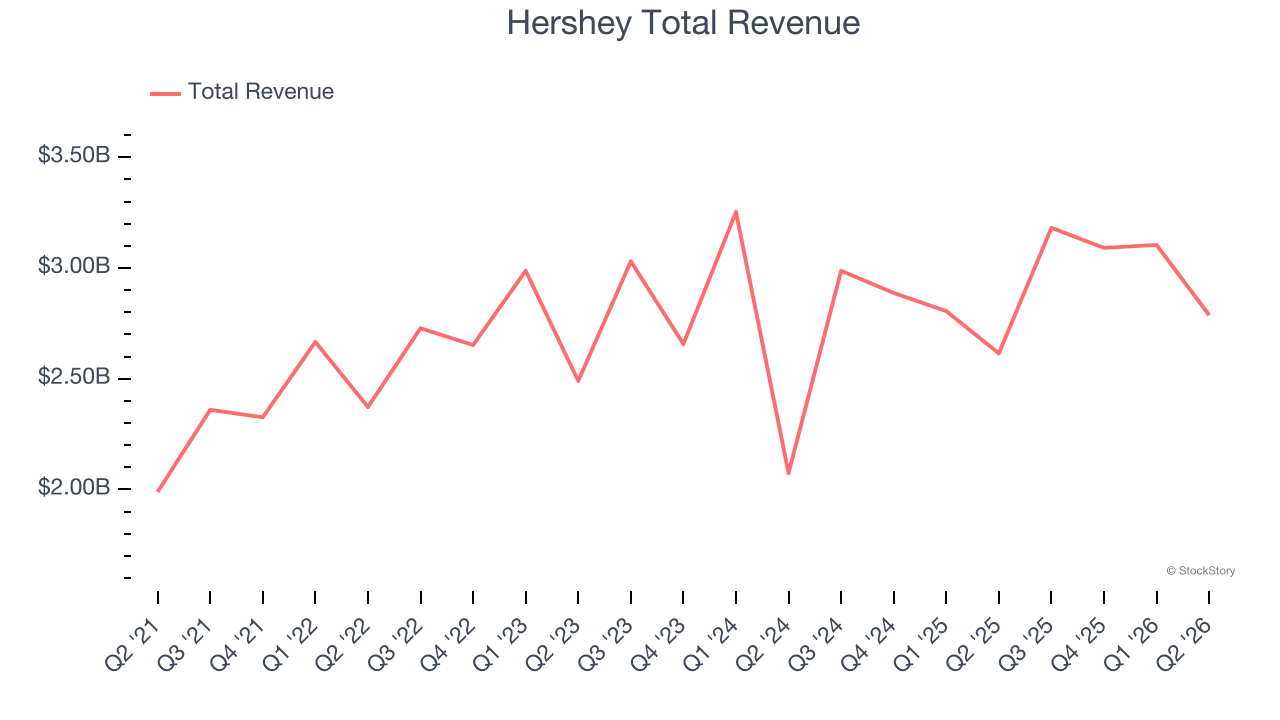
Hershey pulled off the biggest analyst estimate beat among its peers. Investor expectations, however, were likely higher than Wall Street’s published projections, leaving some wishing for even better results (analysts’ consensus estimates are those published by big banks and advisory firms, not the investors who make buy and sell decisions). The stock is down 8.6% since reporting and currently trades at $168.15.
Is now the time to buy Hershey? Access our full analysis of the earnings results here, it’s free.
Best Q2: J. M. Smucker (NYSE: SJM)
Best known for its fruit jams and spreads, J.M Smucker (NYSE: SJM) is a packaged foods company whose products span from peanut butter and coffee to pet food.
J. M. Smucker reported revenues of $2.22 billion, up 5% year on year, outperforming analysts’ expectations by 4.3%. The business had a stunning quarter with a beat of analysts’ EPS estimates and a solid beat of analysts’ EBITDA estimates.
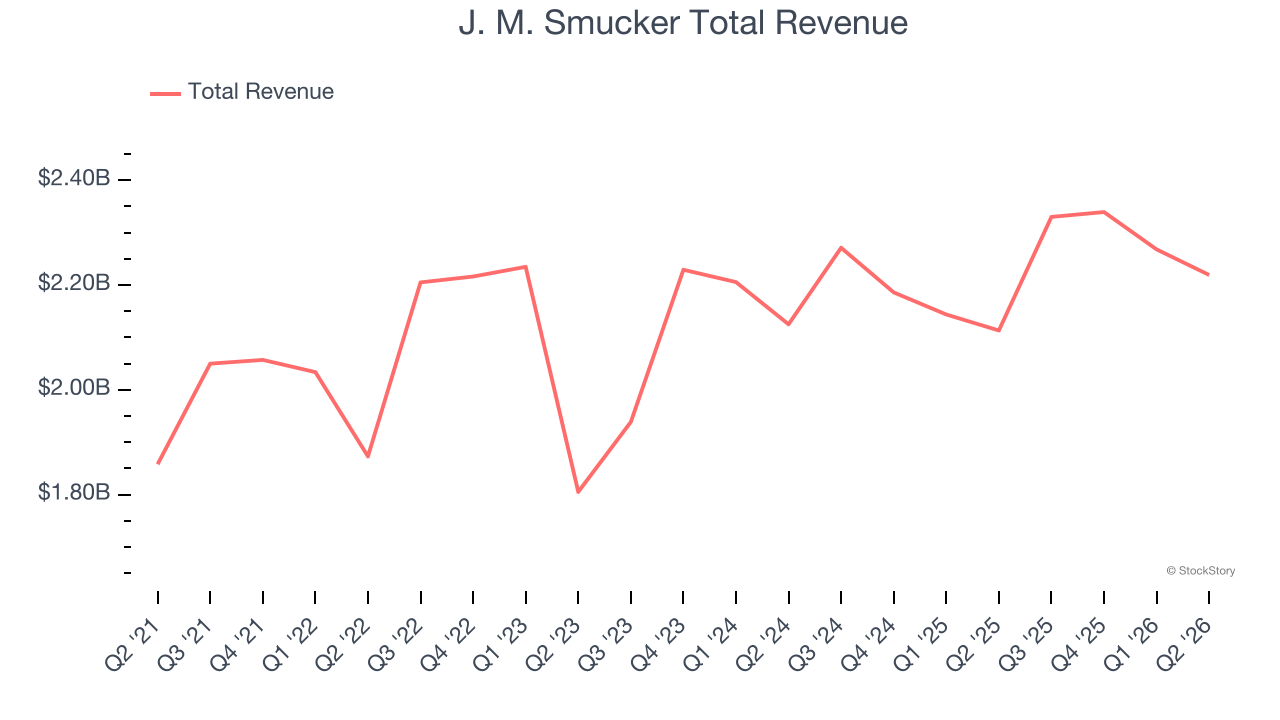
Although it had a fine quarter compared to its peers, the market seems unhappy with the results as the stock is down 4.9% since reporting. It currently trades at $119.34.
Is now the time to buy J. M. Smucker? Access our full analysis of the earnings results here, it’s free.
Weakest Q2: Hain Celestial (NASDAQ: HAIN)
Sold in over 75 countries around the world, Hain Celestial (NASDAQ: HAIN) is a natural and organic food company whose products range from snacks to teas to baby food.
Hain Celestial reported revenues of $263.1 million, down 27.6% year on year, falling short of analysts’ expectations by 2.2%. It was a softer quarter as it posted a significant miss of analysts’ gross margin estimates and EPS in line with analysts’ estimates.
Hain Celestial delivered the slowest revenue growth in the group. As expected, the stock is down 9.8% since the results and currently trades at $0.56.
Read our full analysis of Hain Celestial’s results here.
Utz (NYSE: UTZ)
Tracing its roots back to 1921 when Bill and Salie Utz began making potato chips in their kitchen, Utz Brands (NYSE: UTZ) offers salty snacks such as potato chips, tortilla chips, pretzels, cheese snacks, and ready-to-eat popcorn, among others.
Utz reported revenues of $371.8 million, up 1.4% year on year. This result missed analysts’ expectations by 0.6%. More broadly, it was a mixed quarter as it also produced a solid beat of analysts’ EBITDA estimates but a significant miss of analysts’ gross margin estimates.
The stock is flat since reporting and currently trades at $14.21.
Read our full, actionable report on Utz here, it’s free.
Lamb Weston (NYSE: LW)
Best known for its Grown in Idaho brand, Lamb Weston (NYSE: LW) produces and distributes potato products such as frozen french fries and mashed potatoes.
Lamb Weston reported revenues of $1.77 billion, up 5.6% year on year. This number topped analysts’ expectations by 4.8%. Overall, it was an exceptional quarter as it also produced a beat of analysts’ EPS estimates and an impressive beat of analysts’ gross margin estimates.
The stock is down 3.4% since reporting and currently trades at $47.51.
Read our full, actionable report on Lamb Weston here, it’s free.
Market Update
Over the past year, investors have been forced to repeatedly answer the same question: what is the market’s biggest risk? The answer has changed several times, and each shift has reshaped market leadership.
Late in 2025 and early 2026, artificial intelligence became the market’s primary uncertainty. Investors questioned whether AI would erode software pricing power and weaken competitive moats as AI made it easier to replicate once-differentiated products.
By the spring, technology took a back seat to geopolitics. The U.S. conflict with Iran briefly became the market’s dominant narrative, raising concerns about oil prices, inflation, and global growth. But as energy markets remained orderly and fears of a prolonged supply disruption faded, investors quickly turned their focus back to fundamentals.
Want to invest in winners with rock-solid fundamentals? Check out our Top 5 Quality Compounder Stocks and add them to your watchlist. These companies are poised for growth regardless of the political or macroeconomic climate.