Pet company Central Garden & Pet (NASDAQ: CENT) reported Q2 CY2026 results exceeding the market’s revenue expectations, but sales fell by 8.2% year on year to $882.4 million. Its non-GAAP profit of $1.54 per share was in line with analysts’ consensus estimates.
Is now the time to buy Central Garden & Pet? Find out by accessing our full research report, it’s free.
Central Garden & Pet (CENT) Q2 CY2026 Highlights:
- Revenue: $882.4 million vs analyst estimates of $876.7 million (8.2% year-on-year decline, 0.6% beat)
- Adjusted EPS: $1.54 vs analyst estimates of $1.53 (in line)
- Adjusted EBITDA: $161.9 million vs analyst estimates of $161.1 million (18.3% margin, 0.5% beat)
- Management raised its full-year Adjusted EPS guidance to $2.85 at the midpoint, a 5.6% increase
- Operating Margin: 14.3%, in line with the same quarter last year
- Free Cash Flow Margin: 37.1%, up from 26.2% in the same quarter last year
- Organic Revenue rose 2.4% year on year (beat)
- Market Capitalization: $2.48 billion
Company Overview
Enhancing the lives of both pets and homeowners, Central Garden & Pet (NASDAQ: CENT) is a leading producer and distributor of essential products for pet care, lawn and garden maintenance, and pest control.
Revenue Growth
Examining a company’s long-term performance can provide clues about its quality. Any business can experience short-term success, but top-performing ones enjoy sustained growth for years.
With $3.08 billion in revenue over the past 12 months, Central Garden & Pet carries some recognizable products but is a mid-sized consumer staples company. Its size could bring disadvantages compared to larger competitors benefiting from better brand awareness and economies of scale.
As you can see below, Central Garden & Pet’s revenue declined by 1.9% per year over the last three years, a poor baseline for our analysis.
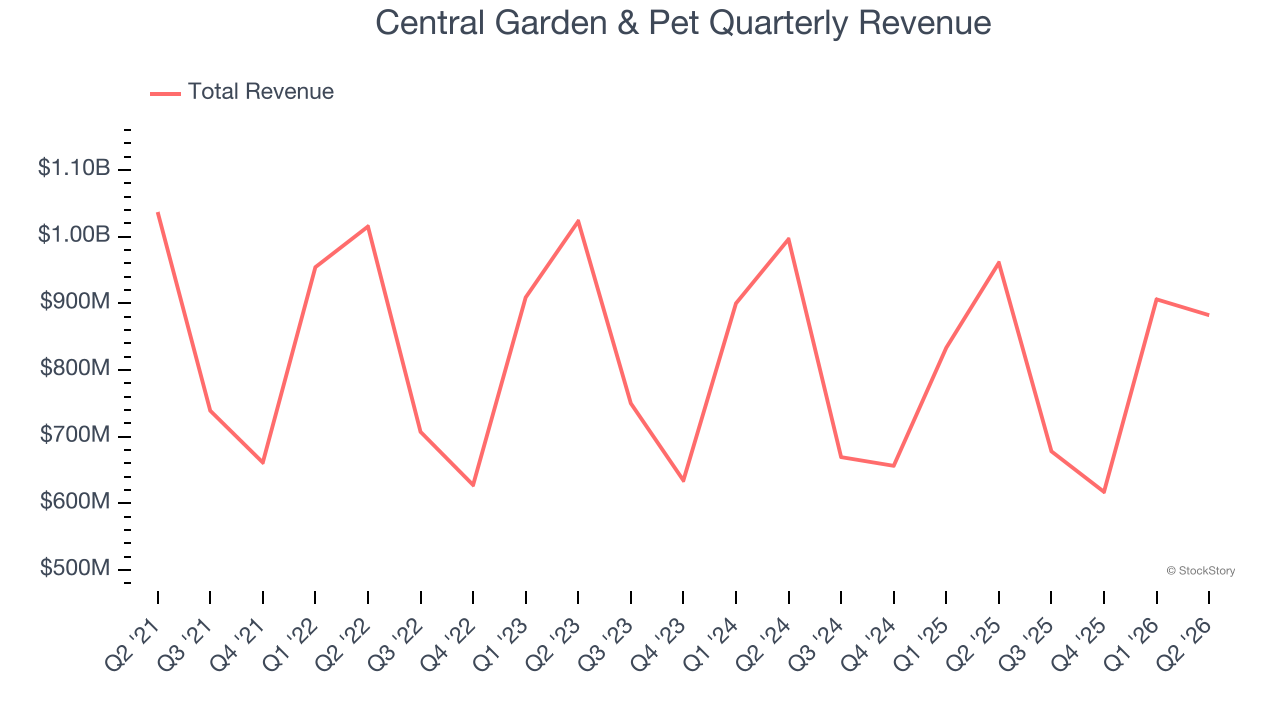
This quarter, Central Garden & Pet’s revenue fell by 8.2% year on year to $882.4 million but beat Wall Street’s estimates by 0.6%.
Looking ahead, sell-side analysts expect revenue to decline by 7.3% over the next 12 months, a deceleration versus the last three years. This projection doesn’t excite us and suggests its products will see some demand headwinds.
WHILE YOU’RE HERE: The Next Palantir? One satellite company captures images of every point on Earth. Every single day. The Pentagon wants it. Hedge funds are using it to beat earnings. You’ve probably never heard of it.
This is what the early days of Palantir looked like before it became a giant. Same playbook. Different technology. If you missed Palantir, you need to see this. Claim The Stock Ticker for Free HERE.
Cash Is King
Free cash flow isn’t a prominently featured metric in company financials and earnings releases, but we think it’s telling because it accounts for all operating and capital expenses, making it tough to manipulate. Cash is king.
Central Garden & Pet has shown robust cash profitability, giving it an edge over its competitors and the ability to reinvest or return capital to investors. The company’s free cash flow margin averaged 10.8% over the last two years, quite impressive for a consumer staples business.
Taking a step back, we can see that Central Garden & Pet’s margin expanded by 1.6 percentage points over the last year. This is encouraging because it gives the company more optionality.
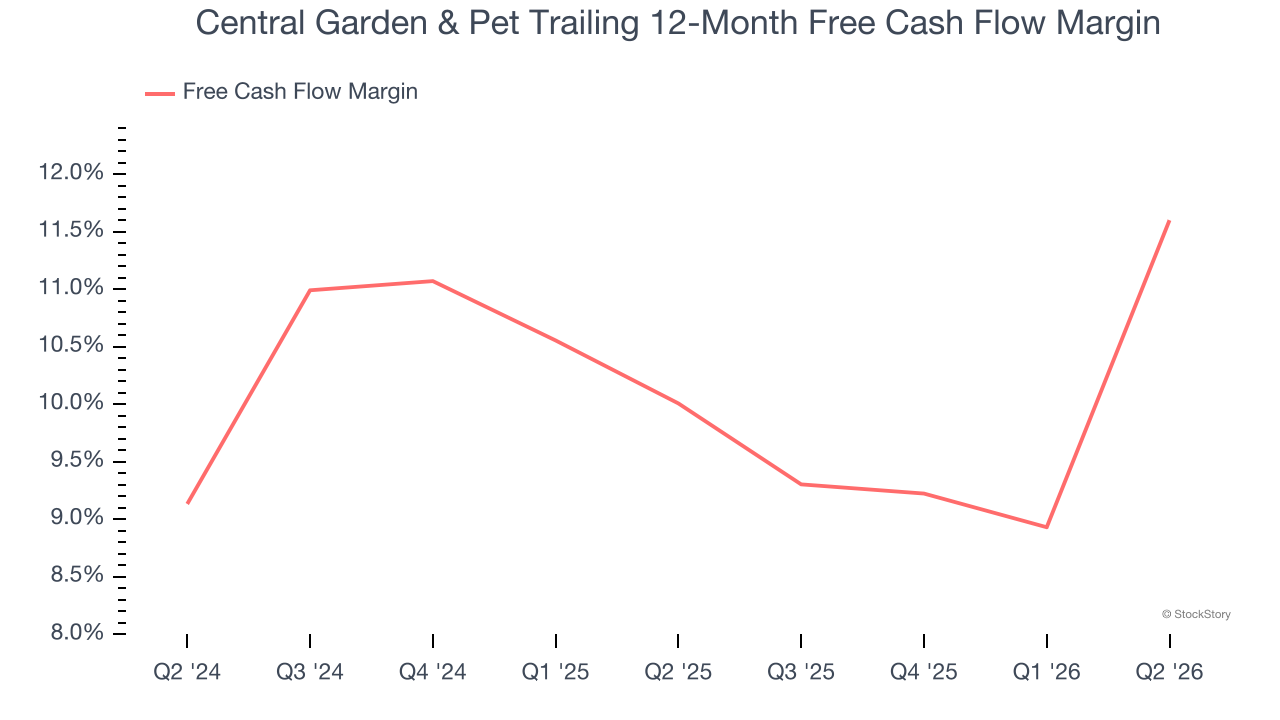
Central Garden & Pet’s free cash flow clocked in at $327 million in Q2, equivalent to a 37.1% margin. This result was good as its margin was 10.9 percentage points higher than in the same quarter last year, building on its favorable historical trend.
Key Takeaways from Central Garden & Pet’s Q2 Results
It was good to see Central Garden & Pet meet analysts’ organic revenue expectations this quarter. We were also happy its gross margin outperformed Wall Street’s estimates. On the other hand, its full-year EPS guidance missed. Overall, this quarter could have been better. The stock remained flat at $44.06 immediately following the results.
Is Central Garden & Pet an attractive investment opportunity at the current price? The latest quarter does matter, but not nearly as much as longer-term fundamentals and valuation, when deciding if the stock is a buy. We cover that in our actionable full research report which you can read here (it’s free).