
Online dating app Bumble (NASDAQ: BMBL) met Wall Street’s revenue expectations in Q2 CY2026, but sales fell by 15.2% year on year to $210.5 million. On the other hand, next quarter’s revenue guidance of $209 million was less impressive, coming in 2.4% below analysts’ estimates. Its GAAP loss of $0.84 per share was significantly below analysts’ consensus estimates.
Is now the time to buy Bumble? Find out by accessing our full research report, it’s free.
Bumble (BMBL) Q2 CY2026 Highlights:
- Revenue: $210.5 million vs analyst estimates of $210.6 million (15.2% year-on-year decline, in line)
- EPS (GAAP): -$0.84 vs analyst estimates of $0.25 (significant miss)
- Adjusted EBITDA: $72.88 million vs analyst estimates of $68.37 million (34.6% margin, 6.6% beat)
- Revenue Guidance for Q3 CY2026 is $209 million at the midpoint, below analyst estimates of $214.1 million
- EBITDA guidance for Q3 CY2026 is $58 million at the midpoint, below analyst estimates of $68.71 million
- Operating Margin: -53.2%, up from -136% in the same quarter last year
- Free Cash Flow Margin: 24.3%, down from 34.8% in the previous quarter
- Paying Users: 3.16 million, down 620,000 year on year
- Market Capitalization: $417.4 million
Company Overview
Started by the co-founder of Tinder, Whitney Wolfe Herd, Bumble (NASDAQ: BMBL) is a leading dating app built with women at the center.
Revenue Growth
Examining a company’s long-term performance can provide clues about its quality. Any business can put up a good quarter or two, but many enduring ones grow for years. Bumble struggled to consistently generate demand over the last three years as its sales dropped at a 2.9% annual rate. This wasn’t a great result and is a tough starting point for our analysis.
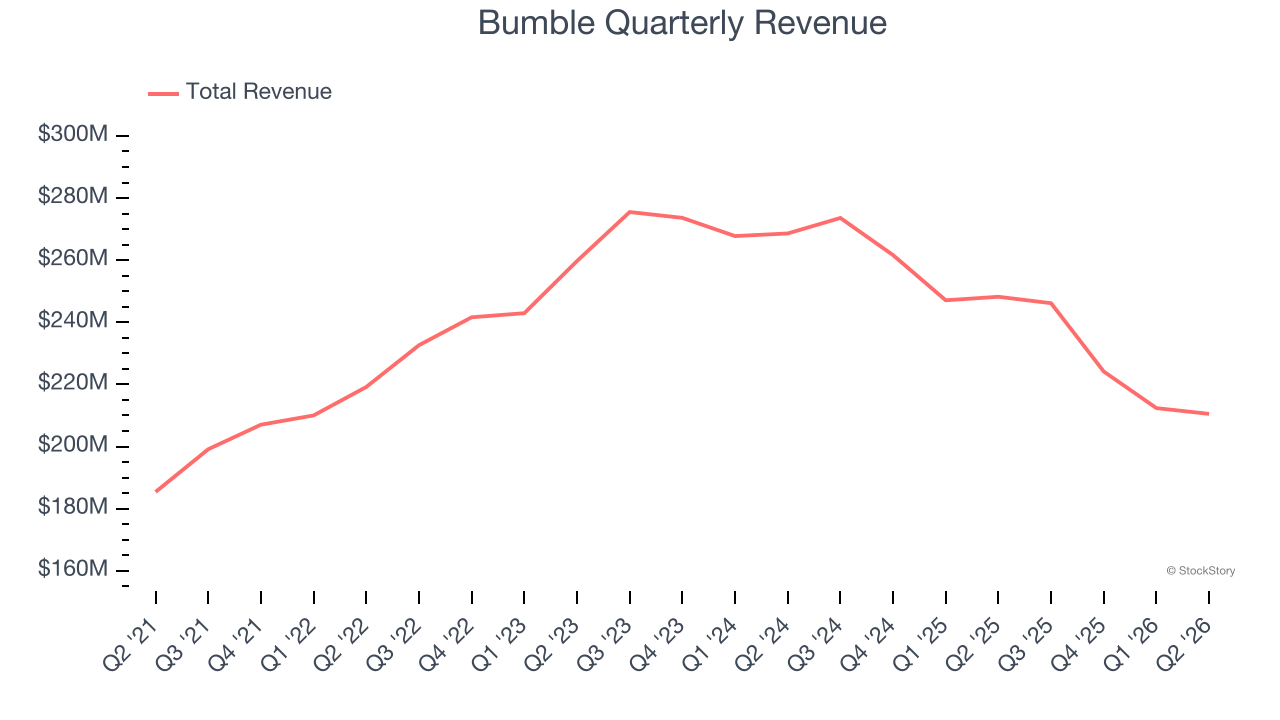
This quarter, Bumble reported a rather uninspiring 15.2% year-on-year revenue decline to $210.5 million of revenue, in line with Wall Street’s estimates. Company management is currently guiding for a 15.1% year-on-year decline in sales next quarter.
Looking further ahead, sell-side analysts expect revenue to decline by 7.1% over the next 12 months, a deceleration versus the last three years. This projection doesn’t excite us and indicates its products and services will see some demand headwinds.
ALSO WORTH WATCHING: Nvidia’s Quiet Partner. Nvidia’s chips cost a hundred grand. The connectors that make them work cost even more. One company makes them all.
Every AI server needs specialized infrastructure the chip companies don’t make. High-speed cables. Power connectors. Thermal sensors. This 90-year-old company built a monopoly on it. The AI boom just started. This stock is still flying under the radar. Claim The Stock Ticker Here for FREE.
Paying Users
Buyer Growth
As a subscription-based app, Bumble generates revenue growth by expanding both its subscriber base and the amount each subscriber spends over time.
Bumble struggled with new customer acquisition over the last two years as its paying users have declined by 6.5% annually to 3.16 million in the latest quarter. This performance isn’t ideal because internet usage is secular, meaning there are typically unaddressed market opportunities. If Bumble wants to accelerate growth, it likely needs to enhance the appeal of its current offerings or innovate with new products. 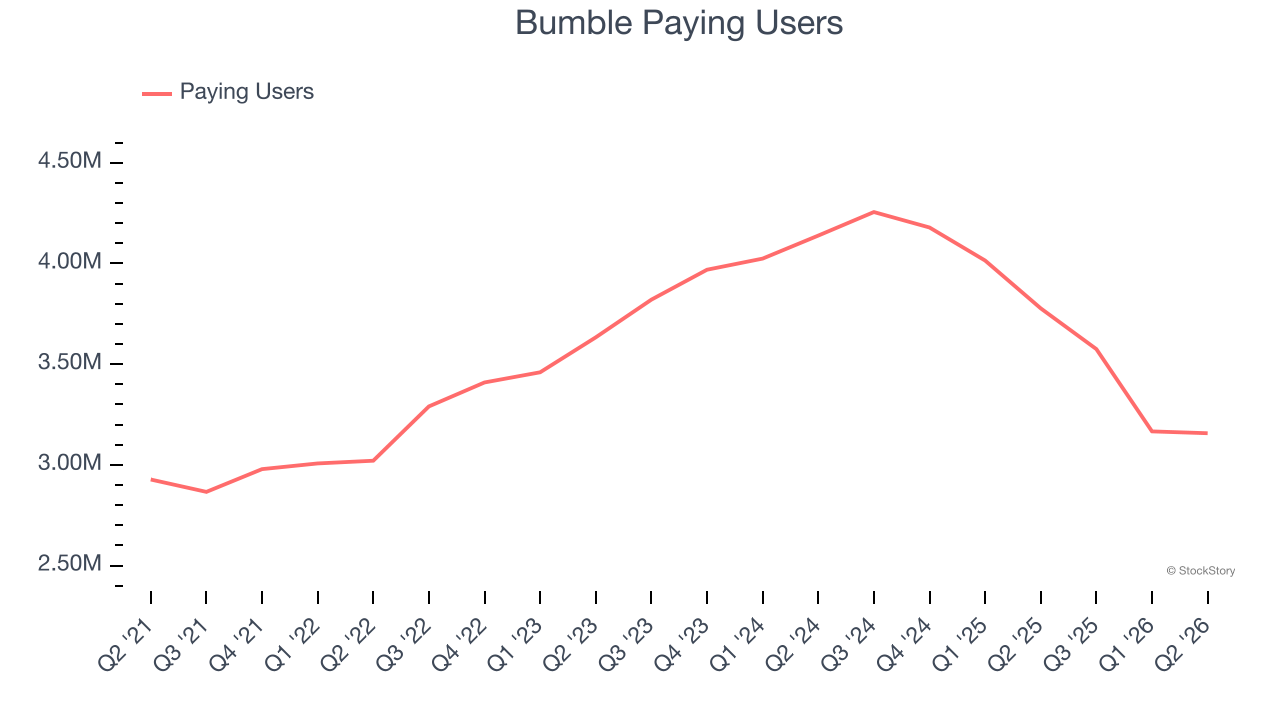
In Q2, Bumble’s paying users once again decreased by 620,000, a 16.4% drop since last year. The quarterly print was lower than its two-year result, suggesting its new initiatives aren’t moving the needle for buyers yet.
Revenue Per Buyer
Average revenue per buyer (ARPB) is a critical metric to track because it measures how much the average buyer spends. ARPB is also a key indicator of how valuable its buyers are (and can be over time).
Bumble’s ARPB fell over the last two years, averaging 9.8% annual declines. This signals its platform’s value is eroding when paired with its declining paying users. If Bumble wants to increase its buyers, it must either develop new features or provide some existing ones for free. 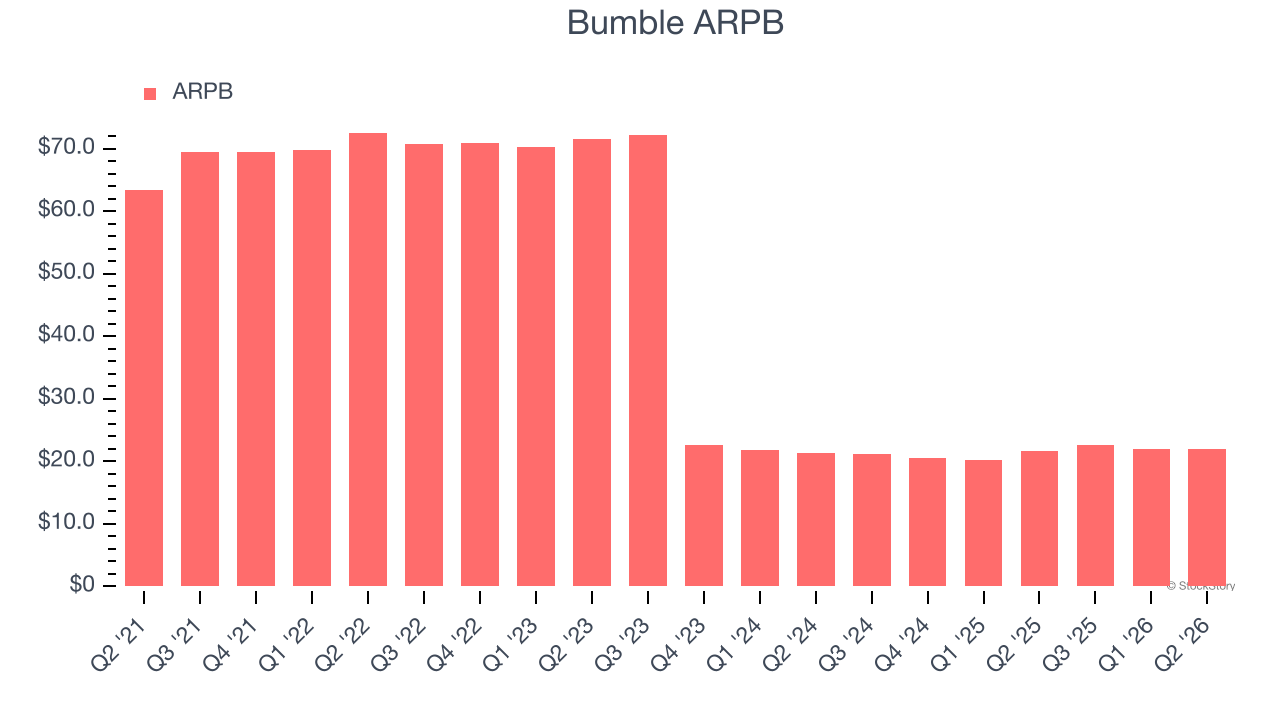
This quarter, Bumble’s ARPB clocked in at $21.96. It grew by 1.2% year on year, faster than its paying users.
Key Takeaways from Bumble’s Q2 Results
We enjoyed seeing Bumble beat analysts’ EBITDA expectations this quarter. On the other hand, its number of buyers declined and its revenue guidance for next quarter fell short of Wall Street’s estimates. Overall, this was a softer quarter. The stock traded down 5.4% to $2.89 immediately after reporting.
Bumble may have had a tough quarter, but does that actually create an opportunity to invest right now? When making that decision, it’s important to consider its valuation, business qualities, as well as what has happened in the latest quarter. We cover that in our actionable full research report which you can read here (it’s free).