Aerospace and defense company Kratos (NASDAQ: KTOS) met Wall Street’s revenue expectations in Q3 2026, with revenue up 35.7% year on year to $471.8 million. The company expects next quarter’s revenue to be around $495 million, coming in 1.4% above analysts’ consensus estimates. Its non-GAAP profit of $0.24 per share was 15.9% above analysts’ consensus estimates.
For more on Kratos, read our free full research report.
Kratos (KTOS) Q3 2026 highlights:
- Revenue $471.8 million vs S&P analysts’ consensus estimates of $473.7 million (35.7% year-on-year growth, in line)
- Adjusted EPS $0.24 vs S&P analysts’ consensus estimates of $0.21 (15.9% beat)
- Adjusted EBITDA $50.9 million vs analysts’ consensus estimates of $44.45 million (10.8% margin, 14.5% beat)
- Revenue guidance $495 million at the midpoint for Q4 2026, above analysts’ consensus estimates of $488.1 million
- EBITDA guidance $178 million at the midpoint for the full year, above analysts’ consensus estimates of $176.2 million
- Operating margin -1%, down from 2% in the same quarter last year
- Free cash flow -$35.4 million compared to -$41.3 million in the same quarter last year
- Organic revenue rose 23.2% year on year (miss)
- Market capitalization $6.75 billion
Eric DeMarco, Kratos’ president and CEO, said, “Kratos third quarter results reflect our position as a leading defense technology, hardware, software and systems company, aligned with the Department of War’s priorities and reindustrialization efforts. Kratos’ Q3 report includes a consolidated revenue growth rate of 35.7 percent, organic growth of 23.2 percent, bookings of $1.037 billion, a book to bill ratio of 2.2 to 1.0, a record backlog of $2.6 billion and an increased opportunity pipeline of $15.5 billion, reflecting the continued acceleration of Kratos’ business with notable strength in our hypersonic and space businesses. Also importantly, we reported an Adjusted EBITDA profit and margin in the third quarter of $50.9 million or 10.8 percent, demonstrating leverage of the business as production quantities increase and as Kratos continues to scale, which we expect to continue into 2027.”
Revenue growth
A company’s long-term performance is an indicator of its overall quality. Any business can experience short-term success, but top-performing ones sustain growth for years. Over the last five years, Kratos grew its revenue at a strong 15.4% compounded annual growth rate. Its growth surpassed the average industrials company and shows its offerings resonate with customers.
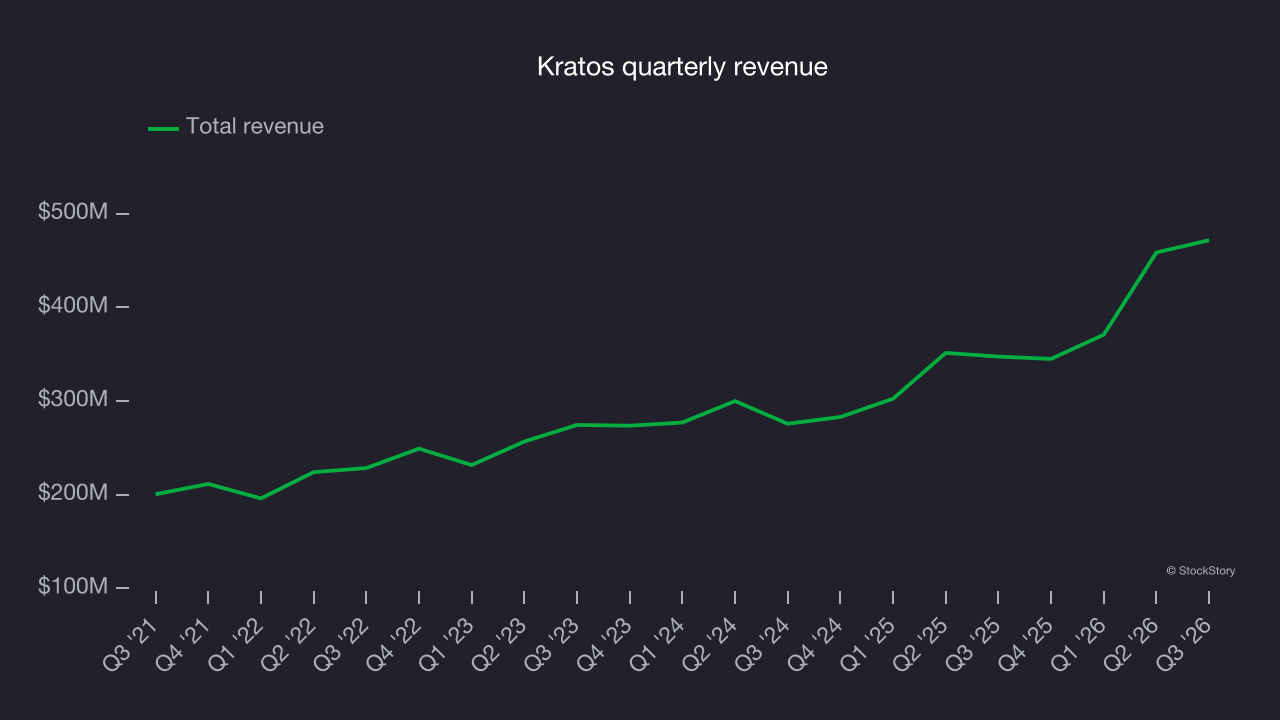
Long-term growth is the most important, but within industrials, a half-decade historical view may miss new industry trends or demand cycles. Kratos’s annualized revenue growth of 20.9% over the last two years is above its five-year trend, suggesting its demand was strong and recently accelerated.
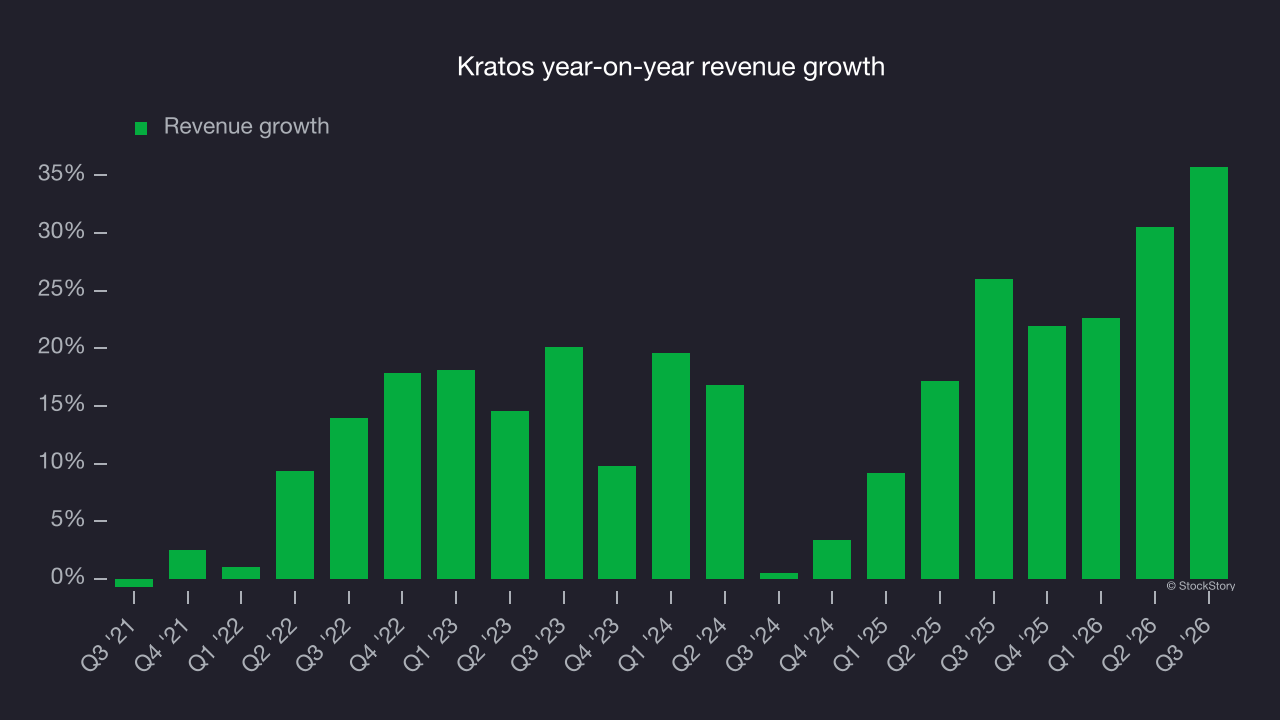
Organic revenue helps clarify the company’s revenue dynamics by stripping out one-time events like acquisitions and currency fluctuations that don’t accurately reflect its fundamentals. Over the last two years, Kratos’s organic revenue averaged 16% year-on-year growth. Total revenue growth outpaced organic growth over that period, indicating that some combination of acquisitions and foreign exchange rates boosted its headline results.
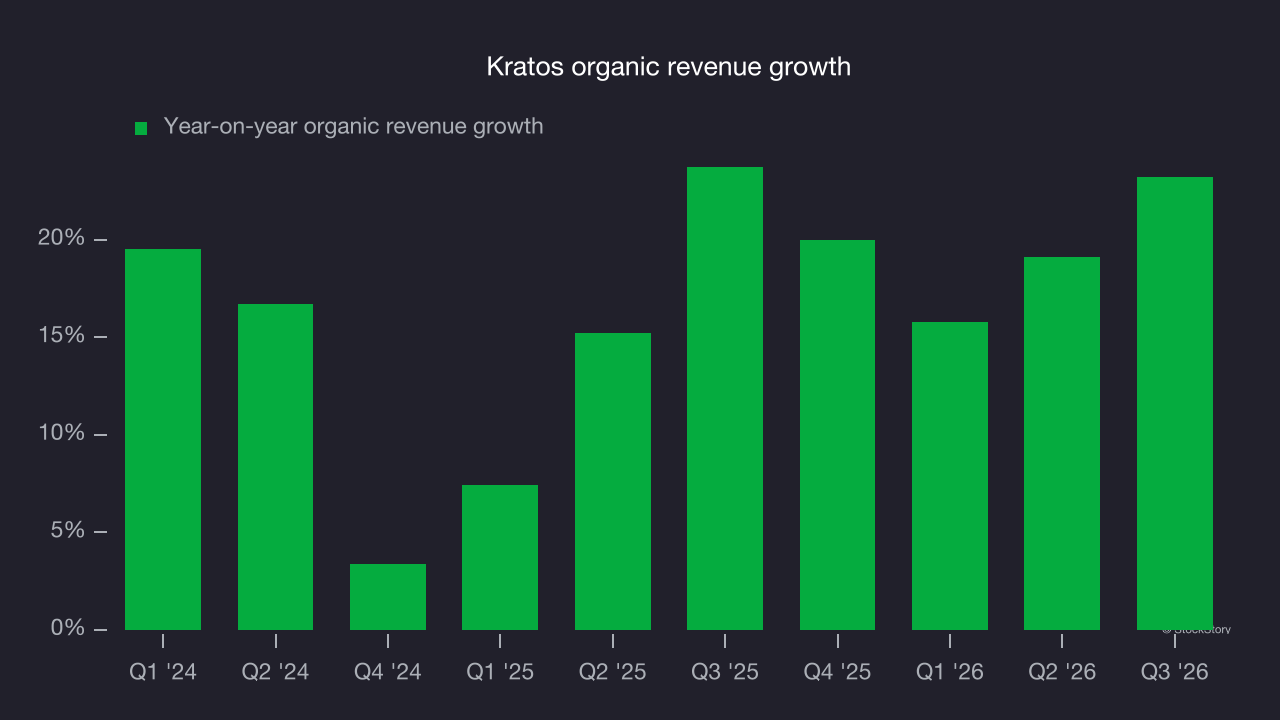
This quarter, Kratos’s year-on-year revenue growth of 35.7% was strong, and its $471.8 million in revenue was in line with Wall Street’s consensus estimates. Management is guiding for a 43.4% year-on-year increase in revenue next quarter.
Looking further ahead, sell-side analysts expect revenue to grow 27.8% over the next 12 months, according to S&P, an improvement versus the last two years. This substantial projected growth indicates its newer products and services will spur better top-line performance.
Operating margin
Kratos’s operating margin has generally stayed the same over the last 12 months, averaging 1.5% over the last five years. This profitability was inadequate for an industrials business and caused by its suboptimal cost structure.
Kratos’s operating margin might have fluctuated slightly but has generally stayed the same over the last five years. This raises questions about the company’s expense base because its revenue growth should have given it leverage on its fixed costs, resulting in better economies of scale and profitability.
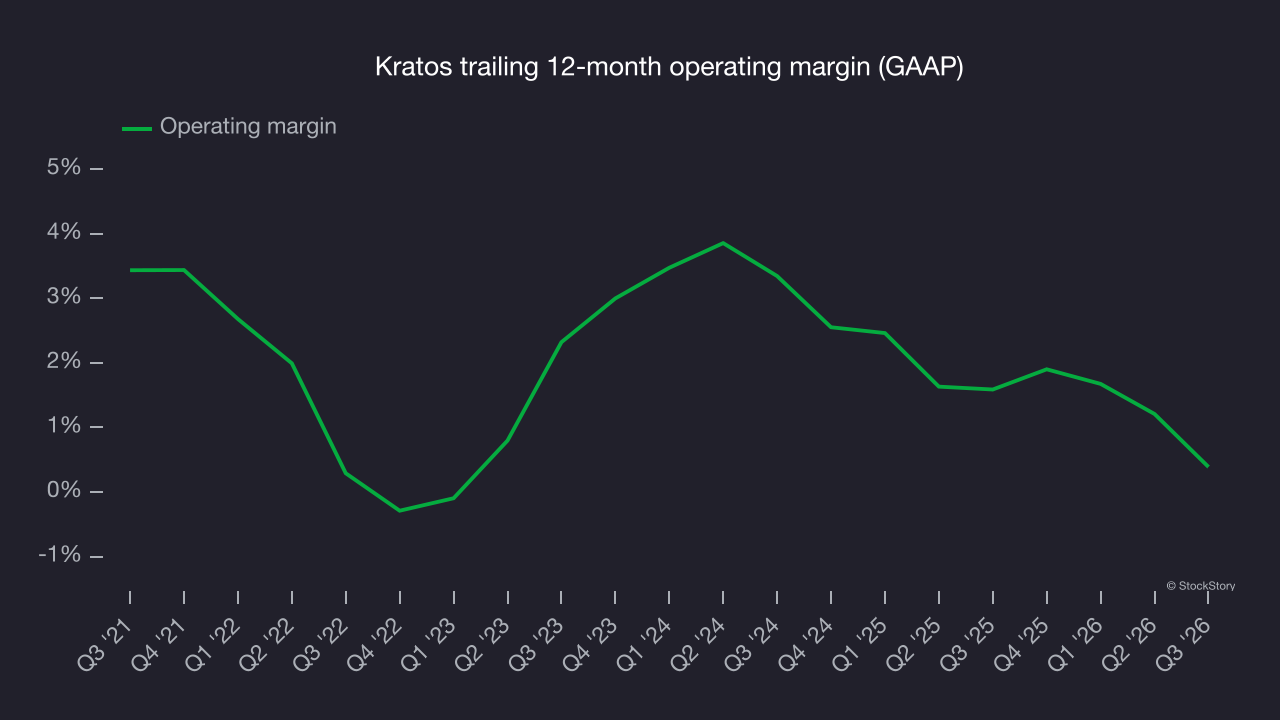
This quarter, Kratos generated an operating margin of negative 1%, down 3.1 percentage points year on year. This contraction shows it was less efficient because its expenses grew faster than its revenue.
Earnings per share
We track the long-term change in earnings per share, or EPS, for the same reason as long-term revenue growth. Compared to revenue, however, EPS highlights whether a company’s growth is profitable.
Kratos’s EPS grew at a 22.2% compounded annual growth rate over the last five years, higher than its 15.4% annualized revenue growth. However, that growth warrants caution because its operating margin didn’t improve and it didn’t repurchase its shares, meaning the difference came from reduced interest expenses or taxes.
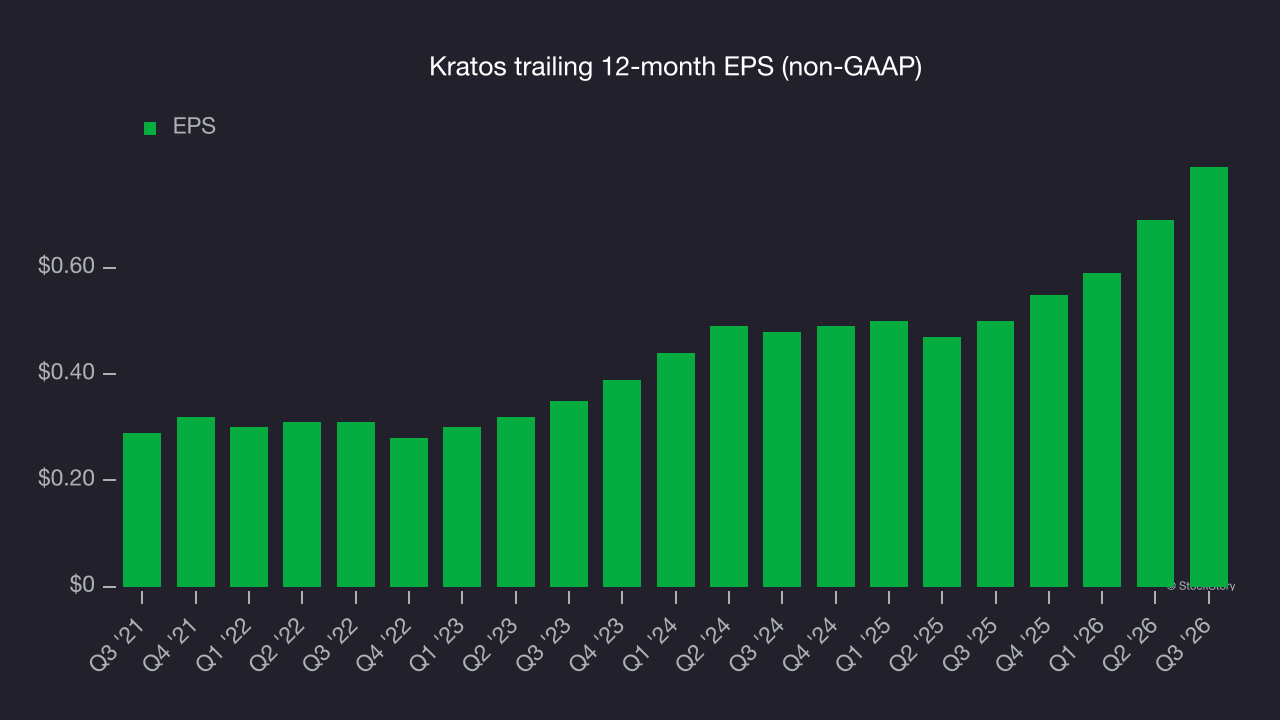
Like with revenue, we analyze EPS over a more recent period because it can provide insight into an emerging theme or development for the business.
For Kratos, its two-year annual EPS growth of 28.3% was higher than its five-year trend. That acceleration is a positive sign, especially given the already high base.
In Q3, Kratos reported adjusted EPS of $0.24, up from $0.14 in the same quarter last year. EPS comfortably exceeded analysts’ consensus estimates, a positive result for shareholders. Over the next 12 months, Wall Street expects Kratos’s full-year EPS to grow 31% from $0.79 to $1.04, according to S&P.
Key takeaways from Kratos’s Q3 results
Kratos delivered a mixed Q3: EBITDA beat analysts’ consensus estimates by a wide margin and EPS also topped expectations, but organic revenue fell short of Wall Street’s consensus. The market appeared to be hoping for more, with shares falling 3.9% to $32.83 immediately after the report.
Considering an investment in the stock? The decision should take into account valuation, business quality and the latest earnings. Read the full research report here (it’s free).